
How Mañjuśrī got its accent back
The ASCII form manjushri is missing something. Mañjuśrī restores the marks the source language used to distinguish this name from a thousand others — and those marks change how the name is read, pronounced, and understood. This post explains, with the full scholarly record behind it, what each restored mark preserves: the Devanagari evidence, the reconstructed sound, the myths the name carries, and the mechanical logic of what each restored mark preserves. By the end, the marks in Mañjuśrī will look less like ornaments and more like what they are — recovered evidence, pinned back in its proper place.
At a Glance
- Restored name: Mañjuśrī
- ASCII form: manjushri
- Meaning: "Gentle glory"
- Domain of influence: Wisdom, Insight
- Pantheon: Buddhist
- Restoration: Preserves stress & vowel length
- Original script: मञ्जुश्री (Devanagari)
- Live domain: mañjuśrī.com
Overview
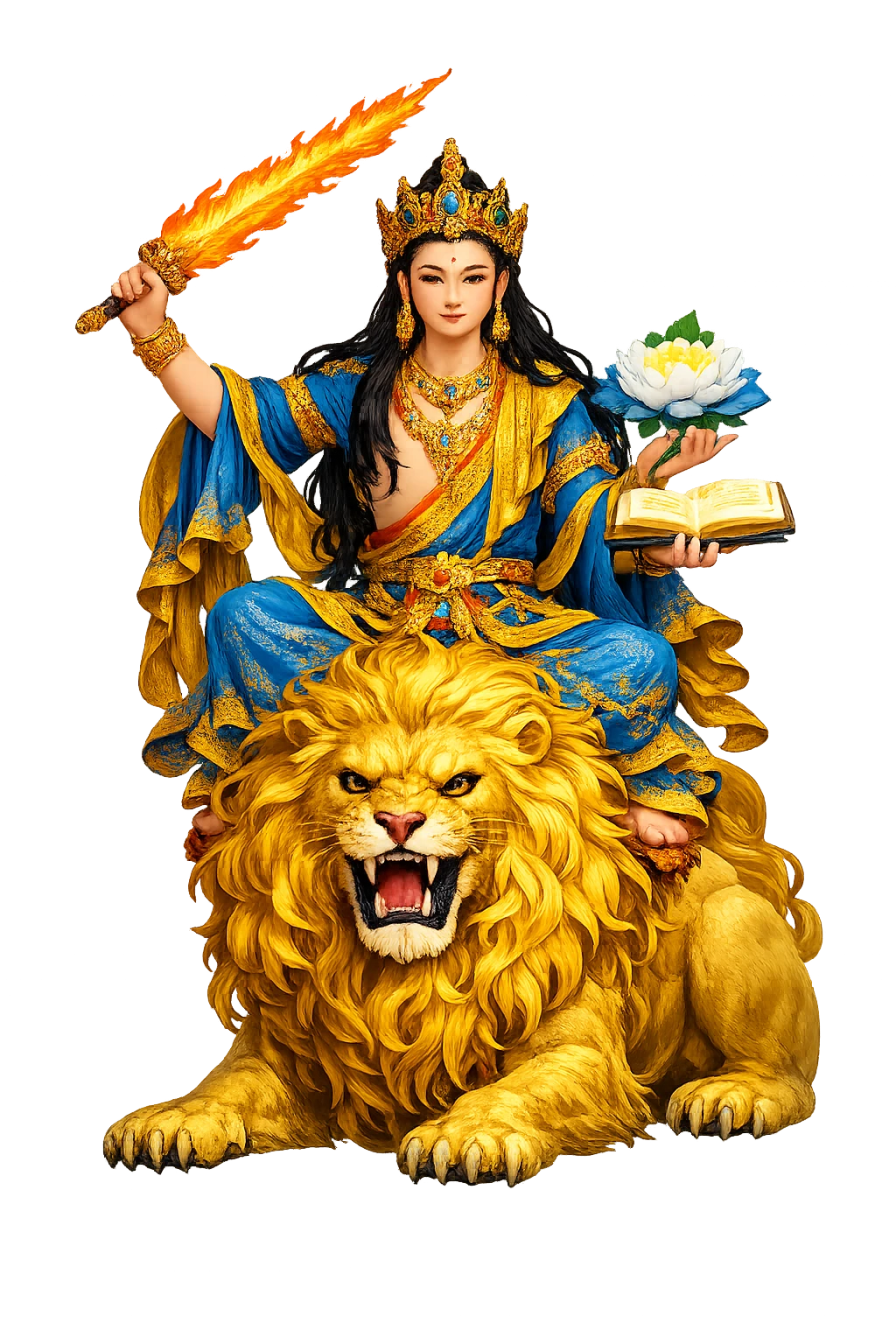
Mañjuśrī (manjushri) — Wisdom, Intellect · The Gentle Glory, Sword of Wisdom — is the bodhisattva of transcendent wisdom (prajñā): the ever-youthful prince of the Mahāyāna who wields the flaming sword that cuts through ignorance and carries the book of the Perfection of Wisdom on his lotus.
His name joins mañju, ‘gentle, beautiful, charming’, with śrī, ‘glory, splendour, majesty’ — ‘Gentle Glory’. The tradition hears the softness as the point: true wisdom is not harsh, and the sword that ends confusion is wielded by a boy. He is the bodhisattva who dares what others will not — in the Vimalakīrtinirdeśa he alone accepts the call to visit the sick layman — and the patron of every student, scholar, and debater in the Buddhist world, from the academies of Nālandā to the examination halls of Tibet.
PuniCodex restores the name as Mañjuśrī and serves its temple at mañjuśrī.com. The restoration keeps the palatal ñ, the palatal ś, and the long final ī of the Sanskrit; the plain ASCII manjushri is a modern convenience of the early domain-name system, not an attested ancient spelling.
The Name
The name is attested in Sanskrit as मञ्जुश्री (IAST mañjuśrī): a compound of mañju, ‘gentle, sweet, lovely’, and śrī, ‘glory, splendour’ — ‘Gentle Glory’ or ‘Sweet Majesty’. His epithets extend the music: Mañjughoṣa, ‘Gentle Voice’ (or ‘Beautiful Sound’); Kumārabhūta, ‘the Ever-Youthful’, for he is always figured as a prince of sixteen; and Vāgīśvara, ‘Lord of Speech’, the orators' bodhisattva.
The ASCII form manjushri survives only because the early domain-name system could not carry diacritics; it is a technological compromise, not an ancient spelling, and it flattens three distinctive letters — the palatal nasal ñ, the palatal sibilant ś, and the long ī — into approximations. The Unicode restoration Mañjuśrī recovers all three directly in the address bar. Because the restoration preserves distinctive letters and vowel length the ASCII form loses, the name is a full restoration.
The letter-by-letter transformation runs:
- m → M — Same, capitalized
- a → a — Same
- n → ñ — Palatal nasal ñ (as in Spanish mañana)
- j → j — Same
- u → u — Same
- s → ś — Palatal sibilant ś
- h → — — Dropped (English digraph, not Sanskrit)
- r → r — Same
- i → ī — Long vowel ī
The project holds the domain mañjuśrī.com (xn--majur-pta32bwm.com) as the canonical home of this name.
The Original Script
The name is preserved in Devanagari as मञ्जुश्री — Brahmic abugida, attested Buddhist Sanskrit, in the sūtra manuscripts of India and Nepal; the script is written left-to-right.
The scholarly transliteration is Mañjuśrī (IAST), giving the normalized reading /məɲ.ˈdʑu.ɕriː/.
The rendering proceeds step by step:
- Sanskrit Mañjuśrī is written मञ्जुश्री in Devanagari: मञ्जु (mañju) + श्री (śrī); the conjunct ञ्ज writes the palatal cluster ñj, and श्री is the ligature śrī.
- The compound is mañju (‘gentle, beautiful’) + śrī (‘glory, splendour’): ‘Gentle Glory’.
- IAST distinguishes the palatal nasal ñ from dental n, the palatal sibilant ś from retroflex ṣ and dental s, and marks the long final ī with the macron.
- The Unicode restoration Mañjuśrī is registrable in .com; the Devanagari form is not supported in the .com IDN table.
Pronunciation
The reconstructed pronunciation of the name is /məɲ.ˈdʑu.ɕriː/ — Sanskrit Reconstruction.
Phoneme by phoneme:
- Ma- — Bilabial [m] with short [ə]
- -ñju- — Palatal nasal [ɲ] (the sound of Spanish ñ) with voiced palatal stop [dʑ] and short [u]; the ‘gentle’ of the name
- -śrī — Palatal sibilant [ɕ] with trilled [r] and long close [iː]; the ‘glory’, its vowel held long
For the modern speaker, the closest approximation is: ‘mun-JOO-shree’ — the ‘nj’ soft as in onion, the final ‘ee’ sustained.
Kindred and historical forms of the name:
- Sanskrit — मञ्जुश्री (mañjuśrī), ‘Gentle Glory’; also Mañjughoṣa, ‘Gentle Voice’
- Chinese — 文殊師利 (Wénshūshīlì), abbreviated 文殊 (Wénshū)
- Japanese — Monju (Monju Bosatsu)
- Tibetan — 'Jam dpal (Jampel), ‘Gentle Splendour’; 'Jam dbyangs (Jamyang), ‘Gentle Voice’
Mañjuśrī preserves both features: ñ, ś, and ī are all distinctive marks the ASCII alphabet cannot write.
Mythology
Mañjuśrī's mythology is a cycle of encounters in which wisdom proves itself by daring.
The Visit to Vimalakīrti (Vimalakīrtinirdeśa)
When the layman Vimalakīrti falls ill and the Buddha asks his great disciples and bodhisattvas to call on him, one after another declines — each has been bested by the layman before. Only Mañjuśrī accepts. Their dialogue is the sūtra's summit: on nonduality, on emptiness, on the bodhisattva's work in the world of passion — and it ends with Vimalakīrti's thunderous silence, which Mañjuśrī alone is quick enough to praise.
The Nāga Princess (Lotus Sūtra 12)
In the Lotus Sūtra's Devadatta chapter, Mañjuśrī emerges from the nāga palace beneath the sea and stuns the assembly by testifying that an eight-year-old nāga girl has attained full awakening — wisdom's declaration that enlightenment is no one's monopoly, not even humanity's.
The Director of the Pilgrimage (Gaṇḍavyūha)
In the Avataṃsaka's closing book it is Mañjuśrī who sends the young Sudhana on his pilgrimage to fifty-three teachers — the bodhisattva of wisdom as the dispatcher of every genuine search.
The Lake of Kathmandu (Svayambhū Purāṇa)
Nepal's own chronicle makes him the valley's founder: Mañjuśrī came from his mountain Wutai to venerate the self-existent flame at the lake of Nāgavāsa, saw that the waters imprisoned the shrine, and with one stroke of his sword cut the gorge at Chobar, draining the lake and opening the Kathmandu valley to settlement. Nepal's geography is, in its own telling, his handiwork.
The Debate of Non-Duality (Vimalakīrti Sūtra)
When the layman Vimalakīrti feigned illness to draw the Buddha's disciples into dialogue, every bodhisattva found an excuse not to visit — each remembered being corrected by him once. Mañjuśrī alone went, leading the whole assembly, and their exchange crowns the Vimalakīrtinirdeśa (ch. 9, 'Entering the Dharma-gate of Non-duality'). Thirty bodhisattvas define non-duality by dissolving paired opposites — motion and rest, self and being, bondage and release — each more subtly than the last. Mañjuśrī declares that all their words are themselves dualistic, and that he has nothing to say. Vimalakīrti answers with silence, and Mañjuśrī pronounces the silence itself the teaching: 'Good sirs, this is truly the entrance into non-duality.' It is the most famous consultation in Buddhist literature — the wisdom bodhisattva certifying that the highest truth declines to be phrased.
The Nāga King's Daughter (Lotus Sūtra)
In the twelfth chapter of Kumārajīva's Lotus Sūtra — the Devadatta chapter — Mañjuśrī returns from the nāga palace beneath the sea, where he had preached the Lotus, and reports that the dragon king's daughter, eight years old, has already attained the highest awakening. The elder Śāriputra objects on every ground his age could supply: a female body, a child, an animal's realm — surely the bodhisattva path cannot be completed so fast, in such a vessel. The girl appears, offers a precious jewel to the Buddha, and completes the path before the whole assembly; the sūtra lets her achievement answer the objection rather than argue it. Mañjuśrī's role is the chapter's quiet engine — he carries the teaching where it was never expected to go, into a palace under the sea. The myth is his brief for the universality of awakening: wisdom, taught well, does not check credentials.
The Sword That Drained the Lake (Svayambhū Purāṇa)
Nepal's own scripture, the Svayambhū Purāṇa, makes him the valley's founder. In the beginning the whole Kathmandu basin lay under a serpent lake, and at its center floated the self-existent flame — the svayambhū, the primordial light that needs no maker. Mañjuśrī came from the five-peaked mountain of China in the north, saw the flame resting on the waters, and resolved that beings must have a valley in which to venerate it. With one stroke of his sword he cut the gorge at Chobhar in the southern rim, and the lake drained away through the cleft, leaving a habitable plain; the flame remained on its hill, crowned today by the Svayambhū stūpa, its painted eyes watching over the city. The gorge and the stūpa still stand. It is his iconography read as geography: the sword that opens a way for beings to live and to worship.
Symbols & Iconography
The iconography of Mañjuśrī is the complete vocabulary of intellect:
- The flaming sword (khadga) — Raised in the right hand, wreathed in fire: the blade of prajñā that cuts ignorance and the flames that burn its roots
- The book on the lotus — The Perfection of Wisdom sūtra (Prajñāpāramitā) resting on a blue utpala lotus in his left hand: the text as flower, wisdom as something that blooms
- The youthful prince — Sixteen forever: princely ornaments, no monastic robes — insight is not a retirement
- The lion mount — In many forms he rides a lion: the roar of the true teaching, fearlessness in debate
- The syllable a — His seed-syllable and the first letter of the Arapacana syllabary, the alphabet taught as a meditation on emptiness; his mantra is oṃ a ra pa ca na dhīḥ
Archaeology & Evidence
Mañjuśrī's material record begins with the sūtra transmission itself and blossoms in the art of the mountain that claimed him. Early images — a princely figure with sword and book — appear in the art of late Kuṣāṇa and Gupta India and multiply in the Pāla-period bronzes of Nālandā, the very university whose scholars made him their patron.
Mount Wutai is the great monument: the Avataṃsaka tradition's identification of its five terraces with the bodhisattva's ‘Clear-and-Cool Mountain’ made the range a sacred geography, and its surviving temples — Foguang si's east hall (857 CE), the oldest dated timber structure in China, and Nanchan si (782 CE), older still — preserve Tang architecture in situ. Ennin's diary (838–847) describes the mountain at the height of its international fame. Nepalese art keeps his other legend: the sword that cut the Chobar gorge is the valley's founding artifact, and Svayambhū's hilltop stūpa marks the flame he came to worship.
Realm & Domain
Mañjuśrī is wisdom personified: not accumulated knowledge but prajñā, the seeing that cuts things loose from illusion.
Transcendent Wisdom
He embodies the prajñā of the Perfection of Wisdom literature — the insight into emptiness that the sūtras call the mother of all Buddhas.
The Sword of Discrimination
His blade severs ignorance at the root: analysis, debate, and the courage to cut through one's own positions.
The Ever-Youthful
Kumārabhūta: wisdom as perpetual beginner's mind, a prince who never hardens into a sage.
Patron of Scholars
Students, monks, and debaters across Asia invoke him before study and examination; the great universities of Buddhist India counted him their patron.
Across Cultures
Mañjuśrī's receptions are the history of Buddhist scholarship itself. In China he became Wénshū, and Mount Wutai in Shanxi — five flat peaks, cold and clear — was identified as his earthly abode, becoming for over a millennium the greatest pilgrimage mountain of East Asia, visited by monks of every nation, including the Japanese pilgrim Ennin, whose ninth-century diary is a classic of the road. In Japan he is Monju, the wisdom of the Zen hall; in Tibet, Jampel and Jamyang, the personal deity of scholars — Tsongkhapa, founder of the Gelug school, was revered as his emanation.
Within the PuniCodex cross-tradition index, kindred figures include Vajrapāṇi and Guānyīn (Avalokiteśvara) — with whom he forms the classic triad of the ‘Lords of the Three Families’: wisdom, power, and compassion as the bodhisattva's complete equipment.
Cultural Legacy
Mañjuśrī is the patron saint of every Buddhist student. His mantra oṃ a ra pa ca na dhīḥ is recited before examinations from Kathmandu to Kyoto; the Arapacana syllabary he anchors — an alphabet whose letters are meditations — made him the Buddha of literacy itself. Mount Wutai, his earthly seat, remains a living pilgrimage city and a UNESCO World Heritage landscape (2009), its temples — among them the Foguang Temple's east hall of 857, the oldest surviving timber hall in China — monuments to a millennium and a half of devotion.
His image set the iconography of intellect for half the world: the sword and the book are so completely his that a bodhisattva bearing them is identifiable across a thousand years of art without an inscription.
The Scholarly Record
The account of Mañjuśrī given in this edition rests on the witnesses and reference works listed below. The lexica secure the name; the great sūtras supply the narratives; the pilgrim records and art histories document the cult.
- Monier-Williams, Monier, A Sanskrit-English Dictionary (Oxford: Clarendon Press, 1899), s.v. mañju, śrī, mañjuśrī.
- Edgerton, Franklin, Buddhist Hybrid Sanskrit Grammar and Dictionary, vol. 2 (New Haven: Yale University Press, 1953), s.v. Mañjuśrī, Mañjughoṣa.
- Watson, Burton, trans., The Vimalakirti Sutra (New York: Columbia University Press, 1997), ch. 5.
- Kern, H., trans., Saddharma-Puṇḍarīka, SBE 21 (Oxford: Clarendon Press, 1884), ch. 12.
- Cleary, Thomas, trans., The Flower Ornament Scripture (Boston: Shambhala, 1993), Gaṇḍavyūha.
- Svayambhū Purāṇa (Newar Buddhist chronicle).
- Reischauer, Edwin O., trans., Ennin's Diary (New York: Ronald Press, 1955).
- Getty, Alice, The Gods of Northern Buddhism (Oxford: Clarendon Press, 1914).
- Huntington, Susan L., The ‘Pāla-Sena’ Schools of Sculpture (Leiden: Brill, 1984).
- Buswell, Robert E., ed., Encyclopedia of Buddhism (New York: Macmillan Reference, 2004), s.v. ‘Mañjuśrī’, ‘Wutai Shan’, ‘Arapacana’.
A Meditation
Mañjuśrī is Buddhism's answer to a fear every thoughtful person knows: that thinking itself is the problem. The tradition could have made wisdom a grey elder; it made her a sixteen-year-old with a sword. The youth is the doctrine — insight does not arrive with age and does not exhaust itself in caution; it stays, in the best minds, permanently quick.
The sword and the book are the whole curriculum. The book says: learn everything. The sword says: hold none of it. Students across Asia still begin their year with his mantra, and the petition hidden in a ra pa ca na is the scholar's honest prayer: let me know a great deal, and let none of it make me stupid.
The Unicode Restoration
Mañjuśrī preserves stress & vowel length. The ASCII fallback manjushri still resolves everywhere, but it is the restored form that carries the name's full information. Across the 9 characters of the name, the restoration adjusts 4: 1 mark of stress (ñ); 1 mark of length (ī); 2 further adjustments (ś, h). That is the whole thesis of this temple: the marks are the message.
The Domain Name
The restored name is live as a working domain: mañjuśrī.com, which the DNS carries in punycode form as xn--majur-pta32bwm.com — an ASCII-compatible encoding that lets a non-ASCII name travel the global network without breaking older infrastructure. The visitor sees Mañjuśrī; the machines see the encoding. That duality is the engineering compromise on which the entire restoration rests, and it is why a name written the way its own tradition wrote it in Devanagari can now be typed into any browser on earth.
Why This Restoration Matters
The marks in Mañjuśrī were never lost; they were only waiting for a carrier that could hold them. Now that the carrier exists, the burden flips: every use of manjushri is a choice to leave evidence on the table. The PuniCodex temple keeps the restored form in circulation — as a domain, a dataset entry, and a scholarly argument — so that the choice to use it stays easy. Accent by accent, macron by macron, that is how the original names come back: not with a single grand gesture, but with a spelling that finally works everywhere.
Explore Further
This post is one doorway into the temple. The home page carries the full character breakdown and the ambient canvas; the lore page tells the myths in long form; the Scholarly Edition preserves the sources, pronunciation data, and revision history; and the patron wall supports the restoration directly. For the wider map, browse the Lexicon, explore the Pantheon, or return to the PuniCodex blog.
Related Names
Sources
The full scholarly apparatus — every citation, revision, and review — lives in the Scholarly Edition. Key references for this post:
- UNESCO, Mount Wutai, World Heritage List no. 1279 (inscribed 2009).
- Buswell, Robert E., ed., Encyclopedia of Buddhism (New York: Macmillan Reference, 2004), s.v. ‘Mañjuśrī’.
- Watson, Burton, trans., The Vimalakirti Sutra (New York: Columbia University Press, 1997).
- Monier-Williams, Monier, A Sanskrit-English Dictionary (Oxford: Clarendon Press, 1899), s.v. mañju, śrī.
- Monier-Williams, Monier, A Sanskrit-English Dictionary (Clarendon Press, 1899), s.v. mañju, śrī.
- Lexicon authorities for this entry: Mahayana texts, Buddhist texts.