The Living Myth
Wisdom, Intellect · The Gentle Glory · Sword of Wisdom
Stories of Mañjuśrī
Mañjuśrī's mythology is the biography of wisdom itself: he appears wherever the sūtras need the hardest question asked — and answered without a flicker. He debates laymen and nāga girls, drains lakes with a sword-stroke, teaches from a mountain that became China's greatest pilgrimage, and sends pilgrims out to find the truth for themselves.
When the layman Vimalakīrti feigned illness to draw the Buddha's disciples into dialogue, every bodhisattva found an excuse not to visit — each remembered being corrected by him once. Mañjuśrī alone went, leading the whole assembly, and their exchange crowns the Vimalakīrtinirdeśa (ch. 9, 'Entering the Dharma-gate of Non-duality'). Thirty bodhisattvas define non-duality by dissolving paired opposites — motion and rest, self and being, bondage and release — each more subtly than the last. Mañjuśrī declares that all their words are themselves dualistic, and that he has nothing to say. Vimalakīrti answers with silence, and Mañjuśrī pronounces the silence itself the teaching: 'Good sirs, this is truly the entrance into non-duality.' It is the most famous consultation in Buddhist literature — the wisdom bodhisattva certifying that the highest truth declines to be phrased.
In the twelfth chapter of Kumārajīva's Lotus Sūtra — the Devadatta chapter — Mañjuśrī returns from the nāga palace beneath the sea, where he had preached the Lotus, and reports that the dragon king's daughter, eight years old, has already attained the highest awakening. The elder Śāriputra objects on every ground his age could supply: a female body, a child, an animal's realm — surely the bodhisattva path cannot be completed so fast, in such a vessel. The girl appears, offers a precious jewel to the Buddha, and completes the path before the whole assembly; the sūtra lets her achievement answer the objection rather than argue it. Mañjuśrī's role is the chapter's quiet engine — he carries the teaching where it was never expected to go, into a palace under the sea. The myth is his brief for the universality of awakening: wisdom, taught well, does not check credentials.
Nepal's own scripture, the Svayambhū Purāṇa, makes him the valley's founder. In the beginning the whole Kathmandu basin lay under a serpent lake, and at its center floated the self-existent flame — the svayambhū, the primordial light that needs no maker. Mañjuśrī came from the five-peaked mountain of China in the north, saw the flame resting on the waters, and resolved that beings must have a valley in which to venerate it. With one stroke of his sword he cut the gorge at Chobhar in the southern rim, and the lake drained away through the cleft, leaving a habitable plain; the flame remained on its hill, crowned today by the Svayambhū stūpa, its painted eyes watching over the city. The gorge and the stūpa still stand. It is his iconography read as geography: the sword that opens a way for beings to live and to worship.
The Avataṃsaka Sūtra names his earthly dwelling: a mountain in the northeast called Clear-and-Cool (Qīngliáng shān), where he teaches amid ten thousand bodhisattvas — 'in this mountain,' the sūtra says, dwells the bodhisattva Mañjuśrī with his assembly. Chinese Buddhists identified the peak with Wǔtái shān, the five-terraced mountain of Shanxi, and made it East Asia's greatest bodhisattva pilgrimage. Emperors climbed its terraces — the Tang and Qing courts endowed its temples lavishly — and Tibetan lamas and Mongol khans came seeking Wenshu's apparitions; the mountain's luminous cloud-halos, still photographed today, were read as the bodhisattva's own radiance, and sudden appearances of a rider on a lion became its standing miracle. Pilgrims still climb the terraces hoping for the lion. The myth means that wisdom is not only a doctrine to study but a place to go — and that the place, for fifteen centuries, has answered back.
The final chapter of the Avataṃsaka, the Gaṇḍavyūha, begins with a boy. Sudhana, the son of a merchant, is moved by the Buddha's teaching and seeks instruction; Mañjuśrī — his first teacher — sends him south with the words that set the whole pilgrimage walking: pursue the practice of a bodhisattva, and do not begrudge your life or comfort. Sudhana visits fifty-three (in the Chinese count) teachers in turn — monks, physicians, kings, shipwrights, an apothecary, a courtesan, a child, Maitreya in his tower of visions — and each sends him onward, until the last door opens back onto Mañjuśrī, who returns him into the world he left. The structure is the teaching: wisdom is a route, not a destination, and its path runs through every kind of life before arriving where it began.
The Flaming Sword, the Book on the Lotus, and the Mountain of Five Terraces
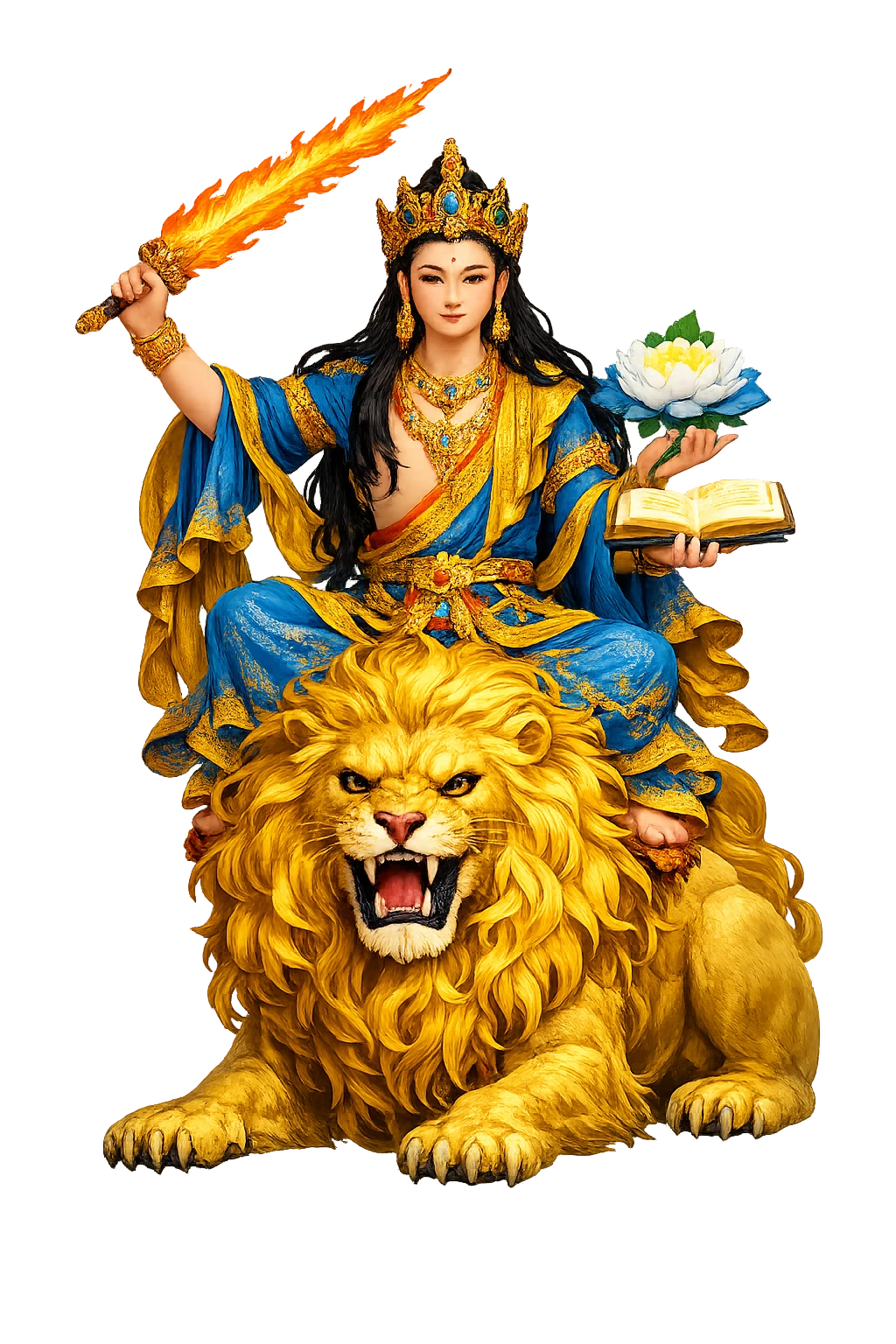
Mañjuśrī is the bodhisattva of transcendent wisdom: the ever-youthful prince who raises the flaming sword that cuts ignorance and bears the book of the Perfection of Wisdom on a blue lotus — the mind of every Buddha made visible as a sixteen-year-old with a blade.
The khadga that does not wound but severs: ignorance cut at the root, wisdom flaming at the edge.
The Prajñāpāramitā volume resting on a blue utpala — the text the sword serves.
He rides the lion of the teaching — wisdom's roar that no argument withstands.
Oṃ A Ra Pa Tsa Na Dhīḥ — the Arapacana syllabary as mantra, recited across the Himalaya for a sharp mind.
From the original script to the living URL
मञ्जुश्री
The name in its original Buddhist form. Mañjuśrī (मञ्जुश्री) is attested in the source tradition — “Gentle glory”. Its macron-length vowels, nasal retroflexes, and palatal/retroflex sibilants carry the full phonetic and orthographic weight of the source tradition.
manjushri
Reduced to plain manjushri, the name loses everything that made it specific: macron-length vowels, nasal retroflexes, and palatal/retroflex sibilants. What remains is an ASCII string that machines can parse but that no longer speaks with its original voice.
Mañjuśrī
The Unicode restoration recovers what ASCII flattened. Mañjuśrī restores macron-length vowels, nasal retroflexes, and palatal/retroflex sibilants, returning the name to its original written dignity. The domain encodes to Punycode, but the browser displays the truth.
Mañjuśrī.com → xn--majur-pta32bwm.com
The non-ASCII characters in Mañjuśrī are encoded while the ASCII remains visible. To the DNS, it is Punycode. To humanity, it is Mañjuśrī.
Owned, ideal, and ASCII forms of Mañjuśrī
Mañjuśrī
Restores मञ्जुश्री. The live temple domain — mañjuśrī.com.
manjushri
Flattens मञ्जुश्री. The plain ASCII fallback — what DNS and legacy systems see.
How Mañjuśrī was spoken
How Mañjuśrī travels from ancient script to the modern URL
The lore you have read is the living myth. Extended Lore opens the scholarly vault beneath it: the cult and its material remains, a history of the image, the name after antiquity, a meditation on what the name still means, and the full scholarly apparatus — etymology, orthography, sources.
Enter Extended Lore