PuniCodex

Extended Lore

मञ्जुश्री Mañjuśrī

Etymology · Orthography · Cult · Iconography · Reception · Sources

Tier 1 Mañjuśrī.com
Mañjuśrī — Wisdom, Intellect
01

Quick Facts

Essential information about Mañjuśrī, Wisdom, Intellect

Original Scriptमञ्जुश्री
Unicode RestorationMañjuśrī
Reconstructed Pronunciation/mɐɲ.ˈdʑu.ɕriː/
PantheonBuddhist
DomainWisdom, Intellect
MeaningGentle glory
ClassificationTier 1
Primary DomainMañjuśrī.com
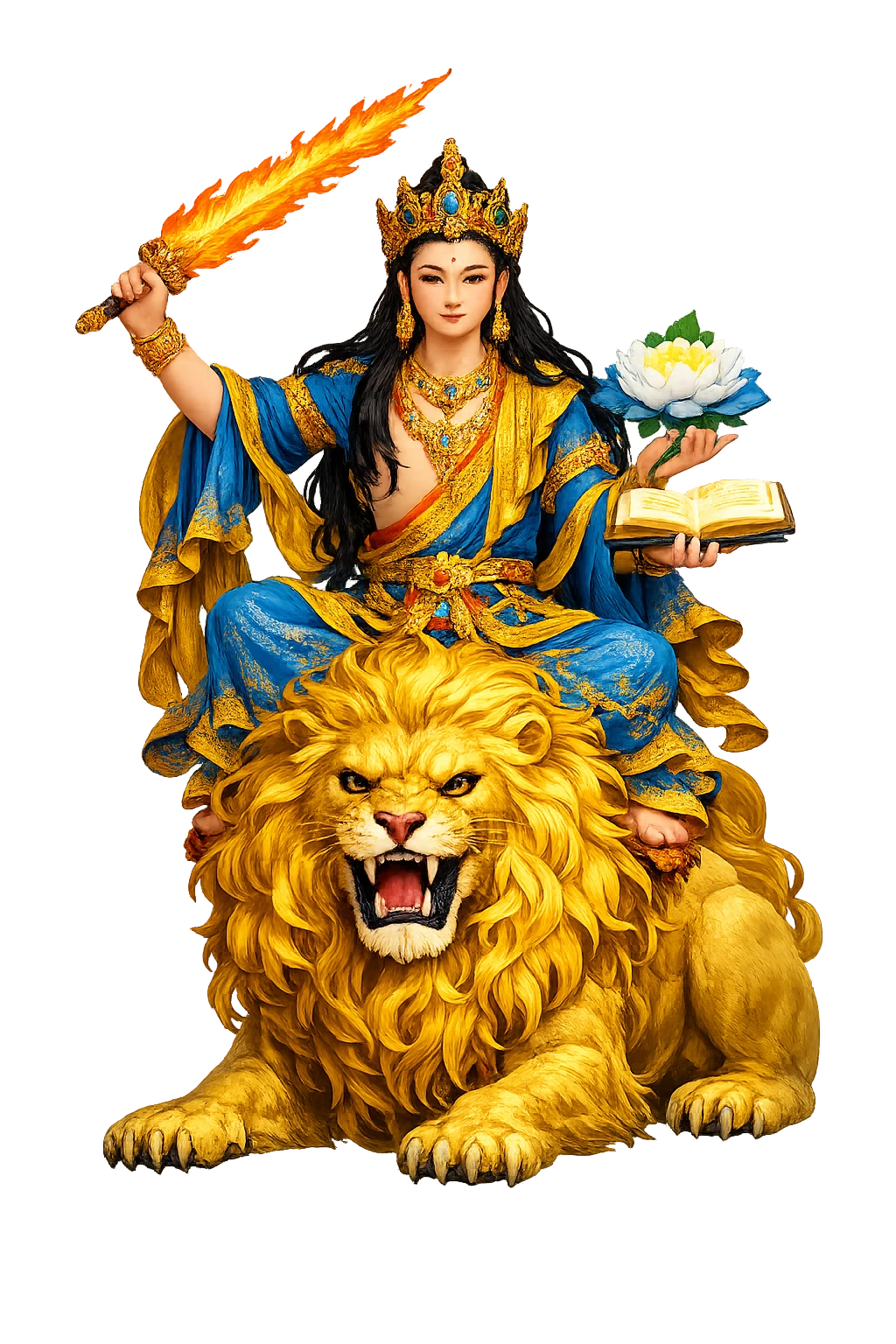
Sacred SymbolsThe flaming sword, The blue lotus and the book, The seed syllable Dhīḥ, The lion mount, The sixteen-year-old form
02

Etymology & Word Family

From original script to Unicode restoration

Original Script मञ्जुश्री Mañjuśrī — "Gentle glory"
Unicode Restoration Mañjuśrī Restored stress, length, and script
Modern ASCII manjushri Plain-ASCII fallback

The name Mañjuśrī carries the orthographic signature of the buddhist tradition: मञ्जुश्री. Unicode restoration recovers what ASCII flattens.

03

Unicode Character Breakdown

Character-by-character philological analysis

CharacterUnicodeNameBlockPhonetic Role
MU+004DLatin Capital Letter MBasic LatinSame, capitalized
aU+0061Latin Small Letter ABasic LatinSame
ñU+00F1Latin Small Letter N with TildeLatin-1 SupplementStress on n
jU+006ALatin Small Letter JBasic LatinSame
uU+0075Latin Small Letter UBasic LatinSame
śU+015BLatin Small Letter S with AcuteLatin Extended-ASpecial character
—N/ADropped characterBuddhist orthographyDropped
rU+0072Latin Small Letter RBasic LatinSame
īU+012BLatin Small Letter I with MacronLatin Extended-ALong vowel

The Tier 1 classification reflects how much of the original phonology this restoration preserves — stress and vowel length for Greek names, distinctive letters and diacritics for every other tradition.

04

Cult & Worship

How the sacred was kept — rites, sanctuaries, remains

The Cult

Mañjuśrī's cult centers on the five-terraced Wǔtái shān in Shanxi, identified as his dwelling in the Avataṃsaka Sūtra and visited by Tibetan, Mongol, and Chinese pilgrims since at least the Tang dynasty. The mountain preserves Nanchan temple (782 CE) and Foguang temple's East Hall (857 CE), China's oldest timber structures. In Tibet he is the patron of the learned Gelukpa tradition and the protector of dialectics. Nepal's Kathmandu valley identifies him as the culture hero who drained the primordial lake; the Svayambhū stūpa and Chobhar gorge anchor this founding myth in pilgrimage geography.

In the Earth

His mountain is the monument: Wǔtái shān preserves the Nanchan temple hall (782 CE) and the Foguang temple's East Hall (857 CE) — the two oldest surviving timber buildings in China — on the terraces pilgrims have climbed for fifteen centuries. The Kathmandu valley keeps his founding stroke in stone and water: the Chobhar gorge through which the lake drained, and the Svayambhū stūpa on its hill. His certain images emerge in the early centuries CE and multiply along the Silk Road; by the Pāla period the sword-and-book type was fixed, and it has not changed since. In Japan, Monju's seat at the temple Tōdai-ji — where the great Vairocana was dedicated in 752 — marks how closely wisdom bodhisattva and cosmic Buddha were paired in the Nara mind.

05

Iconography

How Mañjuśrī was imaged across the ages

The Image

Mañjuśrī is instantly recognized by his attributes of wisdom: the flaming sword that cuts through ignorance, the Prajñāpāramitā sūtra held in the lotus, and the lion mount representing the roar of the Dharma. He appears in peaceful bodhisattva form, with a five-jeweled crown and flowing silk, or in fierce tantric manifestations such as Vajrabhairava. Dunhuang paintings show him enthroned at Wǔtái shān, while Nepalese and Tibetan thangkas emphasize his youthful scholar-king elegance. Chinese iconography also pairs him with Samantabhadra as attendants of Śākyamuni.

06

Reception & Transformation

The name after its own age — transmission, translation, survival

Afterlives

Mañjuśrī began as a relatively minor interlocutor in Mahāyāna sūtras and rose to become the bodhisattva of wisdom par excellence, his prestige peaking during the Tang and Song when Wǔtái shān rivaled India as a pilgrimage destination. Tibetan Buddhism identified him with ʾJam-dpal dbyangs, the patron of monastic debate and the Gelukpa school. In Nepal his cult merged with the valley's autochthonous origin myths, making him a civilizing founder. The mountain itself became a diplomatic site between Mongol Yuan, Tibetan, and Ming courts. Modern Buddhist studies treat Mañjuśrī as a case study in how a literary figure becomes a landscape deity, and his image persists across East Asian temples, Tibetan monasteries, and museum collections.

Identifications Across Traditions

He is the most portable of the great bodhisattvas: Wénshū in China, Monju in Japan, 'Jam dpal in Tibet. In Tibet his cult became inseparable from scholarship itself — Tsongkhapa venerated as his emanation, and the Mañjuśrīnāmasaṃgīti, 'Chanting the Names of Mañjuśrī,' recited as the daily liturgy of the monasteries (Wayman's translation made the text a classic in the West). With Avalokiteśvara and Vajrapāṇi he forms the lords of the three families — wisdom, compassion, and power — the triad painted over a thousand Himalayan doorways. His sword-and-book traveled the sea routes as well: his images stand in the temples of Buddhist Java. And in China the identification ran both ways — Wenshu was held to appear to worthy students as a humble stranger, testing them with a question before vanishing.

Modern Legacy

Mañjuśrī is the patron saint of students across half the world: Himalayan children still have the syllable Dhīḥ traced on their tongues for a quick mind, and his Arapacana mantra is murmured before examinations from Ladakh to Lhasa. His iconography — sword in the right hand, book on the lotus at the left — is the universal Buddhist shorthand for the two halves of wisdom, cutting and knowing. Mount Wutai, his earthly seat, is a UNESCO landscape where a dozen languages still call on Wénshū. In Japan, Monju presides over the school-examination season, his name invoked in June by students at temples from Tokyo to Kamakura. The restoration Mañjuśrī keeps the palatals and the long vowel of a name that, in every language it entered, never stopped meaning a sharp and gentle mind.

07

The Meditation

What Mañjuśrī means — beyond the dictionary

Mañjuśrī is the proof that clarity is a form of compassion: the sword is raised not against persons but against the fog that makes persons suffer. His youth is the point — wisdom is not the slow deposit of years but the freshness of a mind that has not agreed to be confused, and his sword is not a weapon but a diagnosis: confusion cut at the root, before it flowers into cruelty or despair.

He asks of every learner the one question his book and blade pose together: what are you willing to have cut, so that what remains can finally be read? The pairing is exact. A sword without a book is mere aggression; a book without a sword is mere storage. Mañjuśrī holds both, and the tradition holds him — at the head of every classroom, on every tongue that recites Dhīḥ — as the reminder that the gentlest sound and the sharpest cut are one motion when the mind is clear.

08

Frequently Asked Questions

Common questions about Mañjuśrī, Wisdom, Intellect, and Unicode restoration

01How do you pronounce Mañjuśrī?

In reconstructed pronunciation, Mañjuśrī is /mɐɲ.ˈdʑu.ɕriː/ — approximately mun-joo-SHREE — the ñ is the nasal of 'canyon'; śrī is one syllable, the 'sh' softened.

02What does Mañjuśrī mean?

Mañjuśrī means Gentle glory in the buddhist tradition.

03What are the symbols of Mañjuśrī?

Mañjuśrī is associated with The flaming sword (Discrimination that liberates: the cut that ends confusion, not the one that starts it), The blue lotus and the book (Wisdom as a text to be carried and a flower that opens by itself), The seed syllable Dhīḥ (The sound of insight itself, traced on children's tongues in the Himalaya), The lion mount (The vehicle of the teaching: majesty that roars once and settles every dispute), The sixteen-year-old form (Wisdom is not the slow deposit of years but the freshness of a mind that has not agreed to be confused).

04Why restore Mañjuśrī in Unicode?

Plain ASCII manjushri strips the stress, length, and script that make the name specific. Unicode restoration returns the name to its original written dignity.

05What is the most important myth about Mañjuśrī?

“The Debate of Non-Duality” — the Vimalakīrti Sūtra story that anchors the mythology of Mañjuśrī, told in full on the lore page.

09

Scholarly Sources

The philological foundations of this restoration

Every claim on this page is grounded in established scholarship. The orthographic restorations follow disciplinary convention. The etymological chain follows the best available reference works. This is not invention — it is resurrection through scholarship.

◈

Lexicography & Philology

  • Mahayana texts
  • Buddhist texts
◎

Primary Texts

  • The Larger Sukhāvatī-vyūha Sūtra; the Smaller Sukhāvatī-vyūha Sūtra; the Amitāyurdhyāna Sūtra; the Lotus Sūtra.
◉

Archaeology & Art History

  • Material evidence — iconography, inscriptions, and temple archaeology — for Mañjuśrī and related cults.
✦

Religious Studies

  • Vimalakīrtinirdeśa Sūtra, ch. 9
  • Saddharma-puṇḍarīka Sūtra (Lotus Sūtra), ch. 12
  • Avataṃsaka Sūtra (Gaṇḍavyūha)
  • Svayambhū Purāṇa
  • Mañjuśrīnāmasaṃgīti
  • Wayman, Chanting the Names of Mañjuśrī
Return

The Surface Awaits

You have traced the name from its earliest attestation to its Unicode restoration. Now return to the myth. The story is where the name lives.

Back to Lore
Mañjuśrī mascot