
Why Mañjuśrī is spelled that way — and what it costs to get it right
There is a version of this name the early internet had to settle for: manjushri. This is the file on how Mañjuśrī replaced it.
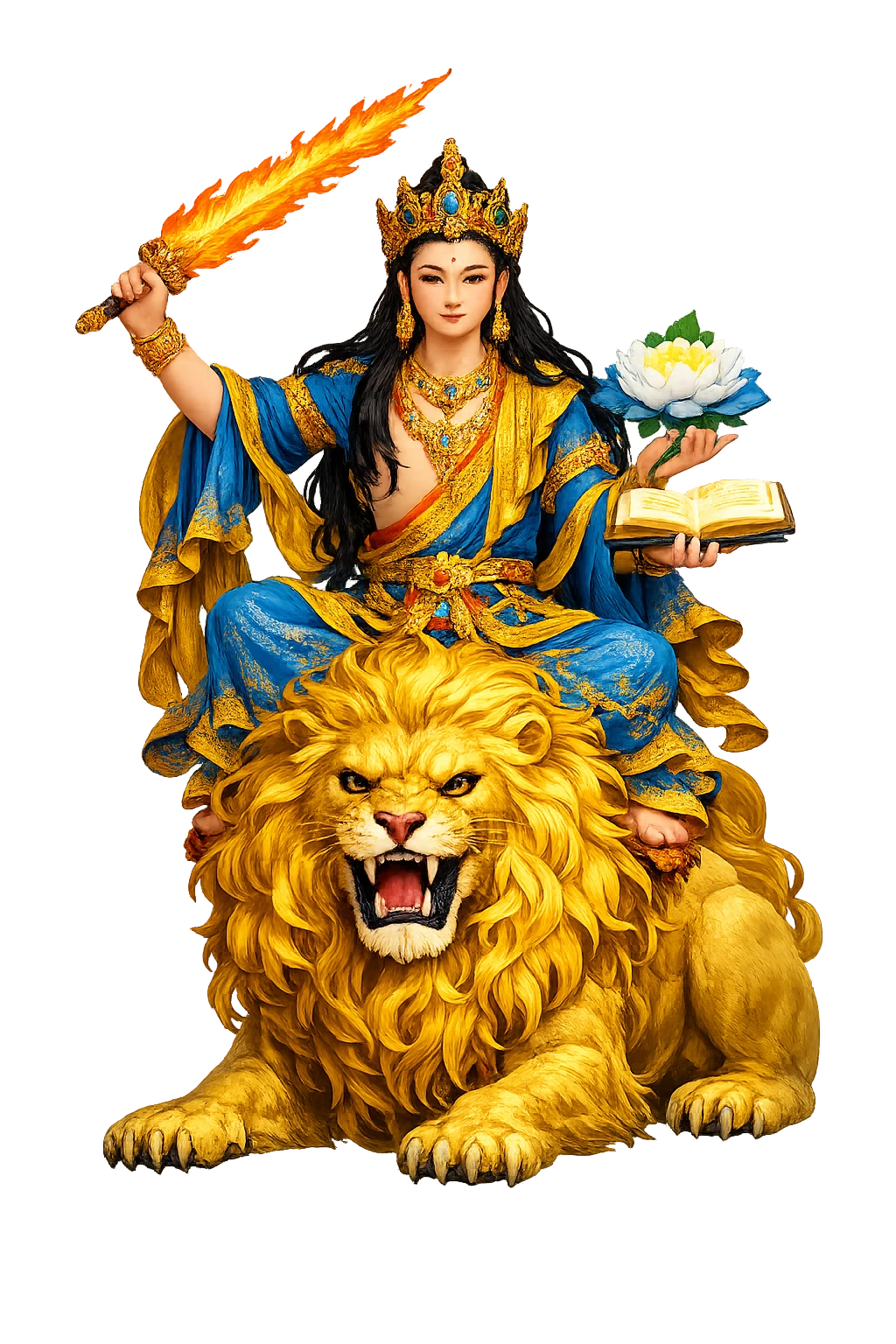
Mañjuśrī's mythology is the biography of wisdom itself: he appears wherever the sūtras need the hardest question asked — and answered without a flicker. He debates laymen and nāga girls, drains lakes with a sword-stroke, teaches from a mountain that became China's greatest pilgrimage, and sends pilgrims out to find the truth for themselves.
At a Glance
- Restored name: Mañjuśrī
- ASCII form: manjushri
- Meaning: "Gentle glory"
- Domain of influence: Wisdom, Intellect
- Pantheon: Buddhist
- Classification: Tier 1
- Original script: मञ्जुश्री
- Series: The Restoration Files, No. 298 of 546
The Name Before the Marks
Strip Mañjuśrī to manjushri and 2 pieces of evidence vanish:
- n → ñ — Stress on n: the stress position the ASCII form cannot show.
- i → ī — Long vowel: the vowel length the ASCII form cannot show.
A reader who knows the marks hears the name correctly on the first try. A reader who never sees them never gets the chance.
Spoken, the name runs `/mɐɲ.ˈdʑu.ɕriː/` — mun-joo-SHREE — the ñ is the nasal of 'canyon'; śrī is one syllable, the 'sh' softened.
The Temple That Stands Now
The restored name is not a plaque; it is an address. The temple of Mañjuśrī lives at /manjushri/, with its mythology in the lore halls, its peer-reviewed record in the Scholarly Edition, and its place in the pattern atlas on the patterns floor.
Tier-1 is not a compliment; it is a measurement. This restoration keeps something the ASCII form provably loses, and the measurement is repeatable.
Where the Name Stood First
His mountain is the monument: Wǔtái shān preserves the Nanchan temple hall (782 CE) and the Foguang temple's East Hall (857 CE) — the two oldest surviving timber buildings in China — on the terraces pilgrims have climbed for fifteen centuries. The Kathmandu valley keeps his founding stroke in stone and water: the Chobhar gorge through which the lake drained, and the Svayambhū stūpa on its hill. His certain images emerge in the early centuries CE and multiply along the Silk Road; by the Pāla period the sword-and-book type was fixed, and it has not changed since. In Japan, Monju's seat at the temple Tōdai-ji — where the great Vairocana was dedicated in 752 — marks how closely wisdom bodhisattva and cosmic Buddha were paired in the Nara mind. The temple on the web is the newest of these addresses — the first one that fits in a pocket.
The Archetype at Work
The pattern atlas seats this temple in 3 industries, each match argued and weighted: Education, Research & Knowledge (the bodhisattva of wisdom; his sword that cuts ignorance is the aim of every curriculum.); AI, Data & Predictive Intelligence (transcendent wisdom (prajñā) personified; the patron of every knowledge engine.); Writing, Publishing & Media (the voice of the Perfection of Wisdom sūtras; a literature in one name.). The Resonance File reads those seats through the myths themselves.
In the Sacred Texts
The Buddhist tradition is not a vibe; it is a library. The Sacred Texts collection holds Lotus Sutra and Sukhāvatīvyūha Sūtras — the primary sources the temple's scholarship is built on. The temple is the argument; the texts are the evidence.
The File Continues
The temple's founding dispatch tells the name's story; its Resonance File reads the myths into the industries; the blog index holds the whole archive.
Continue the series — previous file: Máni (read it here) · next file: Māra (read it here).
The Restoration Files are written from the same canonical record as the temples themselves: the lexicon, the lore catalog, the pattern atlas, and the cited scholarly sources. If a file ever disagrees with its temple, the temple is right — tell us, and the file will be corrected.