
The provenance file on Luxor
Catalogue entry — Luxor. Every claim below carries its chain of custody.
Provenance
1. The attestation. —, from the tradition's own record. On record: Luxor temple birth-colonnade reliefs (Amenhotep III), Opet festival reliefs and barque-docking scenes, Abu Haggag mouloud tradition, Haeny, Luxor in the Oxford Encyclopedia of Ancient Egypt.
2. The narrative record. The Southern Journey — The Opet festival’s climax was the god’s arrival at Ipet-resyt: the barque of Amun moored before the colonnade, the Theban crowd celebrating the union that renewed the Nile, the king, and the year in a single night of liturgy. The return to Karnak closed the cycle eleven days later. Amun and Mutemwiya — Luxor’s colonnade reliefs narrate the conception of Amenhotep III: Amun takes the form of the king, visits queen Mutemwiya, the child is fashioned by Khnum on the potter’s wheel and blessed by the gods — the canonical statement that the pharaoh is the god’s literal son, carved at full scale.
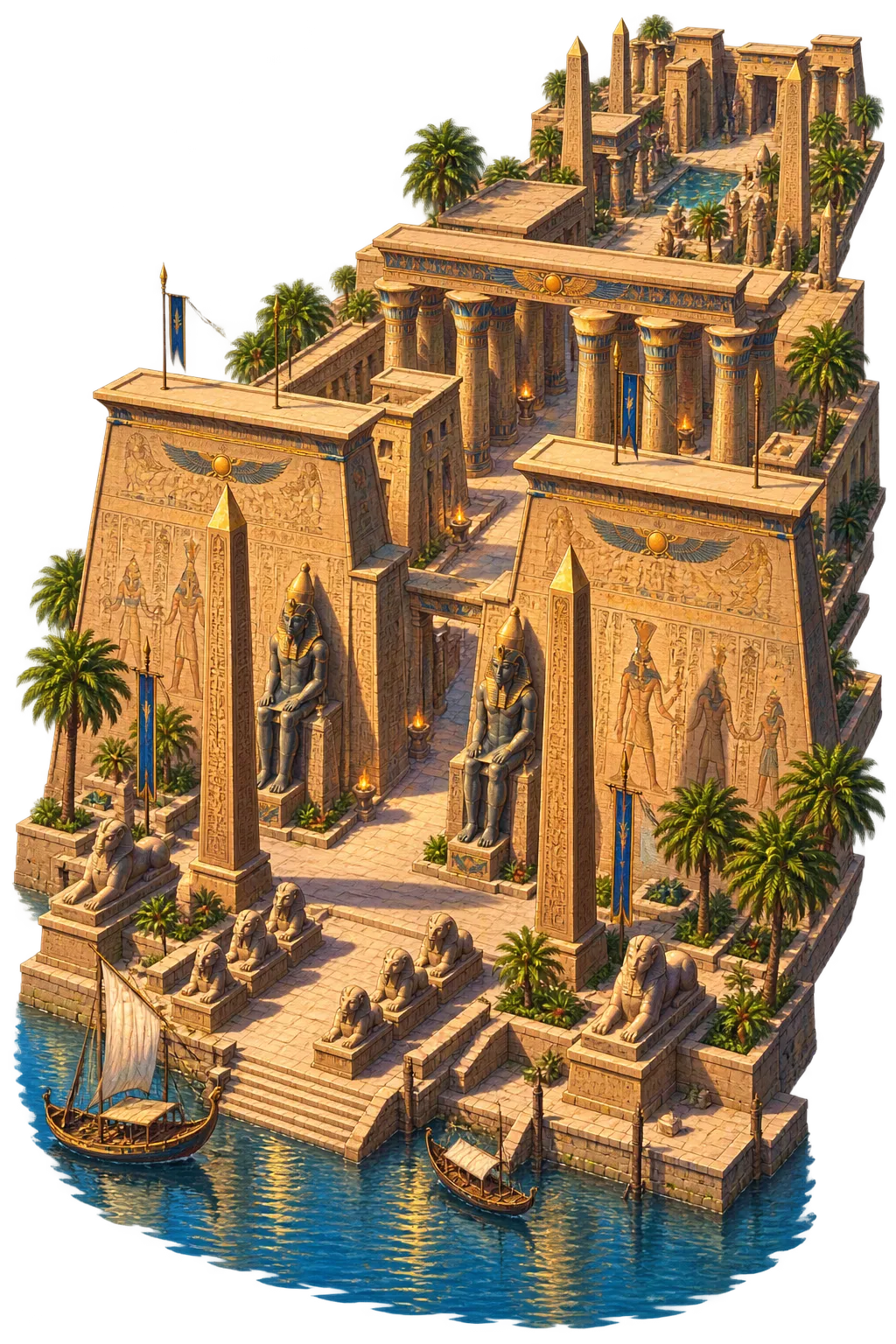
3. The physical record. Amenhotep III’s colonnade and court survive at near-perfect scale; the pylon of Ramesses II fronts it with its single obelisk — the other stands in Paris’ Place de la Concorde. The temple’s axis was recently realigned with the re-excavated Avenue of Sphinxes to Karnak, restoring the ancient processional road.
4. The current holding. The temple at /luxor/, a temple of the restored name. aSCII-equivalent form
5. The documented resonances. Travel, Tourism & Place Branding, Wedding, Family & Maternity, Architecture & Spatial Design — seats argued and weighted in the pattern atlas, read through the myths in this temple's Resonance File.
6. The primary sources. The Book of the Dead — the library this file answers to, open at the Sacred Texts collection.
7. The continuing record. The colonnade of Amenhotep III, floodlit on the Nile’s corniche, is the most photographed temple front in the world after the Pyramids. The birth-colonnade’s iconography — Khnum at the potter’s wheel, the divine child — became the standard visual argument of Egyptian kingship, copied in every royal birth-chapel of the New Kingdom.
At a Glance
- Restored name: Luxor
- ASCII form: luxor
- Meaning: "The palaces"
- Domain of influence: Temple, Thebes, Amun
- Pantheon: Egyptian
- Restoration: ASCII-equivalent form
- Original script: —
- Series: The Restoration Files, No. 305 of 597
The File Continues
Read the founding dispatch for the name's full story, the Resonance File for the archetype at work — or the whole archive in one sitting.
Continue the series — previous file: Lono (read it here) · next file: Mꜣ (read it here).
The Restoration Files are written from the same canonical record as the temples themselves: the lexicon, the lore catalog, the pattern atlas, and the cited scholarly sources. If a file ever disagrees with its temple, the temple is right — tell us, and the file will be corrected.