
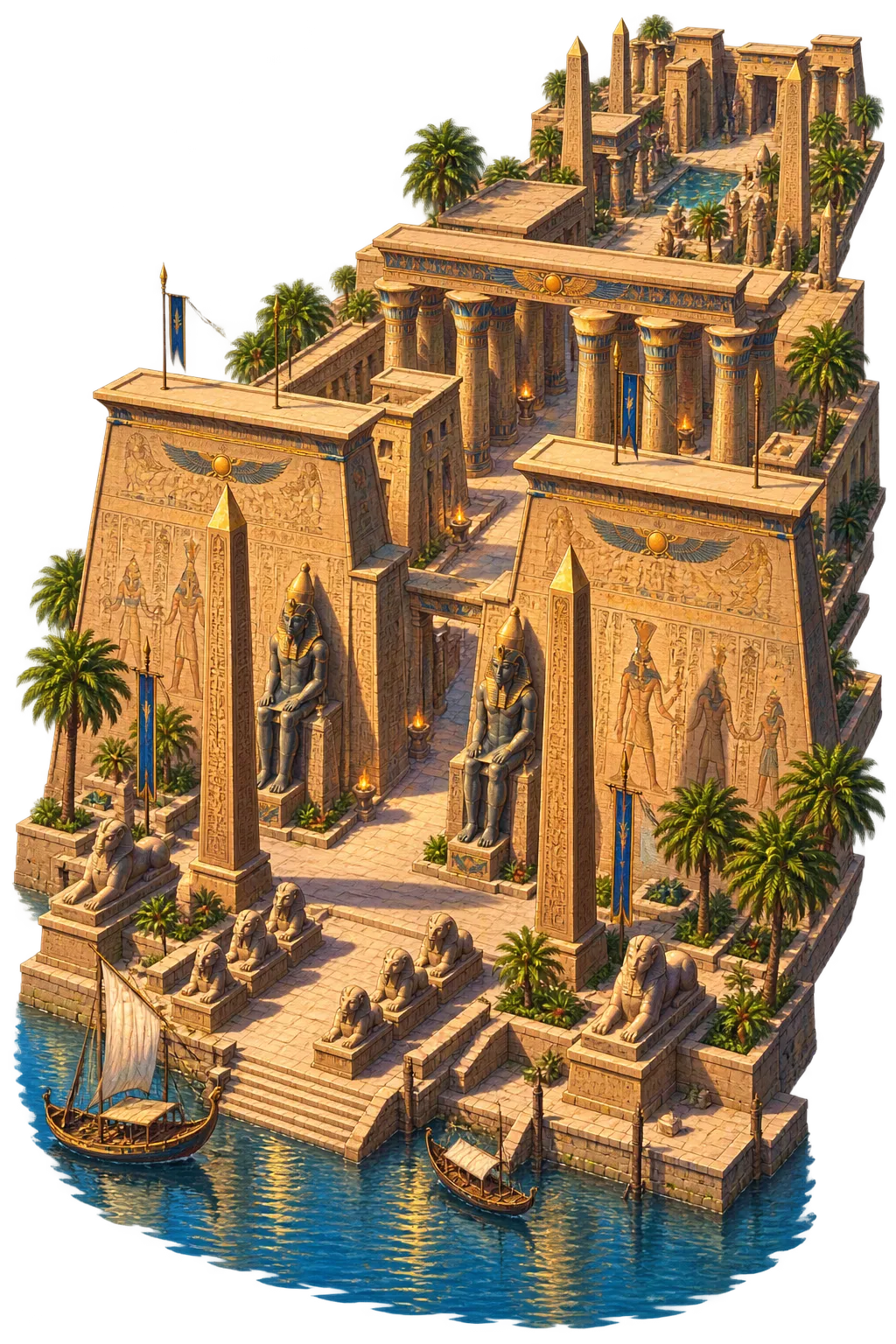
Stress-testing Luxor: do the industry seats hold?
The stress test for Luxor. Every seat in the atlas was attacked with the same question — is the match real, or is it poetry? — and the survivors are recorded with their evidence.
At a Glance
- Temple: Luxor
- Pantheon: Egyptian
- Domain of influence: Temple, Thebes, Amun
- Pattern seats: 3
- Sectors touched: Culture & Entertainment · Home & Lifestyle
- Strongest seat: Travel, Tourism & Place Branding
- Series: The Resonance Files, No. 305 of 597
The Test
Seat 1: Travel, Tourism & Place Branding
Claim: Modern Egypt's tourist capital — the colonnade front is the nation's postcard. Exhibit: The Southern Journey — The Opet festival’s climax was the god’s arrival at Ipet-resyt: the barque of Amun moored before the colonnade, the Theban crowd celebrating the union that renewed the Nile, the king, and the year in a single night of liturgy.
Verdict: stands. Strip both to their function and the functions match.
Seat 2: Wedding, Family & Maternity
Claim: The birth-colonnade narrates Amenhotep III's divine conception — kingship's canonical birth-architecture. Exhibit: Amun and Mutemwiya — Luxor’s colonnade reliefs narrate the conception of Amenhotep III: Amun takes the form of the king, visits queen Mutemwiya, the child is fashioned by Khnum on the potter’s wheel and blessed by the gods — the canonical statement that the pharaoh is the god’s literal son, carved at full scale.
Verdict: holds under load. The correspondence is functional, not decorative.
Seat 3: Architecture & Spatial Design
Claim: The finest preserved New Kingdom colonnade — temple architecture's textbook front. Exhibit: The Sanctuary Continuous — A mosque still stands inside the temple’s court — Abu Haggag of Luxor, whose mouloud festival each year crowds the ancient colonnade with boats and lights.
Verdict: stands. Strip both to their function and the functions match.
The Control Group
Against the seats that survived, one control: the temple's own summary of its figure — Luxor’s mythology is the fertility-cycle of Amun himself: each year the god sailed south from Karnak to his harem at Ipet-resyt, married his own power in the sanctuary, and returned renewed. The seats do not drift far from it. That is the audit's cleanest result.
The Method, Stated Plainly
The atlas is not a horoscope. Seats are earned from the sources — argued, weighted, published — and every one of them can be challenged at the methodology page. A match that cannot survive an argument does not survive review. That is the whole trick: the patterns are claims, and claims can be tested.
For the Ones Who Work There
For a sponsor in travel, tourism & place branding, the fit here is not adjacency — it is inheritance. Your trade already tells this story every working day; the temple simply holds the original. The patron tier and the advertising terms carry the mechanics; the myths above carry the reason.
The File Continues
This is one of 597 Resonance Files — the third dispatch from every flagship temple, where the myths meet the markets. The temple's founding dispatch tells the name's story; its Restoration File tells the spelling's; the blog index holds the whole archive.
Continue the series — previous: Lono (read it) · next: Mꜣ (read it).
The Resonance Files are argued from the same canonical record as the pattern atlas itself: the lexicon, the lore catalog, and the cited sources. Every seat can be challenged at the methodology page — and the challenge is the point.