
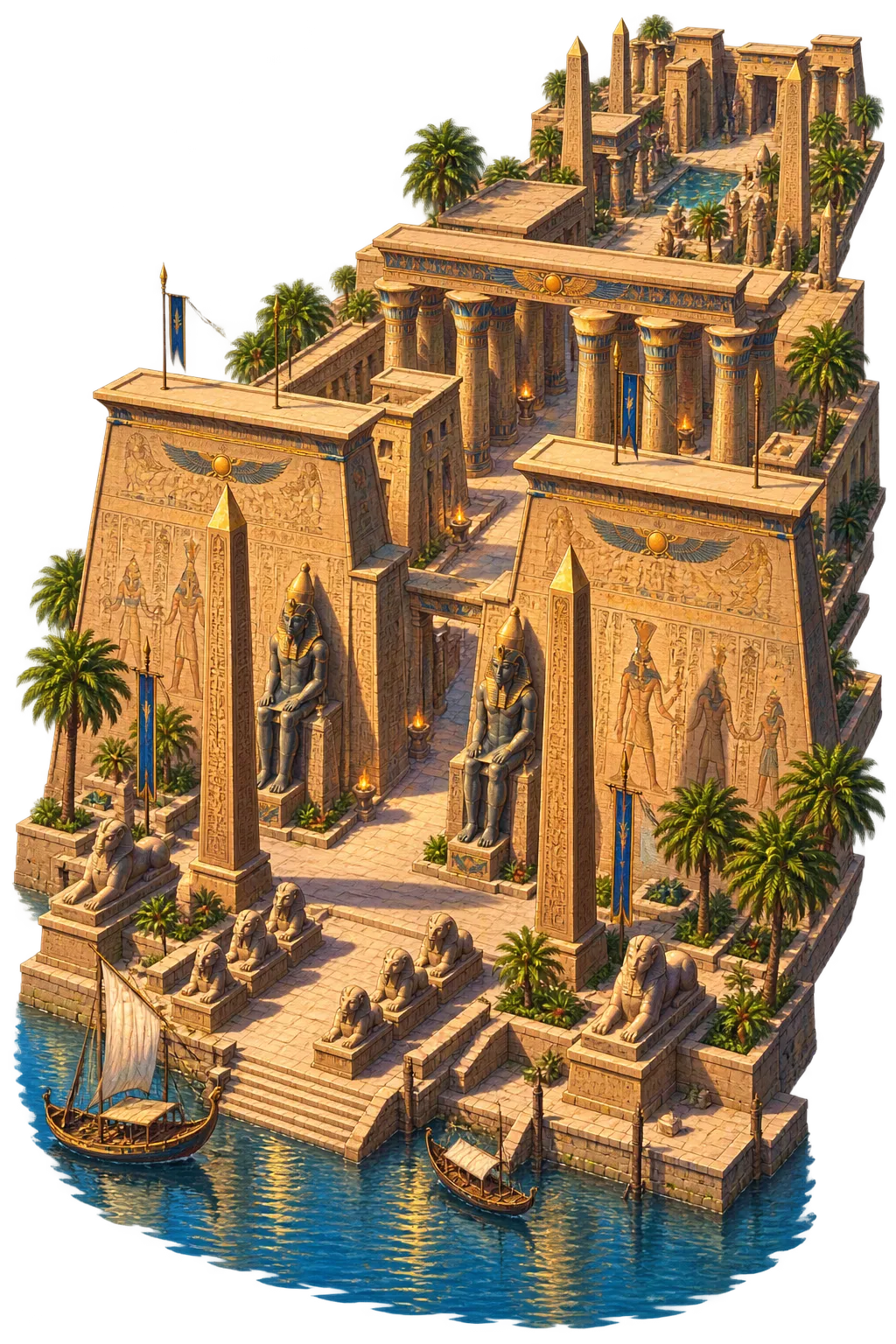
Luxor in 2026: why scholars still care
In 2026, names are treated as data points. Luxor is a reminder that they are also cultural artifacts — and that the difference matters for search engines, AI training corpora, and anyone who types the name of a Egyptian figure into a browser. Scholars never stopped caring about the difference between luxor and Luxor; the web simply made that care actionable. What follows is the full scholarly picture — name, script, sound, myth, cult, and legacy — followed by the engineering compromise that lets a restored spelling live at a real address. The question is not whether the name is old. It is whether the digital world is old enough to hold it.
At a Glance
- Restored name: Luxor
- ASCII form: luxor
- Meaning: "The palaces"
- Domain of influence: Temple, Thebes, Amun
- Pantheon: Egyptian
- Restoration: ASCII-equivalent form
Overview
Luxor (luxor) — The Palaces, the Southern Sanctuary · The palaces — belongs to the Egyptian tradition, where it is catalogued under the domain "Temple, Thebes, Amun". The name means "The palaces".
Luxor — Arabic ‘the palaces’ — names the southern sanctuary of the Theban triad, where Amun visited in the great Opet festival to renew his generative power. Its ancient name, Ipet-resyt, ‘the Southern Select Place’, marks it as Karnak’s counterpart across the river: not the god’s estate but his bridal-chamber.
PuniCodex restores the name as Luxor and serves its temple at its temple. The restoration aSCII-equivalent form — a description computed from the displayed form itself. The plain ASCII form luxor survives as a modern convenience imposed by the early domain-name system; the restoration, not the fallback, is the form the project defends as philologically complete.
The Name
No indigenous written attestation survives for this name; Luxor is a scholarly transliteration of the reconstructed spoken form. Etymologically the name means "The palaces".
The ASCII form luxor survives only because the early domain-name system could not carry diacritics; it is a technological compromise, not an ancient spelling. The Unicode restoration Luxor recovers the full diacritic detail of the scholarly transliteration directly in the address bar. The restoration aSCII-equivalent form — a description computed from the displayed form itself.
The letter-by-letter transformation runs:
- l → L — Same, capitalized
- u → u — Same
- x → x — Same
- o → o — Same
- r → r — Same
The Original Script
The original script for this egyptian name has not yet been added to PUNICODEX. The form shown is a scholarly transliteration.
The form Luxor is therefore a scholarly transliteration rather than an attested ancient spelling; it encodes the reconstructed sound of the name for modern use, and no mark in it is decorative.
Pronunciation
The reconstructed pronunciation of the name is /ˈlʌksɔːr/ (conventional) — Conventional reading — Arabic name of the temple town.
Phoneme by phoneme:
- Luxor — From Arabic al-uqsur, “the palaces/castles” — the Arab name for the temple ruins of Thebes’ east bank.
- ** — Ancient Egyptian: Ipet-resyt, “the Southern Sanctuary” — the harem of Amun.
For the modern speaker, the closest approximation is: “LUK-sor”
Kindred and historical forms of the name:
- Egyptian — Ipet-resyt “the Southern Sanctuary”
A medieval Arabic plural fossilised into a modern proper name — the “palaces” the Arabs found.
Mythology
Luxor’s mythology is the fertility-cycle of Amun himself: each year the god sailed south from Karnak to his harem at Ipet-resyt, married his own power in the sanctuary, and returned renewed. The temple’s birth-colonnade extends the cycle to kingship — Amenhotep III’s divine conception carved as theology-in-stone.
The Southern Journey (Opet Festival)
The Opet festival’s climax was the god’s arrival at Ipet-resyt: the barque of Amun moored before the colonnade, the Theban crowd celebrating the union that renewed the Nile, the king, and the year in a single night of liturgy. The return to Karnak closed the cycle eleven days later.
Amun and Mutemwiya (Divine Birth)
Luxor’s colonnade reliefs narrate the conception of Amenhotep III: Amun takes the form of the king, visits queen Mutemwiya, the child is fashioned by Khnum on the potter’s wheel and blessed by the gods — the canonical statement that the pharaoh is the god’s literal son, carved at full scale.
The Sanctuary Continuous (The Mosque of Abu Haggag)
A mosque still stands inside the temple’s court — Abu Haggag of Luxor, whose mouloud festival each year crowds the ancient colonnade with boats and lights. The building has never stopped being sacred; only the name of the sacred changed, from Ipet-resyt to the Sheikh’s mosque.
The Palaces (Modern Name)
The Arabs who settled among the ruins called them al-uqsur — ‘the castles’ — seeing palaces in the pylons; the name shrank to Luxor and became the city’s. It is one of the few cases where the medieval name of the ruins replaced the ancient name of the living town.
Symbols & Iconography
The iconography associated with Luxor concentrates in a small set of recurring attributes, each a compressed statement about the name:
- The Southern Sanctuary — Ipet-resyt — the harem-temple where Amun’s fertility was renewed each year.
- The Birth Colonnade — Reliefs of the divine birth of Amenhotep III — the king’s theology of legitimate succession.
- The Colonnade of Amenhotep III — Fourteen massive papyrus columns — the finest preserved New Kingdom colonnade.
- Opet’s Destination — The river-end of the great festival: Amun’s barque docked here for the marriage-renewal rites.
Archaeology & Evidence
Amenhotep III’s colonnade and court survive at near-perfect scale; the pylon of Ramesses II fronts it with its single obelisk — the other stands in Paris’ Place de la Concorde. The temple’s axis was recently realigned with the re-excavated Avenue of Sphinxes to Karnak, restoring the ancient processional road.
Realm & Domain
Luxor — Arabic ‘the palaces’ — names the southern sanctuary of the Theban triad, where Amun visited in the great Opet festival to renew his generative power. Its ancient name, Ipet-resyt, ‘the Southern Select Place’, marks it as Karnak’s counterpart across the river: not the god’s estate but his bridal-chamber.
The Southern Sanctuary
Ipet-resyt — the harem-temple where Amun’s fertility was renewed each year.
The Birth Colonnade
Reliefs of the divine birth of Amenhotep III — the king’s theology of legitimate succession.
The Colonnade of Amenhotep III
Fourteen massive papyrus columns — the finest preserved New Kingdom colonnade.
Opet’s Destination
The river-end of the great festival: Amun’s barque docked here for the marriage-renewal rites.
Across Cultures
Luxor temple served Amun in his ithyphallic generative form — Amun-Min-Kamutef, ‘bull of his mother’ — tying the sanctuary to Min’s fertility theology. Its chapels later honoured the Roman imperial cult, then the mosque of Abu Haggag: three religions in one floor-plan, each claiming the same consecrated ground.
Within the Egyptian tradition, closely related names in the corpus include Ꜣb, Ꜣḫ, Ꜣmun, ꜥnḫ, ꜣnpw, and ꜥꜣpp.
Cultural Legacy
The colonnade of Amenhotep III, floodlit on the Nile’s corniche, is the most photographed temple front in the world after the Pyramids. The birth-colonnade’s iconography — Khnum at the potter’s wheel, the divine child — became the standard visual argument of Egyptian kingship, copied in every royal birth-chapel of the New Kingdom.
The Scholarly Record
The account of Luxor given in this edition rests on the witnesses and reference works listed below. Lexica and etymological dictionaries secure the form and meaning of the name; the literary and religious texts supply the narrative evidence.
- Luxor temple birth-colonnade reliefs (Amenhotep III).
- Opet festival reliefs and barque-docking scenes.
- Abu Haggag mouloud tradition.
- Haeny, Luxor in the Oxford Encyclopedia of Ancient Egypt.
A Meditation
Luxor: a medieval plural doing the work of an ancient sanctuary-name. In the lexicon it stands for the archaeological truth that places outlive their theologies — ‘the palaces’ the Arabs named are the same walls where Amun’s fertility was renewed, and the name needs no restoration because it never referred to anything but the stones themselves.
The Unicode Restoration
Luxor aSCII-equivalent form. The ASCII fallback luxor still resolves everywhere, but it is the restored form that carries the name's full information. That is the whole thesis of this temple: the marks are the message.
Character by Character
The journey from luxor to Luxor, one character at a time:
- l → L — Same, capitalized
- u → u — Same
- x → x — Same
- o → o — Same
- r → r — Same
The Egyptian Pantheon
Luxor is one of 66 entries the PuniCodex lexicon catalogues under the Egyptian pantheon. The Pantheon page gathers the tradition's major figures in one place, and the Lexicon lets you filter all 983 restorations by tradition or script — the fastest way to see where this name sits among its kin.
Frequently Asked Questions
What does Luxor mean? The traditional gloss is "The palaces."
Which tradition does Luxor belong to? Luxor is catalogued in the Egyptian pantheon of the PuniCodex lexicon.
What does Luxor preserve that ASCII cannot show? The form itself answers: Luxor aSCII-equivalent form — and the marks in the restored spelling are exactly that evidence.
Can I use Luxor in a normal browser? Yes. The DNS resolves the punycode form automatically, and the type tool on this site converts luxor to Luxor for copying and pasting.
Where does the scholarly information come from? The entry is built from lexica, inscriptional evidence, and reviewed scholarly sources listed in the Scholarly Edition. Every claim is traceable to a canonical source.
Typing Luxor
You do not need a special keyboard to use this restoration. The PuniCodex Type Tool converts the ASCII form luxor into Luxor as you type, and the browser extension offers the same conversion inside any text field. Copy the restored form, paste it into the address bar, and the DNS does the rest.
Sister Temples
Other temples in the Egyptian pantheon include Ḥnḫsšwj, Ḥr, and Kꜣ — each with its own restoration story, its own scholarly record, and its own place in the lexicon.
Why This Restoration Matters
In 2026 the stakes are practical. Search indexes, language models, and localization pipelines all inherit whatever spelling the web normalizes — which means every Unicode domain is also a training signal. Luxor teaches the machinery that the restored form exists, that it is used, and that it points to a real place. That is why a project built on philology ends up caring about DNS: the infrastructure decides which names the future sees. This restoration makes sure the future sees the whole name.
Explore Further
This post is one doorway into the temple. The home page carries the full character breakdown and the ambient canvas; the lore page tells the myths in long form; the Scholarly Edition preserves the sources, pronunciation data, and revision history; and the patron wall supports the restoration directly. For the wider map, browse the Lexicon, explore the Pantheon, or return to the PuniCodex blog.
A Closer Look at the Marks
A restored name is a small map. In the case of Luxor, the map does not lead through diacritics or special letters, because the source tradition wrote the name in Hieroglyphs rather than in the Latin alphabet. The ASCII form luxor and the restored form share the same letters; the restoration is a decision about which conventional spelling should serve as the public reference.
That decision is not cosmetic. The original script attestation carries semantic and phonetic information that no romanization can fully reproduce. By fixing one conventional spelling as the canonical domain form, the project prevents the drift that happens when a name is romanized differently in every article, map, and database. The breakdown still lists each character — l, u, x, o, r — so visitors can see exactly what is being carried forward and what is not. What looks like "no change" is, in fact, a deliberate choice to keep the name stable, searchable, and addressable.
Luxor in Its Tradition
Luxor does not stand alone. It belongs to the Egyptian tradition, where it is counted among 66 names in the PuniCodex lexicon. Its sphere — Temple, Thebes, Amun — places it beside other figures who govern similar aspects of experience. The restored spelling is therefore not only a philological decision; it is a way of keeping the name in the company of its kin. When the address bar shows Luxor, it marks the boundary between a generic search term and a named entry in a living catalog of myth. That catalog is the point of the project. Every restored name is a vote for specificity: the web should know the difference between a figure and a keyword, between a tradition and a trend. Luxor is one such vote.
What You Will Find in the Temple
The temple page for Luxor is more than a landing page. The home tab presents the character breakdown, the pronunciation guide, and the live domain status in a single view. The lore tab gathers the myths and narratives that give the name its depth. The Scholarly Edition tab publishes the sources, variant forms, and review history that justify the restoration. Industry patterns show where the name appears in modern commerce and culture, while the gallery and creatives tabs collect visual and sponsor material. The patron wall lets visitors support the restoration directly. Each tab is generated from the same canonical sources, so the domain, the blog, the scholars page, and the search index all agree. The result is a single source of truth about a name, delivered through several doors.
The Restoration on the Live Web
A domain name is a kind of publication. When Luxor resolves, it proves that the restored spelling is not a theoretical exercise; it is a working address on the public internet. Search engines can index it, language models can encounter it, and anyone who copies it from a manuscript can paste it into a browser. That practical reality changes the status of the restoration. Before Unicode domains, a scholar could write the name correctly in an article while the public web flattened it to luxor. Now the public web can carry the correct form end to end. The punycode translation happens silently, so the infrastructure remains compatible while the visible name keeps its marks. That compromise — human-readable restoration, machine-readable encoding — is the foundation of every PuniCodex temple.
Restoration Notes
Restoring a name is not a single decision; it is a sequence of smaller decisions, each backed by a different kind of evidence. For Luxor, the chain begins with the attested form in Hieroglyphs, continues through the standard scholarly romanizations, and ends with the DNS-compatible Unicode spelling used by this temple. The meaning "The palaces" anchors the name in its semantic field; without that anchor, the marks would float free of the figure they name. The restored form Luxor and the ASCII form luxor share the same Latin letters; the restoration here is a conventional capitalization rather than a recovery of lost diacritics or special characters. Those adjustments are not arbitrary styling. They follow the restoration logic the displayed form wears openly: Luxor aSCII-equivalent form. The rule is mechanical, not editorial, which means the same standard applies to every entry in the lexicon. A visitor who disagrees with the classification can at least see exactly which evidence produced it, because every step is recorded in the Scholarly Edition. That transparency is the difference between a restoration project and a branding exercise. The name is being put back, not invented.
Related Names
Sources
The full scholarly apparatus — every citation, revision, and review — lives in the Scholarly Edition. Key references for this post:
- Luxor temple birth-colonnade reliefs (Amenhotep III).
- Opet festival reliefs and barque-docking scenes.
- Abu Haggag mouloud tradition.
- Haeny, Luxor in the Oxford Encyclopedia of Ancient Egypt.
- Lexicon authorities for this entry: Egyptology, Faulkner.