
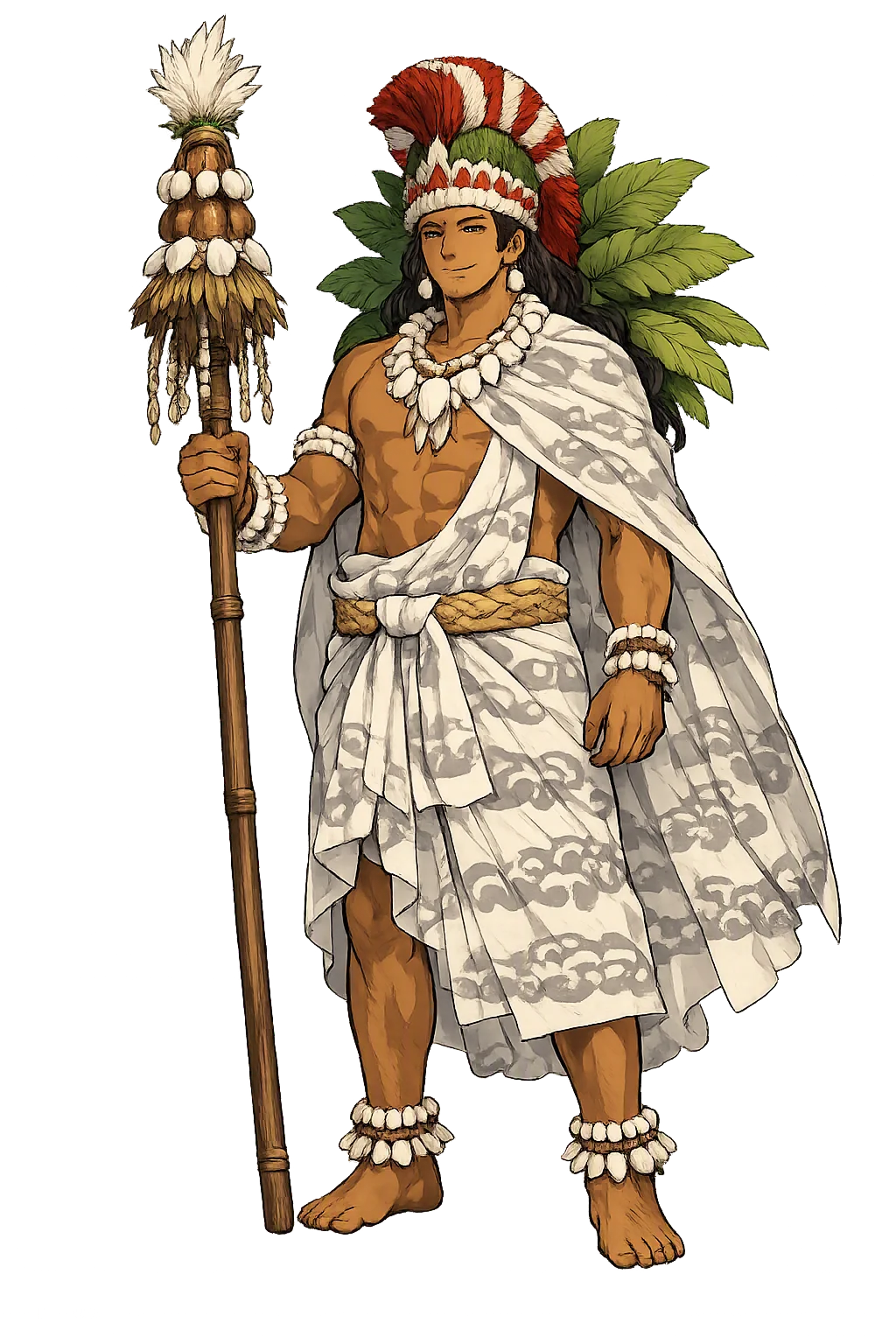
The provenance file on Lono
The provenance file for Lono. Nothing here is unsourced; that is what the file is for.
Provenance
1. The attestation. —, from the tradition's own record.
2. The narrative record. Lono and Kaikilani — Among the chiefly legends preserved by Kamakau and Beckwith, Lono-i-ka-makahiki is a chief of Kaʻawaloa in the Kona district of Hawaiʻi island, whose story became the god's. His wife is the beautiful Kaikilani; a jealous rival fabricates reports of her infidelity, and Lono — believing the lie — kills her, learning the truth too late (Kamakau, Ruling Chiefs of Hawaiʻi). The Circuit of the Long God — The Makahiki, the Hawaiian New Year festival, is Lono's season and his biography performed. When the Pleiades (Makaliʻi) appeared at sunset, the temples closed to war and the image of the long god (akua loa) — a tall staff hung with feathered emblems — was carried around each island counterclockwise, district by district (Malo, Hawaiian Antiquities, ch.
3. The physical record. The material trace of Lono is the Makahiki landscape itself. Hikiau heiau at Kealakekua Bay — the platform where Cook was received as the returned god — survives as a restored temple complex above the bay, beside the older Mailekini heiau, while the Cook monument obelisk stands at Kaʻawaloa across the water. Along the old circuits, ahu — small offering platforms at ahupuaʻa boundaries — mark where the akua image halted and the tribute was laid. No pre-contact temple can be securely assigned to Lono alone: Hawaiian heiau served shifting dedications, and his worship was mobile by design, carried around the island on poles rather than fixed in stone. The archaeology is therefore the route, not the shrine — a procession that left platforms every few miles around every inhabited island.
4. The current holding. The temple at /lono/, classified Tier 2. One decisive feature survives — a single, honest mark — which places the restoration in Tier-2: exact, and exactly labeled.
5. The documented resonances. Beauty, Fashion & Cosmetics, Love, Dating & Relationships, Solar & Renewable Energy — seats argued and weighted in the pattern atlas, read through the myths in this temple's Resonance File.
6. The primary sources. Kumulipo, Polynesian Mythology — the library this file answers to, open at the Sacred Texts collection.
7. The continuing record. The Makahiki never fully died. In the Hawaiian renaissance that began in the 1970s it returned as school festivals, games leagues, and island-wide circuits of the akua images; today Hawaiian immersion schools open their year with it, and the festival's sports — wrestling, surfing, spear-throwing — have league lives of their own.
At a Glance
- Restored name: Lono
- ASCII form: lono
- Meaning: "Hawaiian deity, associated with fertility, agriculture, rainfall, music and peace"
- Domain of influence: Agriculture, Peace, Rain
- Pantheon: Polynesian
- Classification: Tier 2
- Original script: —
- Series: The Restoration Files, No. 284 of 548
The File Continues
Read the founding dispatch for the name's full story, the Resonance File for the archetype at work — or the whole archive in one sitting.
Continue the series — previous file: Lóngwáng (read it here) · next file: Mꜣ (read it here).
The Restoration Files are written from the same canonical record as the temples themselves: the lexicon, the lore catalog, the pattern atlas, and the cited scholarly sources. If a file ever disagrees with its temple, the temple is right — tell us, and the file will be corrected.