
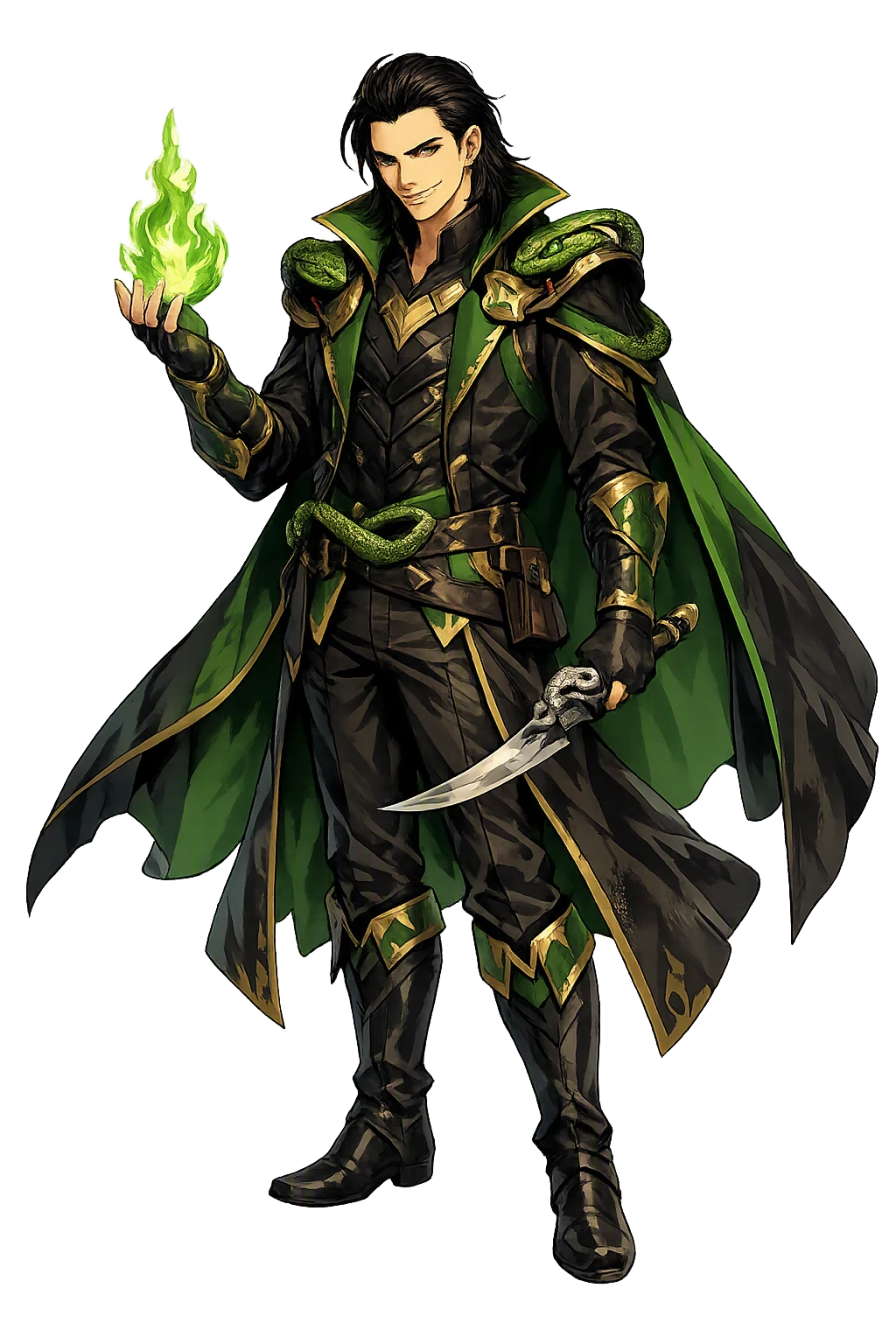
How Loki got its accent back
The ASCII form loki is missing something. Loki restores the marks the source language used to distinguish this name from a thousand others — and those marks change how the name is read, pronounced, and understood. This post explains, with the full scholarly record behind it, what each restored mark preserves: the Younger Futhark evidence, the reconstructed sound, the myths the name carries, and the classification logic that separates Tier 1 restorations from Tier 2. By the end, the marks in Loki will look less like ornaments and more like what they are — recovered evidence, pinned back in its proper place.
At a Glance
- Restored name: Loki
- ASCII form: loki
- Meaning: "Possibly knot, loop, or flame"
- Domain of influence: Trickery, Chaos, Shape-shifter
- Pantheon: Norse
- Classification: Tier 2
- Original script: ᛚᚢᚴᛁ (Younger Futhark)
Overview
Loki (loki) — Trickery, Chaos, Shape-shifter · possibly 'knot' or 'lock' — etymology uncertain — is the trickster of the Norse Æsir: not a god by birth but the giant Fárbauti's son by Laufey, admitted to the fellowship of the gods through an oath of blood-brotherhood with Óðinn, and the author of both their finest treasures and their mortal wound.
The Eddas give him more narrative than any figure save Þórr and Óðinn. He cuts off Sif's hair and wagers his own head against the dwarfs' craft, from which the gods receive the spear Gungnir, the ship Skíðblaðnir, the ring Draupnir, the boar Gullinbursti, and Þórr's hammer Mjǫllnir. He accompanies Þórr to Þrymr's hall disguised as a bridesmaid and talks the party through the wedding feast. And he finds the one thing that never swore Frigg's oath — the mistletoe — and guides the blind Hǫðr's hand, killing Baldr. The Lokasenna stages the rupture: a full flyting against every god in Ægir's hall, then the flight to Franangr, the salmon-shape, the net of his own devising, and the binding with the entrails of his son Nari beneath a venom-dripping serpent, where Sigyn holds her bowl until Ragnarök. At the end he steers the ship Naglfar against the gods and falls with Heimdallr, each slaying the other.
PuniCodex catalogs the name as Loki and serves its temple at /loki/. The name is Tier 2: the normalized Old Norse spelling is Loki, with a short o and no distinctive letter, so the plain ASCII form loses nothing — the restoration and the ASCII form are the same word. The plain-ASCII domain loki.com is registered to a third party, held outside the collection, and watched for release; no owned domain is claimed for this entry.
The Name
The name is attested in normalized Old Norse as Loki (nominative; genitive Loka), spelled throughout the manuscript tradition with a short o and no diacritic. Its etymology is genuinely uncertain, and honest lexicography says so: the most discussed derivation connects it to the Germanic luk- family — Old Norse lok 'cover, lid, bolt, lock' and the verb lúka 'to close, to end' — whence the proposed senses 'knot', 'lock', 'loop', or 'the one who closes', the last reading attractive for the god who brings the world's end. The nineteenth-century equation of Loki with Logi 'flame' is abandoned: the o of Loki is short, and Logi appears in Gylfaginning as a separate figure, the personified wildfire who defeats Loki in an eating contest.
Because the Old Norse spelling is identical to the ASCII spelling, the name is classified Tier 2: the restoration preserves no distinctive feature that ASCII loses. The lexicon also records an attested variant Lóki (alt-stress, acute on o), sourced to Cleasby-Vigfusson and the Poetic Edda; the normalized form Loki remains primary.
The letter-by-letter transformation runs:
- l → L — Same, capitalized
- o → o — Same
- k → k — Same
- i → i — Same
The project holds no domain for this name: loki.com is registered to a third party outside the collection and is watched for release.
The Original Script
The name is preserved in medieval Icelandic manuscripts in the Latin alphabet as Loki — Old Norse (North Germanic), attested 13th c. CE in the Codex Regius of the Poetic Edda and the principal Snorra Edda codices, recording material centuries older. Before the Latin bookhand, Old Norse names were carved in the Younger Futhark; no runic attestation of this theonym survives, so the manuscript form is the primary witness, and the epigraphic rendering ᛚᚢᚴᛁ is a reconstruction only.
The scholarly rendering proceeds step by step:
- The name is a single uncompounded word of uncertain etymology; the luk- family ('lock, knot, closing') is the most discussed derivation, the logi 'flame' equation being abandoned.
- Old Norse orthography writes it Loki, with a short o that takes no length mark and no distinctive letter.
- Because the normalized spelling and the ASCII spelling are identical, the name is Tier 2: the restoration preserves no feature ASCII loses. The lexicon records the attested variant Lóki (alt-stress) alongside the primary form.
- No domain is owned for this name: the plain-ASCII loki.com — the philologically complete form — is registered to a third party, held outside the PuniCodex collection, and watched for release.
Pronunciation
The reconstructed pronunciation of the name is /ˈlo.ke/ — Old Norse Reconstruction.
Phoneme by phoneme:
- Lo- — Voiced alveolar lateral [l] followed by short mid back [o], as in English lot; stressed on the first syllable, as in all Old Norse words
- -ki — Unaspirated velar stop [k] followed by short close front [i]; the second syllable falls away lightly
For the modern speaker, the closest approximation is: 'LOH-kee' — two even syllables, the o short and round, never the diphthong of English low.
Kindred and historical forms of the name:
- Old Norse — Loki, the manuscript form; also by the byname Loptr, 'the airy one'
- Modern Icelandic — Loki, unchanged, and still current as a given name
- Faroese ballad tradition — Lokki, the benevolent helper of the Lokka táttur
- Distinct figure — Útgarða-Loki, the giant king of Útgarðr, who shares the name but not the identity
Loki is Tier 2 because the ASCII form is philologically complete: English 'Loki' loses no sound, no length, and no letter that the Old Norse original carries.
Mythology
Loki's mythology is the largest of any single figure in the Norse corpus: he is the gods' companion, their supplier of wonders, their betrayer, and their doom, and the Eddas never reconcile these into one character.
The Blood-Brother (Lokasenna 9)
When Óðinn moves to silence him in Ægir's hall, Loki invokes the oldest bond in the mythology: 'Do you remember, Óðinn, how in days of old we two blended our blood together? You said you would never taste ale unless it were brought to us both.' The oath explains everything structural about him — why a giant's son sits among the Æsir, and why his betrayal, when it comes, is kin-slaying rather than warfare.
The Flyting at Ægir's Hall (Lokasenna)
Uninvited to Ægir's feast, Loki kills the servant Fimafeng, is driven out, returns on the strength of the oath, and then insults every god and goddess in turn — Bragi, Iðunn, Gefjon, Óðinn, Frigg, Freyja, Njǫrðr, Týr, Freyr, Byggvir, Heimdallr, Skadi, Sif — finding for each the wound that will not close. Only Þórr's arrival ends it: three vows with Mjǫllnir, and Loki yields the floor. The prose epilogue carries him straight to Franangr and the binding.
The Companion on the Road (Þrymskviða)
When Þrymr steals Mjǫllnir and demands Freyja, Loki borrows her feather-coat, learns the terms, and rides beside the disguised Þórr as his maidservant — supplying the ready answers ('Freyja has not eaten for eight nights, so eager was she for Jǫtunheimr') that keep the disguise alive until the hammer is in the bride's lap. The poem preserves the benevolent Loki the later tradition needed to explain.
The Wager of the Head (Skáldskaparmál)
For mischief he cuts off Sif's hair; to escape Þórr's hands he procures from the sons of Ívaldi the golden hair, the ship Skíðblaðnir, and the spear Gungnir — then wagers his own head that the dwarf Brokkr's brother Eitri cannot match them. In the smithy he stings the bellows-worker as a fly, yet the work holds: Gullinbursti, Draupnir, and Mjǫllnir, short-handled from the sting but judged the best of all. Loki concedes his head — and points out that the neck was never in the bargain. The dwarfs sew his lips shut instead.
The Death of Baldr (Gylfaginning 49)
In a woman's shape he draws from Frigg the single omission in her oath — the mistletoe, too young to swear. He pulls it up, puts it in the blind Hǫðr's hand, and guides the throw; Baldr falls dead. When Hermóðr wins the condition that all things must weep Baldr back from Hel, all things weep except the cave-giantess Þǫkk — 'let Hel hold what she has' — and the Æsir believe Þǫkk was Loki.
The Binding (Gylfaginning 50; Lokasenna prose)
Hiding on Franangr in a house with four doors, Loki takes salmon-shape in the falls and, brooding on how he might be caught, devises the net — the first ever made. Óðinn spies him from Hliðskjálf; the gods read the ash-pattern of the burnt net, remake it, and drag the falls until the salmon is taken. Then the punishment: his son Váli is changed into a wolf and tears apart his brother Nari (Narfi in the Lokasenna prose), and with Nari's entrails the Æsir bind Loki across three stones; Skadi fastens a venomous serpent above his face. Sigyn, his wife, holds a bowl beneath the drops, and only when she turns to empty it does the venom strike him — his writhing, Snorri says, is what men call earthquakes.
Ragnarök (Gylfaginning 51; Vǫluspá)
At the end the bonds break. Loki steers Naglfar — the ship built of dead men's nails — against the gods, while his children by the giantess Angrboða close in: Fenrir with jaws from earth to heaven, Jǫrmungandr blowing venom, Hel's host behind him. On the field of Vígríðr he meets Heimdallr, and they kill each other. The sibyl of the Vǫluspá saw it centuries before Snorri: 'the kinsman of Býleistr' steers the ship from the east.
A Necessary Distinction: Útgarða-Loki and Logi
Two figures in Gylfaginning share his name or his old reputation and are neither of them Loki Laufeyjarson. Útgarða-Loki is the giant king of Útgarðr whose illusions humiliate Þórr on the eastern journey — a separate being, and Snorri never confuses them. And Logi, 'wildfire', who beats Loki in the eating contest at Útgarðr, is the fire itself in person — the figure with whom the nineteenth century wrongly fused the god into a fire-deity.
Symbols & Iconography
Loki's iconography is narrative rather than cultic — the corpus gives him no temple regalia, but his myths fixed a tight set of attributes:
- The sewn lips — Brokkr's needle after the lost wager: the trickster's own weapon, speech, bound shut; the scars are the one permanent mark the myths leave on him
- The mistletoe dart — the one thing too young to swear Frigg's oath, shaped into the weapon that kills Baldr: the loophole made lethal
- The net of Franangr — the first net ever devised, invented by Loki himself and then used by the Æsir to take him from the falls: the snare that turns on its maker
- The salmon shape — the slippery, upstream form he takes in flight; even his hiding-place is a thing of currents
- The serpent and the bowl — Skadi's venom-dripping snake above his face, and Sigyn's bowl that catches the drops until she must turn to empty it: the machinery of his binding
- The mare's shape — the form in which he bore Sleipnir, Óðinn's eight-legged horse: parenthood across the line of species and sex
Archaeology & Evidence
One carved stone is nearly the whole candidate corpus for Loki's image. The Snaptun stone (Denmark, c. 1000), a hearth-stone or bellows-shield, bears a bearded face with scarred, sewn-shut lips and is commonly identified as Loki from the Brokkr episode — an identification widely repeated but unprovable, since the stone carries no inscription. The Kirkby Stephen stone in Cumbria, showing a bound horned figure, has likewise been read as the bound Loki, though other scholars read it as a bound devil of Christian iconography.
Beyond these disputed stones the attestation is textual: the Poetic Edda poems survive chiefly in the Codex Regius (GKS 2365 4to, c. 1270) and the Hauksbók, and Snorri's account is transmitted by the principal Snorra Edda manuscripts (GKS 2367 4to, Codex Wormianus, Codex Upsaliensis). No runic inscription names the god, and no Scandinavian place-name is securely his — a silence that matches his standing: the one major figure of the pantheon with no temple, toponym, or votive deposit.
Realm & Domain
Loki is catalogued under Trickery, Chaos, Shape-shifter — and the tradition earns every element of it.
The Trickster
He is the mind that finds the loophole: in Frigg's oath, in the wall-builder's contract, in the dwarfs' wager. Skáldskaparmál's kenning-list names him 'slanderer of the gods' and 'thief of the gods'.
The Shape-Shifter
Salmon in the falls of Franangr, mare to the stallion Svaðilfari, fly at the dwarfs' bellows, old woman drawing secrets from Frigg: his body is the one thing about him that never holds still.
The Companion
On the road he is indispensable — the wit that recovers Mjǫllnir in Þrymskviða and talks Þórr's bridal party through Þrymr's feast.
The End-Bringer
By Angrboða he fathers Fenrir, Jǫrmungandr, and Hel; at Ragnarök he breaks his bonds, steers Naglfar against the gods, and falls with Heimdallr in mutual killing.
Across Cultures
The standing comparative frame for Loki is the Greek Promētheús: a trickster-benefactor chained to rock, torn daily — the eagle and the dripping serpent were paired as early as the Romantic mythographers, and Rooth's monograph remains the standard weighing of the parallel. The comparison illuminates the punishment but not the god: Promētheús suffers for helping mankind, Loki for destroying his own fellowship.
The nineteenth century dissolved Loki into a fire-god on the strength of his name's resemblance to Logi 'flame' — the conflation Wagner's Loge made operatic — but modern philology rejects it: the o of Loki is short, and the texts keep Logi and Loki apart as separate figures. A second honest distinction concerns Útgarða-Loki: the cunning giant-king of the eastern journey shares the name but not the identity, and scholarship since de Vries has treated the coincidence as onomastic, however suggestive the parallel mastery of illusion. Within the corpus, closely related figures include Óðinn (his blood-brother), Þórr (his traveling companion), Baldr (his victim), and Heimdallr (his last opponent), with Sigyn (his wife) and the monstrous children Fenrir, Jǫrmungandr, and Hel completing the household.
Cultural Legacy
Loki's afterlife forked early and never rejoined. The folk record kept a kinder god: the Faroese ballad Lokka táttur makes Lokki the clever helper who, with Óðinn and Þórr, saves a farmer's son from a giant — a benevolent trickster surviving in oral tradition long after the Eddic damnation. Learned Europe remade him as fire: Wagner's Loge in the Ring is the nineteenth century's conflation of Loki with Logi rendered as opera, the cynical flame who talks the gods into their bargains.
The twentieth and twenty-first centuries restored his ambiguity at mass scale: Neil Gaiman's 'Low Key Lyesmith' in American Gods (2001) hides the bound god in a prison cell, and Marvel's Loki — Þórr's adopted brother and rival, on page from 1962 and on screen from 2011 — has carried the name further than the Eddas ever traveled, at the price of thinning the mythology to a family quarrel. Modern heathenry remains honestly divided: many Ásatrú kindreds refuse to hail Loki at blót, reading him as the oath-breaker the Eddas describe, while others honor the necessary disturber without whom nothing in Ásgarðr changes. The quietest survivals are idiomatic: Scandinavian folk usage long attached his name to the shimmering air over hot ground and to knot-tying spiders — small, unsettled things that refuse to hold still.
The Scholarly Record
The account of Loki given in this edition rests on the witnesses and reference works listed below. The two Eddas supply the narratives; the lexica and etymological dictionaries secure what can honestly be said of the name; Rooth's monograph remains the standard dedicated study; the modern handbooks frame the scholarly consensus.
- The Poetic Edda, trans. Carolyne Larrington, 2nd ed. (Oxford: Oxford University Press, 2014): Lokasenna (the flyting and the blood-brother oath), Þrymskviða (the bridesmaid), Vǫluspá (the bound god and Ragnarök), Hyndluljóð (Loki's monstrous parenthood).
- Snorri Sturluson, Edda, trans. Anthony Faulkes (London: Everyman, 1987): Gylfaginning 34–35, 42–51 (the children, the wall-builder, Útgarðr, Baldr, the binding, Ragnarök); Skáldskaparmál (the kennings; Sif's hair and the wager).
- Cleasby, Richard, and Guðbrandur Vigfússon, An Icelandic-English Dictionary, 2nd ed. (Oxford: Clarendon Press, 1957), s.v. Loki, Loptr, lok.
- Zoëga, Geir T., A Concise Dictionary of Old Icelandic (Oxford: Clarendon Press, 1910), s.v. loki, loptr.
- de Vries, Jan, Altnordisches etymologisches Wörterbuch, 2nd ed. (Leiden: Brill, 1962), s.v. Loki.
- de Vries, Jan, Altgermanische Religionsgeschichte, 2nd ed., 2 vols. (Berlin: de Gruyter, 1956–57).
- Rooth, Anna Birgitta, Loki in Scandinavian Mythology (Lund: CWK Gleerup, 1961).
- Simek, Rudolf, Dictionary of Northern Mythology, trans. Angela Hall (Cambridge: D. S. Brewer, 1993), s.v. Loki, Logi, Útgarða-Loki, Sigyn, Angrboða.
- Orchard, Andy, Cassell's Dictionary of Norse Myth and Legend (London: Cassell, 1997), s.v. Loki.
- Lindow, John, Norse Mythology: A Guide to the Gods, Heroes, Rituals, and Beliefs (Oxford: Oxford University Press, 2001), s.v. Loki.
A Meditation
Loki is the god of the loophole, and the tradition built his ending out of his own materials. The net he invented catches him; the sons he fathered supply the rope; the wife he wronged with his shape-shifting stands over him with the bowl; and the earthquakes his writhing causes are the world's flinch at what it cannot quite punish away.
If the uncertain etymology is even half right — the luk- root, the knot, the lock, the closing — then the name carried the whole story from the start: the mind that unties every oath, and the god who ends tied in the one knot he cannot pick. The Eddas never decide whether he saved the gods or damned them, because he did both, with the same wit, in the same lifetime. The honest question the myth leaves is not whether to love him or hate him, but whether a fellowship can survive its own indispensable saboteur — and the Eddic answer, written in Baldr's blood and the nails of Naglfar, is that it cannot, and keeps him at the table anyway, until the hall itself burns.
The Unicode Restoration
Loki is classified as Tier 2: the restoration needs no distinctive letters or diacritics its ASCII form would lose. The ASCII fallback loki still resolves everywhere, but it is the restored form that carries the name's full information. That is the whole thesis of this temple: the marks are the message.
Why This Restoration Matters
The marks in Loki were never lost; they were only waiting for a carrier that could hold them. Now that the carrier exists, the burden flips: every use of loki is a choice to leave evidence on the table. The PuniCodex temple keeps the restored form in circulation — as a domain, a dataset entry, and a scholarly argument — so that the choice to use it stays easy. Accent by accent, macron by macron, that is how the original names come back: not with a single grand gesture, but with a spelling that finally works everywhere.
Explore Further
This post is one doorway into the temple. The home page carries the full character breakdown and the ambient canvas; the lore page tells the myths in long form; the Scholarly Edition preserves the sources, pronunciation data, and revision history; and the patron wall supports the restoration directly. For the wider map, browse the Lexicon, explore the Pantheon, or return to the PuniCodex blog.
Related Names
Sources
The full scholarly apparatus — every citation, revision, and review — lives in the Scholarly Edition. Key references for this post:
- Poetic Edda: Lokasenna (the flyting at Ægir's hall; the blood-brother oath, st. 9; Bellows translation)
- Poetic Edda: Þrymskviða (Loki as Þórr's bridesmaid; Bellows translation)
- Snorri Sturluson, Prose Edda: Gylfaginning (Útgarða-Loki's hall, the death of Baldr, the binding, Ragnarök; Brodeur translation)
- Gylfaginning, Old Norse text (Guðni Jónsson edition), chs. 33–34, 44–51
- Skáldskaparmál, Old Norse text (the kennings for Loki; Sif's hair and the wager of the head)
- Cleasby & Vigfusson, An Icelandic-English Dictionary (1874), s.v. Loki
- Lokasenna (Poetic Edda), including the prose epilogue, trans. Carolyne Larrington, The Poetic Edda, 2nd ed. (Oxford: Oxford University Press, 2014).
- Snorri Sturluson, Edda, Skáldskaparmál (Sif's hair and the wager of the head), ed. and trans. Anthony Faulkes (London: Everyman, 1987).
- Þrymskviða (Poetic Edda), trans. Larrington (2014).
- Snorri Sturluson, Edda, Gylfaginning 49 (the death of Baldr), trans. Faulkes (1987).
- Lexicon authorities for this entry: Cleasby-Vigfusson, Zoëga.