
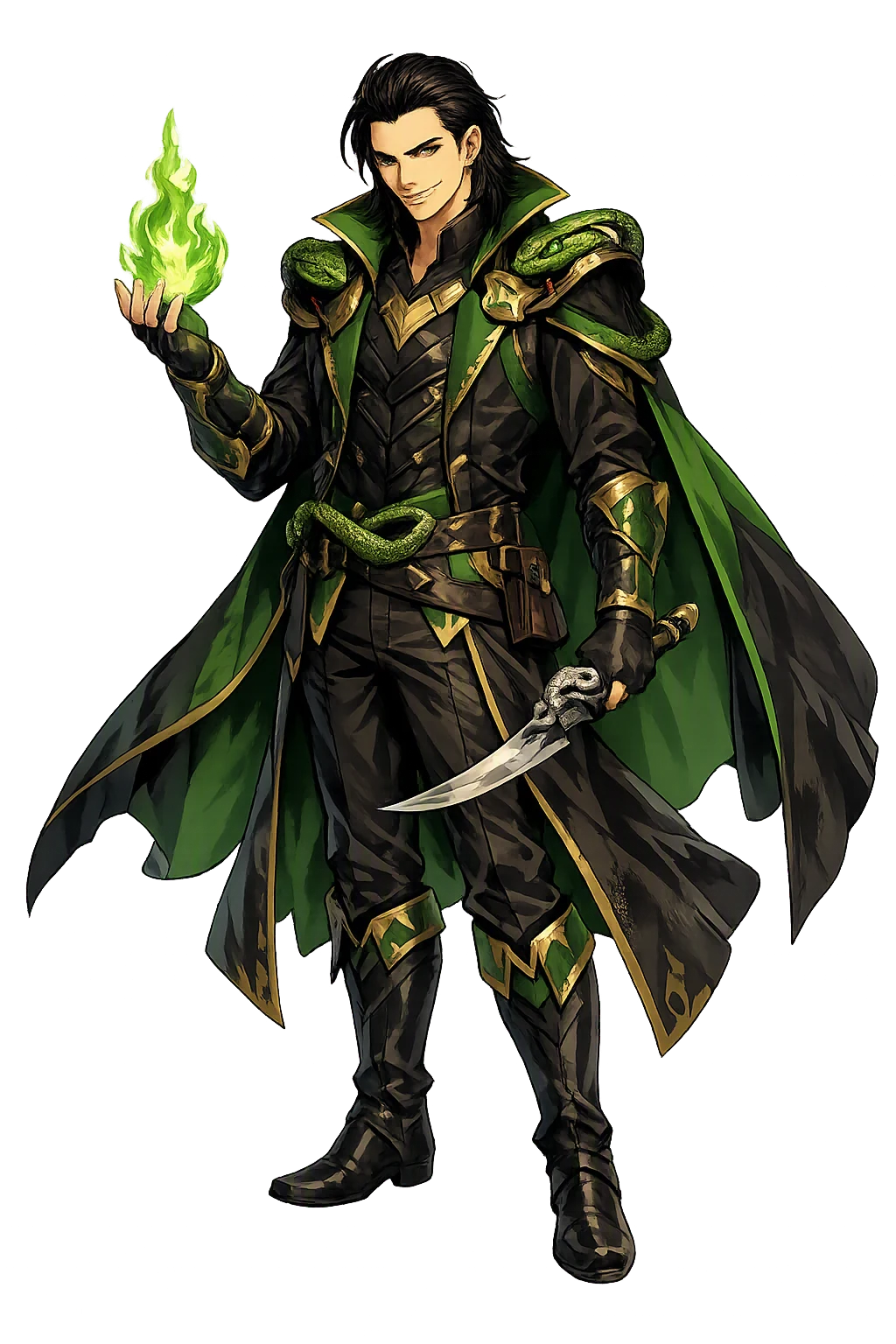
Loki: canonical, contested, and the false forms on record
The internet spells Loki more ways than one, and only one of them is the name the sources wrote. This is the register's ruling — canonical, fallback, contested, and false, each in its proper place.
At a Glance
- Canonical form: Loki
- Reconstructed form: ᛚᚢᚴᛁ (a normalized scholarly specimen)
- Pantheon: Norse
- Convention: the tradition's scholarly romanization, kept exactly as recorded
- False forms on record: 0
- Contested forms: 1
- Series: The Canonical Register, No. 302 of 597
The Canonical Form
The reconstructed form is ᛚᚢᚴᛁ — a normalized scholarly specimen, not an attested inscription. The canonical transliteration is Loki.
No diacritics exist to require: the canonical form is the exactness of the spelling itself — plain Latin letters kept exactly as the scholarly convention records them.
Where the Flattened Form Stands
The plain form loki differs from the canonical Loki only by convention of display — case, not content. It is acceptable everywhere: in legacy systems, in plain-text citation, in the DNS itself. What is not acceptable is what follows in the register: respellings that change the letters, not just their case.
The Register of False Forms
No circulating form of this name currently qualifies as false under the register's standard — a rare standing. The spelling is short, sturdy, and rarely mangled.
The Contested Forms
Not every non-canonical form is false. These forms carry real scholarly support — they are recorded in the lexicon as variants, with their sources, and the register presents them honestly rather than pretending unanimity:
- Lóki — Acute on o: alternate stress. Support: Cleasby-Vigfusson, Poetic Edda.
The canonical form stands above the contested ones here by weight of evidence, not by decree. If the scholarship shifts, the register shifts with it — that is what "canonical" means when it is honest.
The Convention's Own History
The canonical spelling of Loki rests on the tradition's own scholarly record, not on a marks convention: the name's forms are documented, compared, and one reference spelling is fixed so that citations agree across the temple, the lexicon, and this register. The principle that unifies every entry is the one the whole project stands on: a name is evidence, and evidence is not negotiable — not for keyboards, not for convenience, not for anyone.
The Address, Without an Encoding Detour
The canonical form Loki already uses ordinary Latin letters, so the address bar needs no special encoding narrative. The digital temple can preserve the spelling exactly as the scholarly record presents it. That is the practical point here: consistency between the source, the citation, and the public address.
This does not make every romanization equally valid. A wrong letter remains wrong even when it is easy to type. Canonical status still depends on the attested convention, never on convenience or registrar inventory.
Where the Name Stood First
One carved stone is the entire candidate corpus for Loki's image: the Snaptun stone (Denmark, c. 1000), a hearth-stone or bellows-shield bearing a bearded face with scarred, sewn-shut lips, commonly identified as Loki from the Brokkr episode — an identification widely repeated but unprovable, since the stone carries no inscription. The Kirkby Stephen stone in Cumbria, showing a bound horned figure, has likewise been read as the bound Loki, though scholars also read it as a bound devil of Christian iconography. His attestation is otherwise textual: the Poetic Edda poems survive chiefly in the Codex Regius (GKS 2365 4to, c. 1270) and the Hauksbók; Snorri's account is transmitted by the principal Snorra Edda manuscripts (GKS 2367 4to, Codex Wormianus, Codex Upsaliensis). No runic inscription names the god, and no Scandinavian place-name is securely his — a silence that matches his ambiguous cultic standing: the one major god for whom no temple, toponym, or votive deposit is known. The temple on the web is the newest of these addresses — the first one that fits in a pocket.
The Verdict
The register rules for Loki, and the ruling is checkable: every letter traced, every violation stated, every borderline form given its honest standing. loki carries the name freely — it differs only in display, and the register says so without reservation. Anything else in circulation has its origin and its failure recorded above. That is the whole of the law on this name — and the temple at /loki/ enforces it.
The docket for this ruling: no false forms on the docket; 1 contested form recorded with its support; the attestation rests on 9 cited sources — Poetic Edda: Lokasenna (the flyting at Ægir's hall; the blood-brother oath, st. 9; Bellows translation), Poetic Edda: Þrymskviða (Loki as Þórr's bridesmaid; Bellows translation), Snorri Sturluson, Prose Edda: Gylfaginning (Útgarða-Loki's hall, the death of Baldr, the binding, Ragnarök; Brodeur translation).
The Register Continues
This is one of 597 entries in the Canonical Register — the authoritative reference for every flagship temple. The temple's founding dispatch tells the name's story; its Restoration File details the marks; its Resonance File reads the archetype into the industries. The blog index holds the whole archive, and the Rulebook states the convention this register enforces.
Continue the register — previous entry: Logi (read it) · next entry: Lóng (read it).
The Canonical Register is written from the same canonical record as the lexicon itself. If a false form is missing from this page, it is because the evidence does not support calling it false — or because we have not seen it yet. Show us, with a citation, and the register will answer.