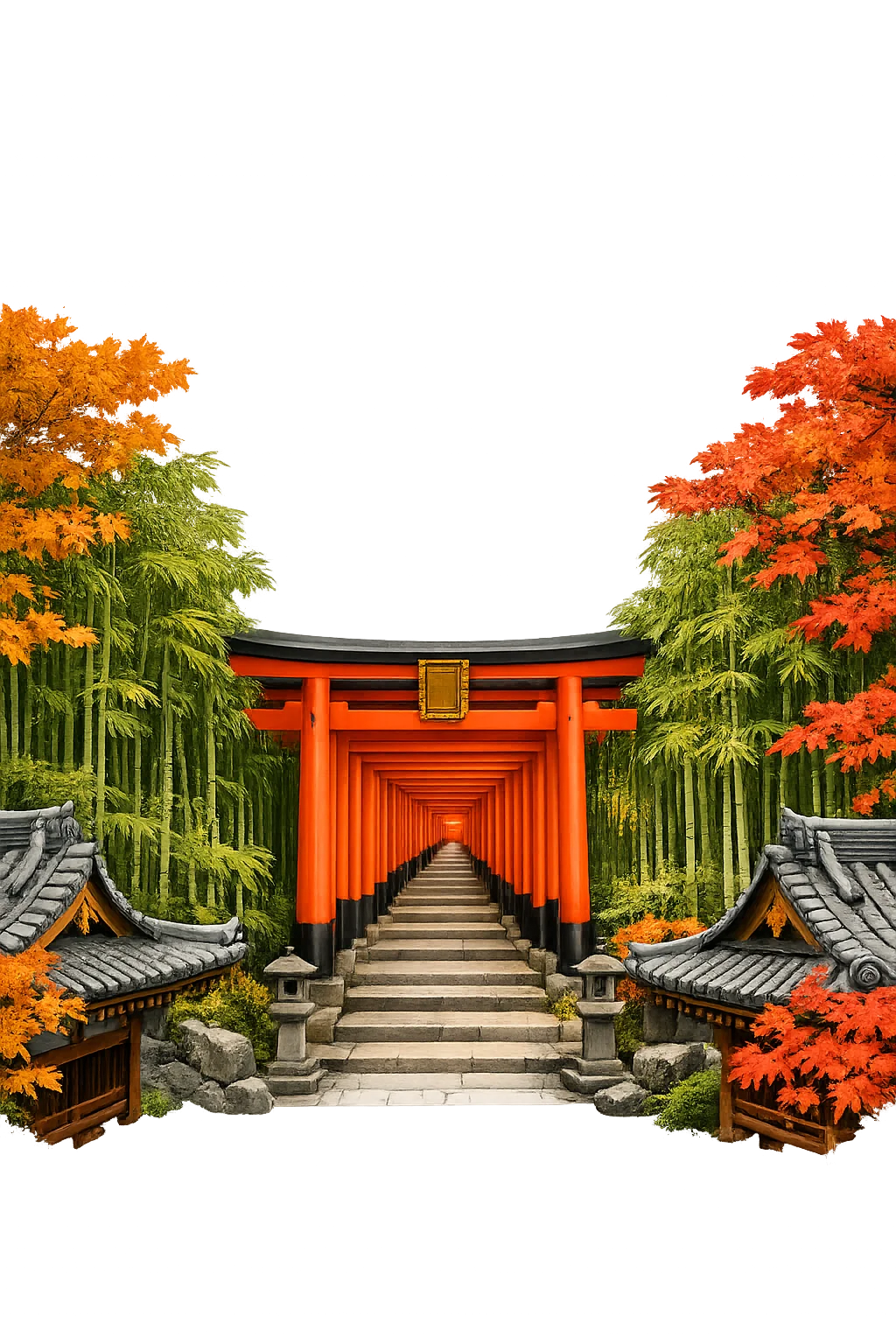
Stories of Kyōto
Kyōto was Japan's imperial capital for more than a thousand years, a city planned according to Chinese geomancy, guarded by shrines at its four directions, and later celebrated as the soul of traditional Japan. Its history is not merely administrative; it is a story of deliberate cosmic placement, aristocratic culture, and survival through war and modernization.
In 794 CE Emperor Kammu moved the court from Nagaoka-kyō to a new site modelled on the Tang-dynasty capital Chang'an, as the Shoku Nihongi (797) records. He named it Heian-kyō, 'Capital of Peace and Tranquillity' — the city we now call Kyōto. The location was chosen with feng-shui geomancy in mind: mountains to the north, east, and west, the Kamo River to the east, and a grid of avenues designed to mirror cosmic order. The great central boulevard aligned the palace with the city's southern gate, so that the emperor sat at the axis of heaven and earth. The founding act was cosmological before it was administrative: the capital was laid out so that the realm would possess a fixed, centered point around which the seasons of rule could turn. That Chinese-inspired grid remains the skeleton of the modern city, a plan older than any building on it.
Kammu enlisted two local clans, the Hata and the Kamo, and established protective shrines at key geomantic points to shield the new capital from malign influences. Matsunoo Taisha and Fushimi Inari guarded the west and south-east, while the Kamo shrines — Shimogamo and Kamigamo — stood to the north; the tenth-century Engishiki lists them among the highest ranks of the realm's shrines. These sanctuaries still anchor Kyōto's sacred geography and are among the seventeen UNESCO World Heritage sites that define the city's historic landscape. The choice set the pattern for a thousand years: the capital's safety was negotiated with the local gods as partners and protectors, not conquered subjects, and the Hata and Kamo lineages who kept the shrines kept a share of the city's soul — and its politics — for centuries.
During the Heian period (794–1185) Kyōto became the stage for a court culture of extraordinary refinement. It was in this city that Murasaki Shikibu composed The Tale of Genji (c. 1000–1012), often called the world's first novel, and that Sei Shōnagon set The Pillow Book, her miscellany of lists, courtiers, and morning glories. Aristocrats competed in poetry, incense, and music; every exchange of fans and guessing of incense blends was at once an art and a policy, and a misplaced word in a poem could end a career. The imperial palace and the nobles' villas turned the city into a work of art as much as a seat of government. No earlier capital anywhere left us its own inner life in prose as rich as the one Genji's Kyōto recorded — the city not just governed but described, feelingly, from inside its own painted screens.
Political power shifted to Kamakura, then Edo, and finally to Tōkyō in 1868, yet Kyōto remained the symbolic heart of Japan. The Ōnin War (1467–1477) burned much of the medieval city — the chronicle Ōnin ki reads as a tragedy of the capital's own children destroying their inheritance — but Kyōto was rebuilt by Oda Nobunaga, Toyotomi Hideyoshi, and the Tokugawa shoguns. Spared from atomic bombing in 1945 and named a UNESCO World Heritage site in 1994, it preserves more pre-modern architecture than any other Japanese city. The city's survival is the real plot of its second millennium: every generation rebuilt the sacred grid after the last burned it, until keeping Kyōto became a national act of memory — the one city Japan agreed, at every turning, not to let die.
Imperial Centre · Buddhist-Shinto Synthesis · Aristocratic Culture
Kyōto was Japan's imperial capital from 794 to 1868, a city laid out on a Chinese grid and guarded by shrines at its four directions. It became the stage on which emperors, aristocrats, monks, and shoguns performed the art of traditional Japan.
Kammu's capital was modelled on Tang Chang'an, with north-south avenues defining a geomantically ordered city.
Kiyomizu-dera, Kinkaku-ji, Shimogamo, and Kamigamo anchor more than a millennium of Buddhist and Shinto culture.
The Way of Tea, Noh theatre, and ikebana were refined here after political power moved to the samurai east.
Nishijin textiles, Kiyomizu pottery, and yuzen dyeing turned Kyōto into a living museum of Japanese artisanship.
From the original script to the living URL
京都
The name in its original Japanese form. Kyōto (京都) is attested in the source tradition — “Capital city”. Its macron-length vowels carry the full phonetic and orthographic weight of the source tradition.
kyoto
Reduced to plain kyoto, the name loses everything that made it specific: macron-length vowels. What remains is an ASCII string that machines can parse but that no longer speaks with its original voice.
Kyōto
The Unicode restoration recovers what ASCII flattened. Kyōto restores macron-length vowels, returning the name to its original written dignity. The domain encodes to Punycode, but the browser displays the truth.
Kyōto.com → xn--kyto-m3a.com
The non-ASCII characters in Kyōto are encoded while the ASCII remains visible. To the DNS, it is Punycode. To humanity, it is Kyōto.
Owned, ideal, and ASCII forms of Kyōto
Kyōto
Restores 京都. The live temple domain — kyōto.com.
kyoto
Flattens 京都. The plain ASCII fallback — what DNS and legacy systems see.
How Kyōto was spoken
How Kyōto travels from ancient script to the modern URL
Japanese 京都 Kyōto; from 京 kyō “capital" + 都 to “metropolis"; the former imperial capital of Japan.
Imperial Capital, Kansai
The Unicode restoration Kyōto preserves the Hepburn macron; the kanji form is not registrable in .com.
The lore you have read is the living myth. Extended Lore opens the scholarly vault beneath it: the cult and its material remains, a history of the image, the name after antiquity, a meditation on what the name still means, and the full scholarly apparatus — etymology, orthography, sources.
Enter Extended Lore