
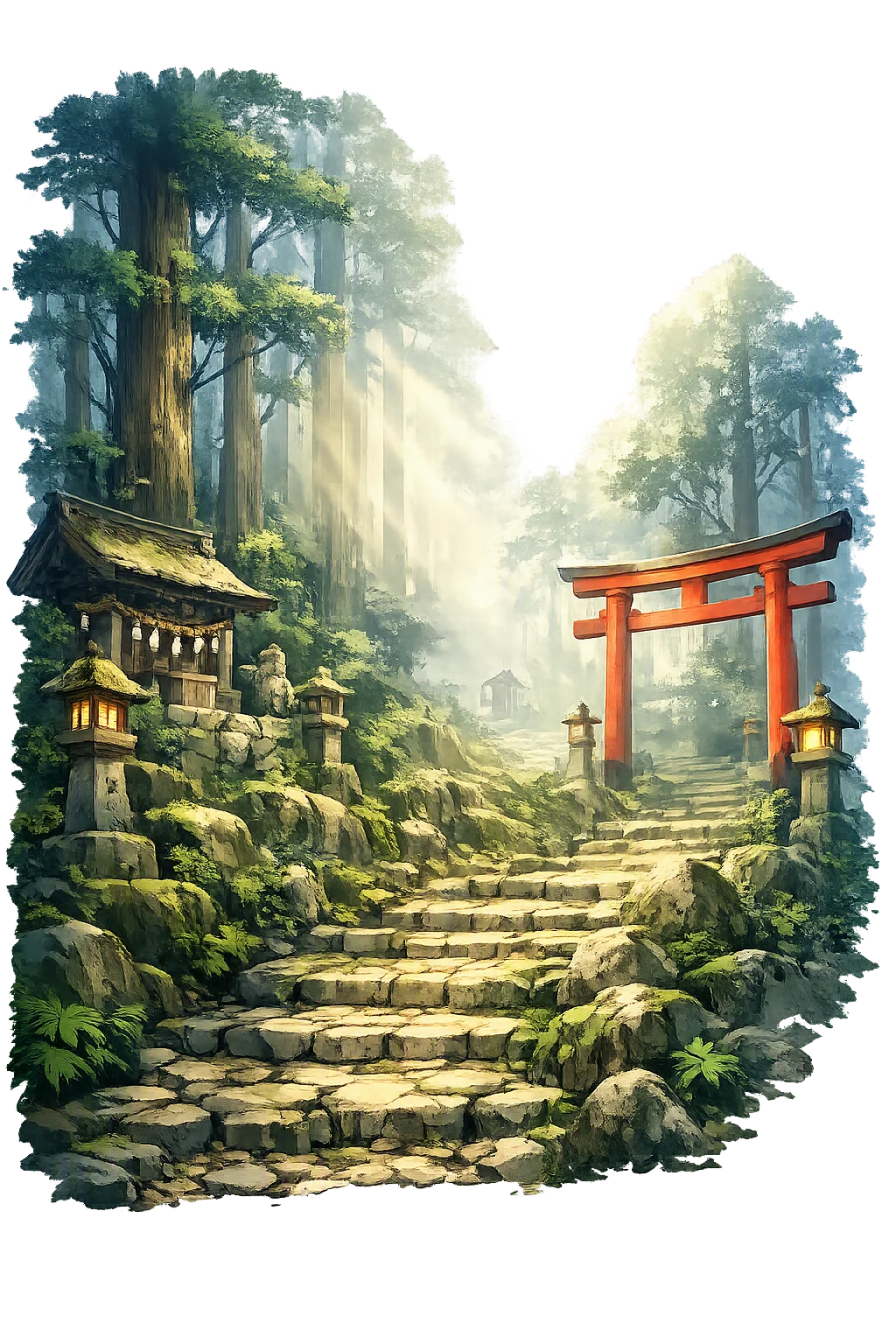
Why Kumano belongs in the scholarly record
A name can be complete without carrying a single diacritic. Kumano is a canonical scholarly spelling, not a damaged form waiting for decoration. This post follows the evidence behind that spelling: the Japanese characters record, the reconstructed sound, the myths, the material culture, and the reasons this particular romanization became the public reference. The plain ASCII letters already contain the whole form. The scholarly work is to prove their provenance, preserve their capitalization, and keep the name attached to its history.
At a Glance
- Canonical name: Kumano
- ASCII form: kumano
- Meaning: "Bear plain"
- Domain of influence: Sacred Region, Three Shrines
- Pantheon: Japanese
- Restoration: ASCII-equivalent form
- Original script: 熊野 (Japanese characters)
Overview
Kumano (kumano) — Sacred Region, Three Shrines · The three Kumano grand shrines — belongs to the Japanese tradition, where it is catalogued under the domain "Sacred Region, Three Shrines". The name means "Bear plain".
Kumano is a mountainous region on the Kii Peninsula that has been sacred for over a thousand years. Its three great shrines — the Kumano Sanzan — drew emperors, aristocrats, and commoners on pilgrimage along the Kumano Kodō. Kumano is a place where dense forest, rushing rivers, and waterfalls create a landscape felt to be inhabited by powerful kami and Buddhas.
PuniCodex records the canonical scholarly spelling Kumano and serves its temple at its temple. The displayed form is ASCII-equivalent — a description computed from the displayed form itself. The plain ASCII form kumano contains the same letters: no recovered diacritics or special encoding is claimed. The work here is consistent citation, capitalization, provenance, and cultural context.
The Name
The name is attested in Japanese characters as 熊野. Etymologically it means "Bear plain".
The canonical spelling Kumano matches the conventional scholarly romanization. The plain ASCII form kumano contains the same letters, so no lost diacritics or encoding transition is claimed. The editorial work is to fix one reviewed reference spelling, preserve capitalization and provenance, and keep the original evidence visible. The displayed form is ASCII-equivalent — a description computed from the displayed form itself.
The letter-by-letter transformation runs:
- k → K — Same, capitalized
- u → u — Same
- m → m — Same
- a → a — Same
- n → n — Same
- o → o — Same
The Original Script
The name is written in Japanese characters as 熊野. That attested script remains the primary evidence for the conventional romanization Kumano. The canonical Latin spelling does not pretend to recover marks it never contained: it fixes one reviewed reference form while leaving the original script visible for comparison.
熊野 — 熊 'bear' + 野 'field, plain' — is a descriptive toponym with no divine bearer: no Kojiki kami bears the name Kumano. The chronicles know the district as a remote mountain country of exile and retreat, and the Man'yōshū already carries poems on its landscape. The three shrines — Hongū, Nachi, Hayatama — enter the documentary record in the early medieval period, and the Kumano pilgrimage's 'ant processions' of the twelfth and thirteenth centuries made the name a synonym for the journey to the other world.
Pronunciation
The reconstructed pronunciation of the name is /kɯ.ma.no/ — Modern Standard Japanese (Hepburn).
Phoneme by phoneme:
- Ku- — Voiceless velar stop [k] plus close back unrounded [ɯ]; from 熊 'bear'
- -ma- — Bilabial [m] plus open central [a]
- -no — Alveolar nasal [n] plus open-mid [o]; from 野 'plain/field'
For the modern speaker, the closest approximation is: 'KOO-mah-noh' — three even syllables, with the first vowel soft and back.
Kindred and historical forms of the name:
- Japanese — 熊野 (Kumano), 'Bear Plain,' a sacred region in the Kii mountains
- Shrines — Kumano Sanzan: Hongū, Hayatama, and Nachi
- Pilgrimage — The Kumano Kodō, a network of ancient pilgrimage routes
Kumano keeps its restoration plain: plain Hepburn. Its significance is geographic, ritual, and symbolic rather than orthographic.
Mythology
Kumano's mythology blends imperial foundation legend, mountain asceticism, and the medieval fusion of kami and Buddha. Its sources are chronicle, mandala, and ritual text rather than epic, and its stories are walked as much as told: the crow who guided an emperor, the hermits who heard sermons in waterfalls, and the retired sovereigns who came on foot to meet them.
Yatagarasu and Emperor Jimmu (Imperial legend)
When Emperor Jimmu, the first emperor of the chronicles, led his eastern expedition into the mountains of Kumano, his army lost its way among the peaks. The Kojiki and Nihon Shoki tell that the heavenly gods sent Yatagarasu, a great three-legged crow, to guide him: it flew before the host as a living arrow, and Jimmu emerged from the mountains to claim Yamato. The tale plants the imperial founding inside Kumano's forests and makes the crow — black, solar, three-footed — the sign of divine guidance through wilderness. A thousand years later the mountain shrines still claimed that protection: emperors did not command Kumano, they visited it, and the crow they had followed remained the region's emblem. Guidance through trackless country is Kumano's first gift, and Japan still uses it — the three-legged crow stands on the crest of the national football association.
Mountain Asceticism (Shugendō)
Kumano became the greatest mountain center of Japan's ascetic tradition, Shugendō. Its legendary founder, En no Gyōja, was said to have wandered the Kii peaks in the seventh century working miracles; by the Heian period the yamabushi — 'those who lie down in the mountains' — walked the Kumano Kodō in straw sandals, performed cold-water ablutions beneath Nachi's falls, and sought visions in the cedar dark. They understood the mountains not as scenery but as a mandala: every peak a deity, every waterfall a sermon. The sources for this layer are late and hagiographic, but the practice they describe is real and documented for over a millennium: to enter Kumano was to enter a realm where the boundary between the human and the divine wore thin, and discipline was the price of crossing it.
The Court Comes on Foot (Heian period)
From the tenth century the court itself came. Retired Emperor Uda opened the fashion with pilgrimages in the early 900s; by the late Heian age the journey to Kumano had become the highest form of aristocratic devotion, and the retired Emperor Go-Shirakawa is said to have made it some thirty times. These were not retreats but processions — hundreds of riders, boats up the coast, poetry composed at each shrine — yet they ended in mountain humility. Court diaries and shrine records preserve the pattern in detail, and the routes they used still run under the cedars. Pilgrimage was politics performed on foot: every journey bound the imperial house more tightly to the mountains' protection, and broadcast to anyone watching from the pilgrimage roads that the sovereign's power was rooted in the gods of the land.
Kami and Buddha in the Mountains (Sacred union)
In the medieval theology of honji-suijaku, 'original ground and local manifestation,' Kumano's kami were declared the local appearances of Buddhas: Hongū's deity was Amitābha, Hayatama's Śākyamuni, Nachi's the waterfall-god Hiryū Gongen, read as an emanation of Kannon. Painted Kumano mandalas show the mountain shrines floating as a Buddhist paradise, the Nachi falls descending like a golden thread of the bodhisattva's compassion. Pilgrims too old or poor to walk could gaze on the mandala and receive the same merit — one famous print added the words, 'those who see this picture will be born in the Pure Land.' The synthesis was not a trick but a theology: the local gods had always been Buddhas in disguise, waiting for the teaching to say so. When the Meiji state forcibly separated the two religions in 1868, Kumano kept both memories — the kami's names and the Buddhas' faces — in a single landscape.
Symbols & Iconography
The iconography associated with Kumano concentrates in a small set of recurring attributes, each a compressed statement about the name:
- Three-legged crow (Yatagarasu) — The divine guide who led Emperor Jimmu through the mountains
- Nachi Falls — The sacred waterfall and the deity of water and longevity
- Cedar forest — The ancient trees through which pilgrims walked
- Stone markers and oji — The sub-shrines and markers along the Kumano Kodō
Archaeology & Evidence
The Kumano Sanzan (Kumano Hongū Taisha, Kumano Hayatama Taisha, Kumano Nachi Taisha) and the Kumano Kodō pilgrimage routes preserve a landscape of shrines, stone pavements, ritual sites, and Nachi Falls. Archaeological and architectural study documents the region's importance from the Heian period onward.
Realm & Domain
Kumano is a mountainous region on the Kii Peninsula that has been sacred for over a thousand years. Its three great shrines — the Kumano Sanzan — drew emperors, aristocrats, and commoners on pilgrimage along the Kumano Kodō. Kumano is a place where dense forest, rushing rivers, and waterfalls create a landscape felt to be inhabited by powerful kami and Buddhas.
Kumano Sanzan
The three shrines of Hongū, Hayatama, and Nachi form a unified sacred complex.
Kumano Kodō
Ancient pilgrimage routes, now a UNESCO World Heritage site.
Nachi Falls
Japan's tallest waterfall, worshipped as the dwelling of a kami.
Imperial Pilgrimage
Emperors and retired emperors made repeated pilgrimages to Kumano.
Across Cultures
Kumano is a classic case of shinbutsu shūgō, the medieval fusion of Shinto and Buddhism. The Kumano shrines housed Buddhist temples, and the kami were identified with Buddhist divinities. The region also absorbed Shugendō practices, making it a threefold meeting ground of kami worship, Buddhism, and mountain asceticism. The Meiji separation of Shinto and Buddhism stripped away the Buddhist layers, but the landscape retains its hybrid memory.
Kindred figures in the PuniCodex cross-tradition index include Delphoí, Fuji, Ise, Nagoya, Omphalós, and Shikoku, each linked through sacred center / world navel / axis mundi.
Cultural Legacy
The Kumano Kodō and Kii mountain shrines were designated a UNESCO World Heritage site in 2004. Modern pilgrims continue to walk the ancient routes, and Kumano remains a powerful symbol of spiritual journey in Japan. The three-legged crow appears on the logo of the Japan Football Association, tracing its lineage back to Jimmu's guide.
The Scholarly Record
The account of Kumano given in this edition rests on the witnesses and reference works listed below. Lexica and etymological dictionaries secure the form and meaning of the name; the literary and religious texts supply the narrative evidence.
- Kojiki (712) and Nihon Shoki (720), Jimmu and Yatagarasu episodes.
- UNESCO, Sacred Sites and Pilgrimage Routes in the Kii Mountain Range (World Heritage listing, 2004).
- Kumano shrine records and medieval Kumano mandalas.
- Grapard, R. D., The Protocol of the Gods (1988).
A Meditation
Kumano asks us to walk. The pilgrimage is not a metaphor but a practice: each step through the cedar forest is a step away from ordinary life and toward encounter — with the kami in the waterfall, with the self under fatigue, with the crow that still guides those who are lost. For a thousand years the route made emperors humble: the most powerful men in Japan removed their shoes and climbed. Kumano's lesson is that the sacred is not a doctrine but a geography, and that renewal is something you approach on foot, season after season, one honest pilgrimage at a time.
The Canonical Spelling
Kumano is the canonical spelling used by this temple. The plain ASCII form kumano contains the same letters, so there are no lost diacritics to recover and no special encoding transition to explain. What the temple preserves is the reviewed reference form: capitalization, conventional romanization, original evidence, and a stable place to inspect them. The value here is not added decoration; it is fidelity to the attested record.
Character by Character
The canonical form Kumano and the plain ASCII form kumano share the same letters. The character list therefore documents continuity rather than recovery: every character is carried forward deliberately, with capitalization serving as the proper-noun convention. No additional mark is inserted merely to make the restoration appear more elaborate.
The Japanese Pantheon
Kumano is one of 45 entries the PuniCodex lexicon catalogues under the Japanese pantheon. The Pantheon page gathers the tradition's major figures in one place, and the Lexicon lets you filter all 983 restorations by tradition or script — the fastest way to see where this name sits among its kin.
Frequently Asked Questions
What does Kumano mean? The traditional gloss is "Bear plain."
Which tradition does Kumano belong to? Kumano is catalogued in the Japanese pantheon of the PuniCodex lexicon.
Does this name need recovered diacritics? No. Kumano is already an ASCII-form canonical spelling. The scholarly work is to preserve the attested convention and its evidence, not to add marks.
Can I use Kumano in a normal browser? Yes. The spelling works directly in an ordinary browser, and the type tool can confirm and copy the canonical form.
Where does the scholarly information come from? The entry is built from lexica, inscriptional evidence, and reviewed scholarly sources listed in the Scholarly Edition.
Typing Kumano
You do not need a special keyboard to use this name. Kumano already uses ordinary Latin letters. The PuniCodex Type Tool lets you confirm the canonical spelling and copy it cleanly, while the original-script notes in the temple show the evidence behind the romanization.
Sister Temples
Other temples in the Japanese pantheon include Inari, Kannon, and Nagoya — each with its own restoration story, its own scholarly record, and its own place in the lexicon.
Why This Record Matters
Recording Kumano accurately is part of a larger effort to make the web more faithful to the names it carries. This spelling needs no recovered marks; it needs a defensible chain of evidence. The script, sound, myths, and material record converge on the same point: the canonical form is information, and information deserves an address of its own. The temple keeps that address connected to the scholarship that justifies it.
Explore Further
This post is one doorway into the temple. The home page carries the full character breakdown and the ambient canvas; the lore page tells the myths in long form; the Scholarly Edition preserves the sources, pronunciation data, and revision history; and the patron wall supports the restoration directly. For the wider map, browse the Lexicon, explore the Pantheon, or return to the PuniCodex blog.
A Closer Look at the Spelling
A canonical name is a small map. In the case of Kumano, the route does not lead through diacritics or special letters, because the conventional scholarly spelling already uses the Latin alphabet. The original evidence — 熊野 in Japanese characters — carries semantic and phonetic information that no romanization can fully reproduce.
By fixing one reviewed spelling as the public reference, the project prevents the drift that occurs when a name is romanized differently in every article, map, and database. The character list shows exactly what is carried forward. "No change" here means a deliberate choice to keep the name stable, searchable, and faithful to the record.
Kumano in Its Tradition
Kumano does not stand alone. It belongs to the Japanese tradition, where it is counted among 45 names in the PuniCodex lexicon. Its sphere — Sacred Region, Three Shrines — places it beside other figures who govern similar aspects of experience. The canonical spelling keeps the name in the company of its kin and gives researchers one stable reference across the temples, the APIs, and the scholarly record.
What You Will Find in the Temple
The temple page for Kumano is more than a landing page. The home tab presents the character breakdown, pronunciation guide, and digital address. Lore gathers the myths and narratives that give the name its depth. The Art room brings together the historical collection, Commons works, and Creatives. The Scholarly Edition publishes the sources, variant forms, and review history that justify the canonical spelling.
Industry patterns show where the name appears in modern commerce and culture, while the patron wall lets visitors support the work directly. Each surface is generated from the same canonical sources, so the temple, the blog, the scholars page, and the search index agree.
The Canonical Name on the Live Web
A digital address is a kind of publication. When Kumano resolves, it proves that the canonical spelling is not a theoretical exercise; it is a working reference on the public internet. Search engines can index it, language models can encounter it, and anyone who copies it from a manuscript can paste it into a browser.
The address already uses Latin letters, so there is no special encoding narrative to tell. Its practical value is continuity: the same reviewed form appears in the temple, the lexicon, the API, and the address bar.
Related Names
Sources
The full scholarly apparatus — every citation, revision, and review — lives in the Scholarly Edition. Key references for this post:
- Kojiki (712) and Nihon Shoki (720), Jimmu and Yatagarasu episodes.
- UNESCO, Sacred Sites and Pilgrimage Routes in the Kii Mountain Range (World Heritage listing, 2004).
- Kumano shrine records and medieval Kumano mandalas.
- Grapard, R. D., The Protocol of the Gods (1988).
- Lexicon authorities for this entry: Kojiki, Nihon Shoki.