
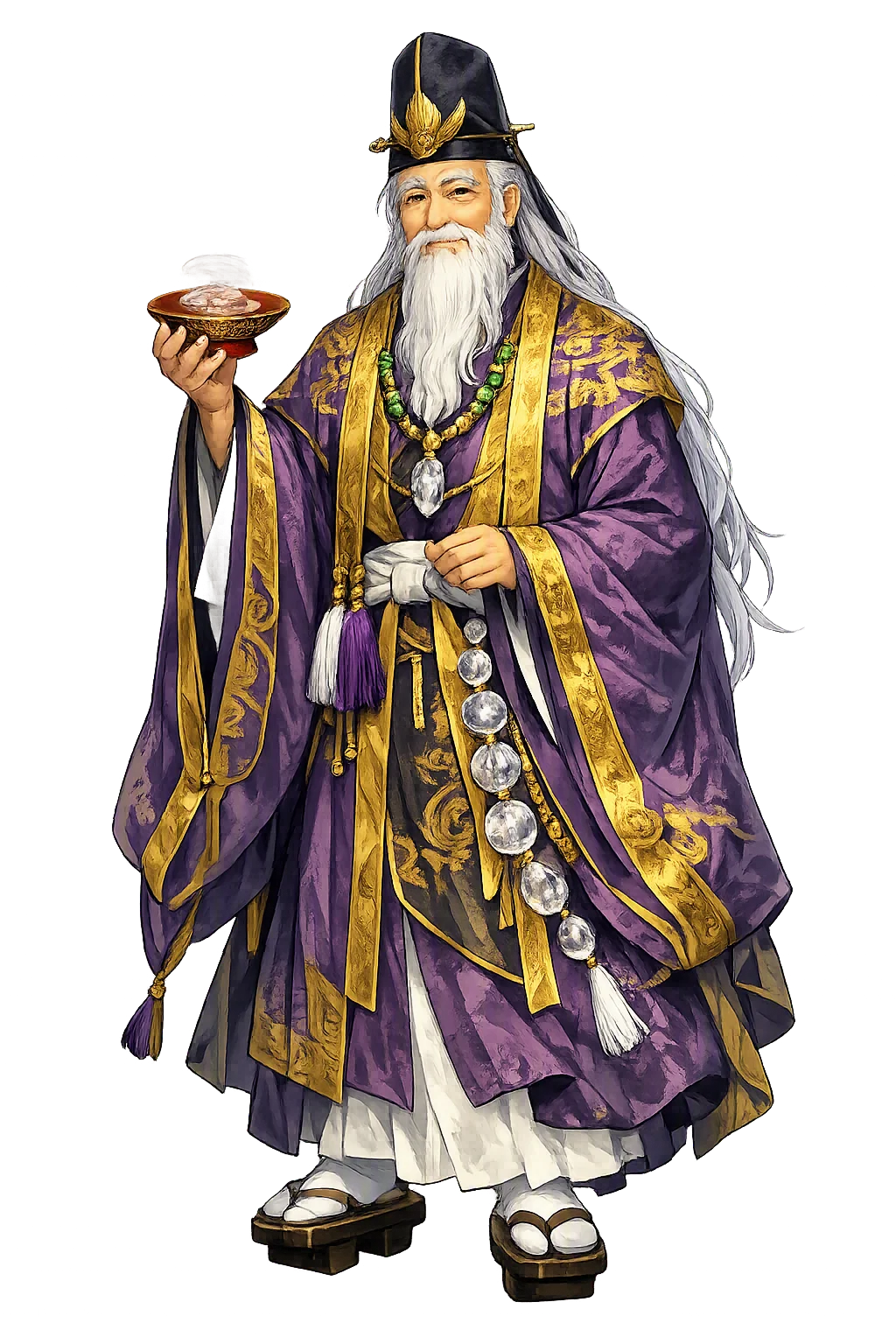
Why Kotoshironushi is spelled that way — and what it costs to get it right
There is a version of this name the early internet had to settle for: kotoshironushi. This is the file on how Kotoshironushi replaced it.
Kotoshironushi’s mythology is brief but pivotal: as a son of Ōkuninushi, ruler of the earthly kami, he advised the peaceful cession of the land to the heavenly line of Amaterasu and then withdrew from the world. His “hiding” let the imperial succession begin without the annihilation of the old order, and later ages gathered his memory into Ebisu, the beloved god of fishermen and merchants.
At a Glance
- Restored name: Kotoshironushi
- ASCII form: kotoshironushi
- Meaning: "Lord who substitutes"
- Domain of influence: Oracles, Fishing
- Pantheon: Japanese
- Classification: Tier 2
- Original script: 事代主神
- Series: The Restoration Files, No. 265 of 548
The Name Before the Marks
The name is attested as 事代主神, as Kojiki — the land-transfer episode (Ōnamuchi, Takeminakata, and the counsel of Kotoshironushi) and Nihon Shoki — the parallel account; the oracle age of Emperor Sujin record. On the evidence, it means "Lord who substitutes".
Spoken, the name runs `/ko.to.ɕi.ɾo.nɯ.ɕi/` — 'KOH-toh-shee-roh-noo-shee' — the 'r' is a light tap, and the final vowels are soft.
The Temple That Stands Now
The restored name is not a plaque; it is an address. The temple of Kotoshironushi lives at /kotoshironushi/, with its mythology in the lore halls, its peer-reviewed record in the Scholarly Edition, and its place in the pattern atlas on the patterns floor.
The restoration keeps one feature the ASCII form drops. One is enough to matter, and the label says so plainly: Tier-2.
Where the Name Stood First
Ōmiwa Jinja in Sakurai, Nara prefecture — among the oldest shrine sites in Japan — faces Mount Miwa directly, the mountain itself revered as the shintai, the divine body of the god; no main hall stands between worshipper and peak. The site’s antiquity is supported by third-century Chinese chronicles, which attest the political prominence of the Yamato region’s great shrine cults, and by the dense concentration of kofun burial mounds in the Miwa area. At the other pole of his myth, Suwa in Nagano preserves the Takeminakata cult that the land-transfer story left behind. Nishinomiya Shrine’s Ebisu identification took its present form in the early modern period, but the shrine claims older precedent, and the Tōka Ebisu rite is documented from the Edo period onward. The temple on the web is the newest of these addresses — the first one that fits in a pocket.
The Archetype at Work
The pattern atlas seats this temple in 3 industries, each match argued and weighted: Maritime, Shipping & Ocean Industries (the oracular kami of fishing who yields the sea's knowledge along with its catch.); Faith & Spiritual Organizations (the oracular kami enshrined at Izumo and beyond; divination and sacred proxy are acts of faith.); Astrology, Tarot & Esoteric Services (the kami of oracles and hidden knowledge; divination is his original craft.). The Resonance File reads those seats through the myths themselves.
In the Sacred Texts
The Japanese tradition is not a vibe; it is a library. The Sacred Texts collection holds Kojiki and Nihon Shoki — the primary sources the temple's scholarship is built on. The temple is the argument; the texts are the evidence.
The File Continues
The temple's founding dispatch tells the name's story; its Resonance File reads the myths into the industries; the blog index holds the whole archive.
Continue the series — previous file: Kǒngzǐ (read it here) · next file: Krátos (read it here).
The Restoration Files are written from the same canonical record as the temples themselves: the lexicon, the lore catalog, the pattern atlas, and the cited scholarly sources. If a file ever disagrees with its temple, the temple is right — tell us, and the file will be corrected.