
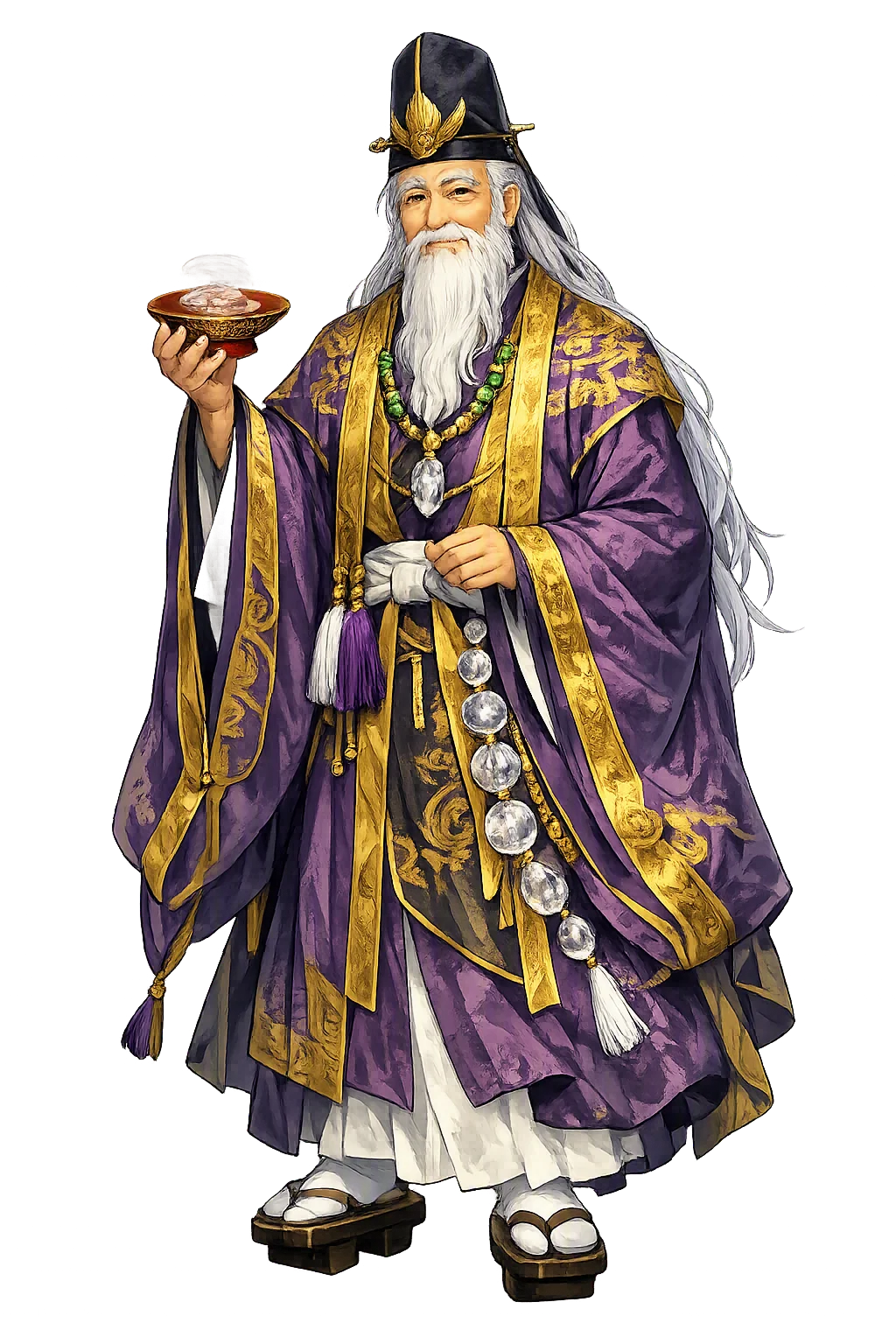
Where Kotoshironushi works now: the myths behind the markets
The myths did not retire. They moved offices. This is the file on where Kotoshironushi works now.
Kotoshironushi’s mythology is brief but pivotal: as a son of Ōkuninushi, ruler of the earthly kami, he advised the peaceful cession of the land to the heavenly line of Amaterasu and then withdrew from the world. His “hiding” let the imperial succession begin without the annihilation of the old order, and later ages gathered his memory into Ebisu, the beloved god of fishermen and merchants.
The pattern atlas — which maps every flagship temple to the industries its archetype demonstrably resonates with, each match argued and open to challenge — seats this temple in 3 industries. This file reads those seats the way they were earned: through the myths.
At a Glance
- Temple: Kotoshironushi
- Pantheon: Japanese
- Domain of influence: Oracles, Fishing
- Pattern seats: 3
- Sectors touched: Energy & Natural World · Society & Spirit
- Strongest seat: Maritime, Shipping & Ocean Industries
- Series: The Resonance Files, No. 265 of 548
The Myth at Work
The Cession of the Land. Amaterasu resolved that her grandson Ninigi should rule the central land of reed plains, and sent the warrior god Takemikazuchi to compel its ruler, Ōnamuchi — Ōkuninushi — to yield. Ōkuninushi’s son Takeminakata answered the embassy with defiance, was defeated in a trial of strength, and fled across the sea to Suwa. — that is not just a story. It is a business model, four thousand years early.
The God Who Hides. The Nihon Shoki’s parallel account deepens both the withdrawal and the genealogy: it names Kotoshironushi’s mother a child of the sea deity, binding him to Watatsumi’s watery realm, and dwells on the hiding itself — the kakuremi by which the god of the old dispensation removes himself so that the new one can begin. Japanese scholarship has long read the “hiding kami” as the mythic signature of cults that withdrew from the political centre: deities who lost the argument survived by retreating into oracles, mountains, and the sea, keeping a voice precisely by surrendering a throne. — hold that image; the industries below are where it goes to work.
The Seats
Each of these is argued in the atlas with a weight and a why-line. What the atlas cannot fit in one line is the whole myth — so here is each seat with its story restored.
Maritime, Shipping & Ocean Industries
Shipping, ports, fishing, and ocean exploration. (Sector: Energy & Natural World)
The oracular kami of fishing who yields the sea's knowledge along with its catch. — the atlas stops there, out of discipline. The myth keeps going: the function Kotoshironushi performs in the stories is precisely the function this industry sells.
Faith & Spiritual Organizations
Religious institutions, faith media, and devotional services. (Sector: Society & Spirit)
The why-line says it in one breath: The oracular kami enshrined at Izumo and beyond; divination and sacred proxy are acts of faith. That is not a resemblance; it is the same act, performed in a newer building.
Astrology, Tarot & Esoteric Services
Astrology apps, tarot, and spiritual guidance. (Sector: Society & Spirit)
The kami of oracles and hidden knowledge; divination is his original craft. Swap the costume and the sentence is indistinguishable from the myth. That is what a resonance seat means.
The Long Employment
Kotoshironushi is rarely worshipped under his own name today, but his legacy is everywhere in January: Ebisu, his smiling later form, presides over the first business of the year at shrines from Nishinomiya to Osaka’s Imamiya. The Tōka Ebisu festival draws millions of merchants and fishermen who buy lucky bamboo to invite prosperity into the new year. The age changed. The work did not.
The Method, Stated Plainly
None of this is numerology. A seat exists only where the match can be argued from the deity’s documented domains and deeds — weighted, published, and falsifiable. The derivation, the weights, and the challenge process are public on the methodology page. If a seat in this file reads wrong, the atlas itself tells you how to prove it — and the correction becomes part of the record.
For the Ones Who Work There
If you work in maritime, shipping & ocean industries, faith & spiritual organizations, or any trade this temple holds a seat in, this is the honest version of what a placement means: your industry beside the story it has been re-telling all along — on the temple floor itself, before an audience that came specifically to read it. The patron tier and the advertising terms describe the mechanics; the resonance above describes the fit.
The File Continues
One of 548 Resonance Files — the series where the pantheon goes to work. Read the founding dispatch for the name, the Restoration File for the spelling, or the whole archive end to end.
Continue the series — previous: Kǒngzǐ (read it) · next: Krátos (read it).
The Resonance Files are argued from the same canonical record as the pattern atlas itself: the lexicon, the lore catalog, and the cited sources. Every seat can be challenged at the methodology page — and the challenge is the point.