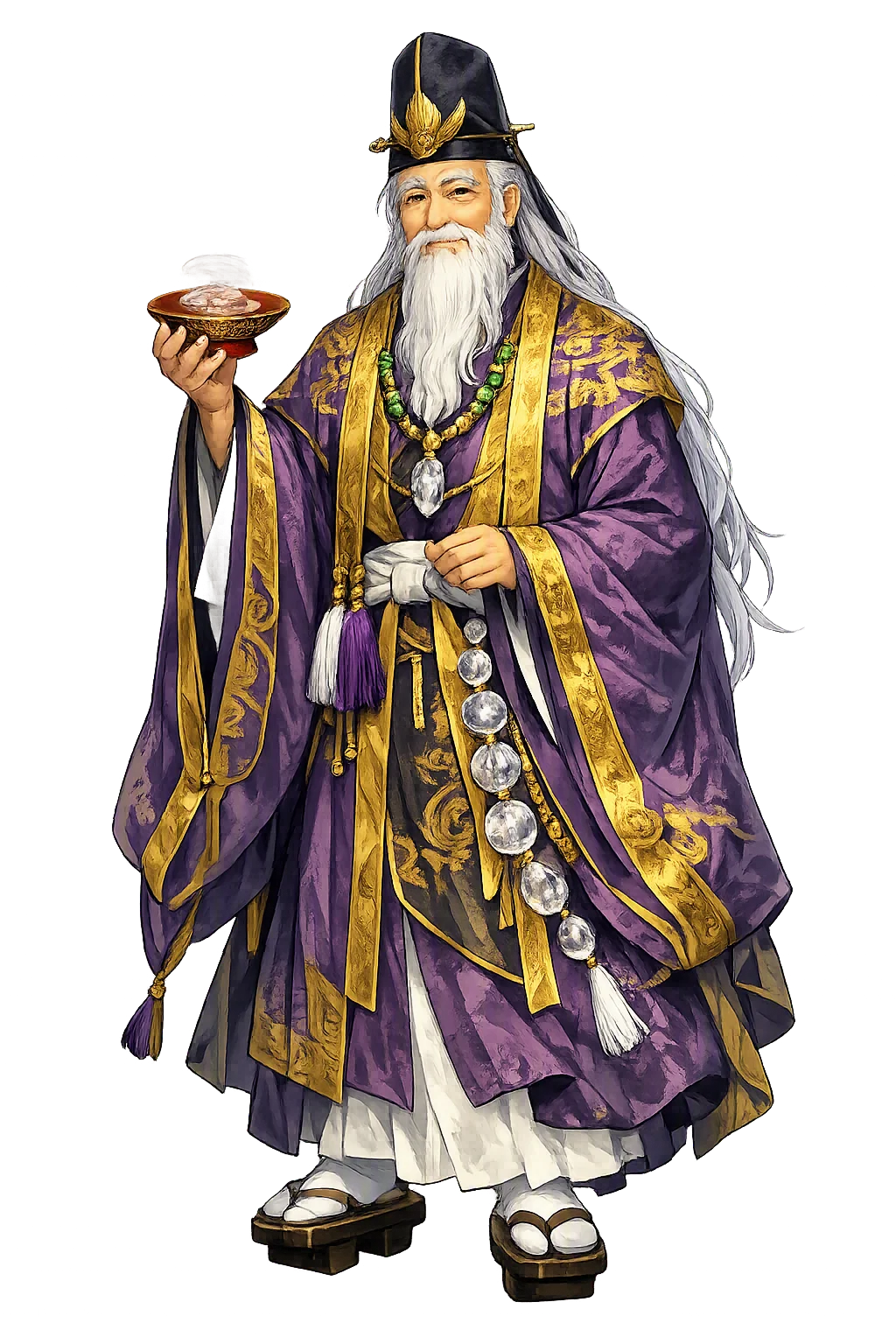
Stories of Kotoshironushi
Kotoshironushi’s mythology is brief but pivotal: as a son of Ōkuninushi, ruler of the earthly kami, he advised the peaceful cession of the land to the heavenly line of Amaterasu and then withdrew from the world. His “hiding” let the imperial succession begin without the annihilation of the old order, and later ages gathered his memory into Ebisu, the beloved god of fishermen and merchants.
Amaterasu resolved that her grandson Ninigi should rule the central land of reed plains, and sent the warrior god Takemikazuchi to compel its ruler, Ōnamuchi — Ōkuninushi — to yield. Ōkuninushi’s son Takeminakata answered the embassy with defiance, was defeated in a trial of strength, and fled across the sea to Suwa. Then the Kojiki slows for the decisive interview: Ōkuninushi asked his son Kotoshironushi what should be done. Kotoshironushi answered that the land should be given up to the heavenly grandchildren, and — his counsel accepted — he withdrew into concealment, kakuremi, and “the land was then at peace.” His mother, the Kojiki adds, was Hayaakitsuhime, a daughter of the sea deity Ōwatatsumi, which is why his disappearance ran seaward. By choosing counsel over resistance, one son of the old order ended a war that his brother’s arms could not have won — and the mythology marks the cost exactly: the surrendering god simply vanishes from the story he made possible.
The Nihon Shoki’s parallel account deepens both the withdrawal and the genealogy: it names Kotoshironushi’s mother a child of the sea deity, binding him to Watatsumi’s watery realm, and dwells on the hiding itself — the kakuremi by which the god of the old dispensation removes himself so that the new one can begin. Japanese scholarship has long read the “hiding kami” as the mythic signature of cults that withdrew from the political centre: deities who lost the argument survived by retreating into oracles, mountains, and the sea, keeping a voice precisely by surrendering a throne. The theme recurs across the early chronicles — gods who conceal themselves and must be lured, cajoled, or divined back into relationship with the court. Kotoshironushi is the purest case: he is the patron of every defeated thing that refuses to die, and his entire myth is an exit that turned out to be a survival.
His very name — 事代主, “lord who substitutes for the matter” — was read by later generations as a title of the oracular god: the one who speaks the divine word in place of another, and so “substitutes” for the hidden deity behind the message. Shrine tradition around Ōmiwa, at the foot of Mount Miwa in Nara prefecture — one of the oldest sanctuaries in Japan, where the mountain itself is the sacred body of the god — links his lineage to the Miwa cult, through which the will of the kami was delivered to the court by divination and trance. Some scholars have gone further and proposed identifying Kotoshironushi with Ōmononushi, the great kami of Miwa itself; the identification remains a hypothesis, but a telling one. In the Nihon Shoki’s age of oracles, the troubled reign of Emperor Sujin — plagues, failed harvests, and divine warnings that had to be sought and obeyed — taught that neglected gods of the land would speak until properly housed. Kotoshironushi’s specialty is precisely that: being the voice of the one who is absent.
By the medieval and early modern centuries, the hidden god had resurfaced as the most approachable of deities. The great shrine of Nishinomiya in Hyōgo prefecture identifies its kami with Kotoshironushi and calls him Ebisu — “the prosperous guest” — the smiling god who carries a fishing rod and a red sea bream, the tai whose name puns on medetai, “auspicious.” Every January the shrine fills with merchants and fishermen for the Tōka Ebisu festival, when visitors buy lucky bamboo grass and invite the god of the new year into their shops and boats. Among the Seven Gods of Fortune, Ebisu is the only one worshipped purely as a native kami, without Buddhist, Daoist, or foreign pedigree. The transformation is one of the neatest survivals in Japanese religion: the son who advised his father to surrender an empire became the guest who blesses a shopkeeper’s ledger. The old order lost the land — and won the marketplace.
Oracle, Fishing, and the Transfer of the Land
Kotoshironushi is the son of Ōkuninushi who, according to the Kojiki, surrendered the central land of reed plains to the heavenly descendants of Amaterasu. A god of oracles and fishing, he withdrew to the sea and became identified in later tradition with the fortune god Ebisu.
His counsel ceded the land of reed plains to the heavenly grandchildren — the surrender that founded imperial rule without a war of extermination.
His name means “lord who substitutes”: the voice that speaks the divine will when the god himself is hidden.
A grandson of the sea deity Ōwatatsumi, he withdrew toward the water and became patron of its catches.
Nishinomiya’s Ebisu — rod and red tai in hand — is his smiling later face, the only purely Japanese god among the Seven Gods of Fortune.
From the original script to the living URL
事代主神
The name in its original Japanese form. Kotoshironushi (事代主神) is attested in the source tradition — “Lord who substitutes”. Its original diacritics and script distinctions carry the full phonetic and orthographic weight of the source tradition.
kotoshironushi
The plain kotoshironushi form is identical to the Unicode restoration. Because this name is already written in Latin letters, no diacritics, stress, or script information were lost — only capitalization differs.
Kotoshironushi
The Unicode restoration does not need to recover lost marks for Kotoshironushi. Its value is canonical spelling and consistent cataloguing, not the reconstruction of erased orthography. The domain is readable as-is to both DNS and humanity.
Kotoshironushi.com
This restoration is written entirely in ASCII letters — no Punycode encoding stands between Kotoshironushi and the DNS. The domain reads identically to machines and to human eyes.
Owned, ideal, and ASCII forms of Kotoshironushi
Kotoshironushi
Restores 事代主神. The full Unicode restoration. kotoshironushi.com is not in the PuniCodex collection — it is watched for release; if it drops, this temple upgrades to an owned flagship.
How Kotoshironushi was spoken
How Kotoshironushi is preserved in writing
A bespoke provenance study for Kotoshironushi is being prepared by the PUNICODEX scholarly team.
Contribute scholarly provenance →The lore you have read is the living myth. Extended Lore opens the scholarly vault beneath it: the cult and its material remains, a history of the image, the name after antiquity, a meditation on what the name still means, and the full scholarly apparatus — etymology, orthography, sources.
Enter Extended Lore