
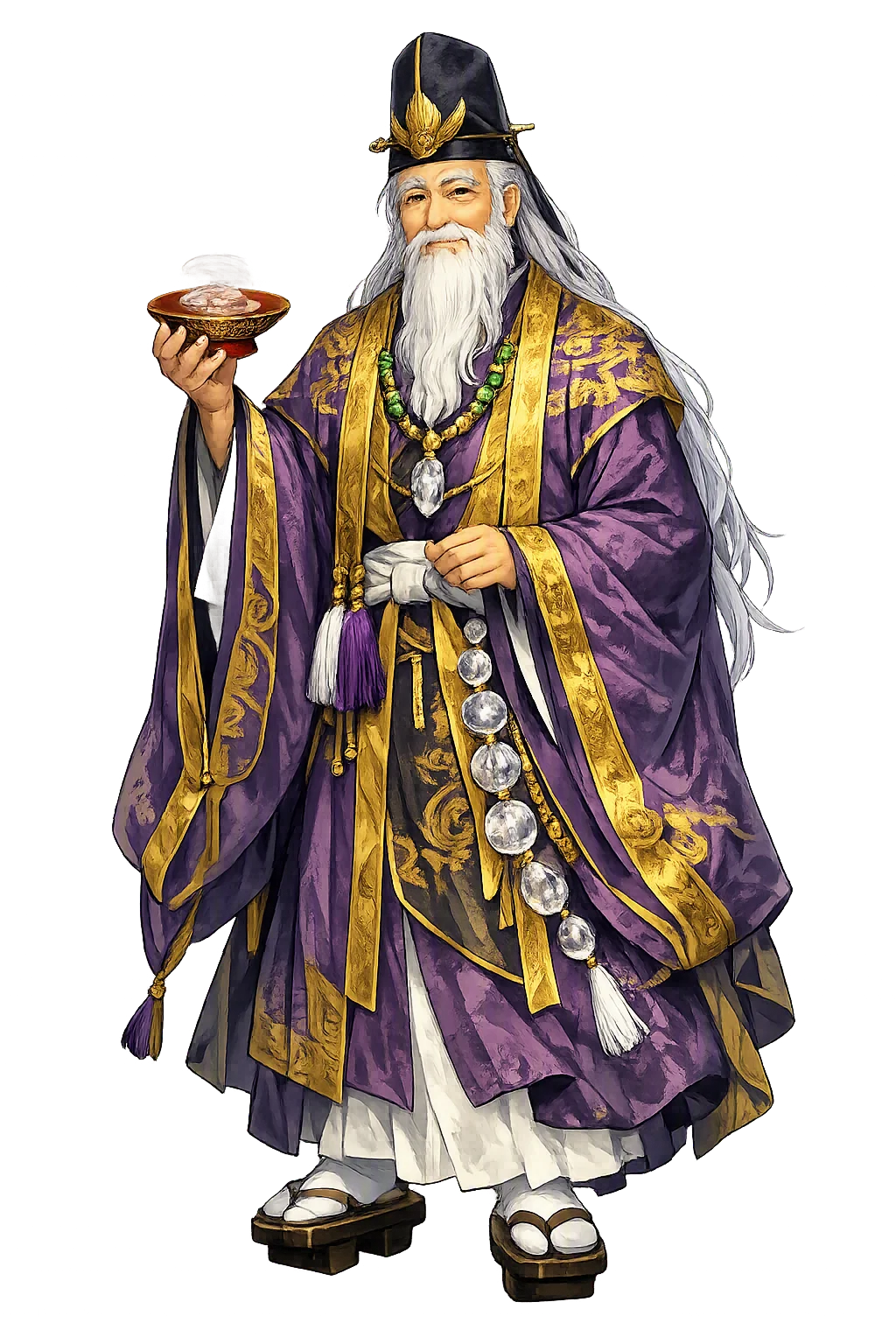
How Kotoshironushi found its canonical form
The ASCII form kotoshironushi is not missing anything that this name requires. Kotoshironushi is the canonical spelling supported by the Japanese characters evidence and the tradition's scholarly conventions. This post explains what that form preserves, how it is pronounced, which narratives surround it, and why consistency matters. There are no recovered accents to celebrate; there is something more useful — a spelling whose history can actually be checked.
At a Glance
- Canonical name: Kotoshironushi
- ASCII form: kotoshironushi
- Meaning: "Lord who substitutes"
- Domain of influence: Oracles, Fishing
- Pantheon: Japanese
- Restoration: ASCII-equivalent form
- Original script: 事代主神 (Japanese characters)
Overview
Kotoshironushi (kotoshironushi) — Oracles, Fishing · Lord who substitutes — belongs to the Japanese tradition, where it is catalogued under the domain "Oracles, Fishing". The name means "Lord who substitutes".
Kotoshironushi is the son of Ōkuninushi who, according to the Kojiki, surrendered the central land of reed plains to the heavenly descendants of Amaterasu. A god of oracles and fishing, he withdrew to the sea and became identified in later tradition with the fortune god Ebisu.
PuniCodex records the canonical scholarly spelling Kotoshironushi and serves its temple at its temple. The displayed form is ASCII-equivalent — a description computed from the displayed form itself. The plain ASCII form kotoshironushi contains the same letters: no recovered diacritics or special encoding is claimed. The work here is consistent citation, capitalization, provenance, and cultural context.
The Name
The name is attested in Japanese characters as 事代主神. Etymologically it means "Lord who substitutes".
The canonical spelling Kotoshironushi matches the conventional scholarly romanization. The plain ASCII form kotoshironushi contains the same letters, so no lost diacritics or encoding transition is claimed. The editorial work is to fix one reviewed reference spelling, preserve capitalization and provenance, and keep the original evidence visible. The displayed form is ASCII-equivalent — a description computed from the displayed form itself.
The letter-by-letter transformation runs:
- k → K — Same, capitalized
- o → o — Same
- t → t — Same
- o → o — Same
- s → s — Same
- h → h — Same
- i → i — Same
- r → r — Same
- o → o — Same
- n → n — Same
- u → u — Same
- s → s — Same
- h → h — Same
- i → i — Same
The Original Script
The name is written in Japanese characters as 事代主神. That attested script remains the primary evidence for the conventional romanization Kotoshironushi. The canonical Latin spelling does not pretend to recover marks it never contained: it fixes one reviewed reference form while leaving the original script visible for comparison.
事代主神 — 事 koto 'affairs, words' + 代 shiro 'substitute, proxy' + 主 nushi 'lord' — has been read since the medieval commentaries as 'the lord who serves as proxy for the divine word', a spelling chosen to explain his oracle function at Ōmiwa. It is a semantic, even exegetical, spelling rather than a phonetic one, and the Nihon Shoki's variants differ in detail. The characters argue for an office — speaking for the numinous — and the office, at Ōmiwa, is attested for well over a millennium.
Pronunciation
The reconstructed pronunciation of the name is /ko.to.ɕi.ɾo.nɯ.ɕi/ — Modern Standard Japanese (Hepburn).
Phoneme by phoneme:
- Koto- — Voiceless velar [k], open-mid [o], alveolar [t], open-mid [o]; from 事 'matter/affair'
- -shiro- — Voiceless alveolo-palatal [ɕ], close front [i], alveolar tap [ɾ], open-mid [o]; from 代 'substitute/age'
- -nushi — Alveolar nasal [n], close back [ɯ], voiceless alveolo-palatal [ɕ], close front [i]; from 主 'lord/master'
For the modern speaker, the closest approximation is: 'KOH-toh-shee-roh-noo-shee' — the 'r' is a light tap, and the final vowels are soft.
Kindred and historical forms of the name:
- Japanese — 事代主神 (Kotoshironushi-no-kami), “Lord who Substitutes”
- Father — Ōkuninushi, ruler of the earthly kami
- Mother — Hayaakitsuhime, daughter of the sea deity Ōwatatsumi (Kojiki)
Kotoshironushi keeps its restoration plain: plain Hepburn. He is a son of Ōkuninushi and a key figure in the transfer of the land to Amaterasu's descendants.
Mythology
Kotoshironushi’s mythology is brief but pivotal: as a son of Ōkuninushi, ruler of the earthly kami, he advised the peaceful cession of the land to the heavenly line of Amaterasu and then withdrew from the world. His “hiding” let the imperial succession begin without the annihilation of the old order, and later ages gathered his memory into Ebisu, the beloved god of fishermen and merchants.
The Cession of the Land (Kojiki)
Amaterasu resolved that her grandson Ninigi should rule the central land of reed plains, and sent the warrior god Takemikazuchi to compel its ruler, Ōnamuchi — Ōkuninushi — to yield. Ōkuninushi’s son Takeminakata answered the embassy with defiance, was defeated in a trial of strength, and fled across the sea to Suwa. Then the Kojiki slows for the decisive interview: Ōkuninushi asked his son Kotoshironushi what should be done. Kotoshironushi answered that the land should be given up to the heavenly grandchildren, and — his counsel accepted — he withdrew into concealment, kakuremi, and “the land was then at peace.” His mother, the Kojiki adds, was Hayaakitsuhime, a daughter of the sea deity Ōwatatsumi, which is why his disappearance ran seaward. By choosing counsel over resistance, one son of the old order ended a war that his brother’s arms could not have won — and the mythology marks the cost exactly: the surrendering god simply vanishes from the story he made possible.
The God Who Hides (Nihon Shoki)
The Nihon Shoki’s parallel account deepens both the withdrawal and the genealogy: it names Kotoshironushi’s mother a child of the sea deity, binding him to Watatsumi’s watery realm, and dwells on the hiding itself — the kakuremi by which the god of the old dispensation removes himself so that the new one can begin. Japanese scholarship has long read the “hiding kami” as the mythic signature of cults that withdrew from the political centre: deities who lost the argument survived by retreating into oracles, mountains, and the sea, keeping a voice precisely by surrendering a throne. The theme recurs across the early chronicles — gods who conceal themselves and must be lured, cajoled, or divined back into relationship with the court. Kotoshironushi is the purest case: he is the patron of every defeated thing that refuses to die, and his entire myth is an exit that turned out to be a survival.
The Oracle Lord of Miwa (Shrine tradition)
His very name — 事代主, “lord who substitutes for the matter” — was read by later generations as a title of the oracular god: the one who speaks the divine word in place of another, and so “substitutes” for the hidden deity behind the message. Shrine tradition around Ōmiwa, at the foot of Mount Miwa in Nara prefecture — one of the oldest sanctuaries in Japan, where the mountain itself is the sacred body of the god — links his lineage to the Miwa cult, through which the will of the kami was delivered to the court by divination and trance. Some scholars have gone further and proposed identifying Kotoshironushi with Ōmononushi, the great kami of Miwa itself; the identification remains a hypothesis, but a telling one. In the Nihon Shoki’s age of oracles, the troubled reign of Emperor Sujin — plagues, failed harvests, and divine warnings that had to be sought and obeyed — taught that neglected gods of the land would speak until properly housed. Kotoshironushi’s specialty is precisely that: being the voice of the one who is absent.
The Smiling God of Nishinomiya (Ebisu)
By the medieval and early modern centuries, the hidden god had resurfaced as the most approachable of deities. The great shrine of Nishinomiya in Hyōgo prefecture identifies its kami with Kotoshironushi and calls him Ebisu — “the prosperous guest” — the smiling god who carries a fishing rod and a red sea bream, the tai whose name puns on medetai, “auspicious.” Every January the shrine fills with merchants and fishermen for the Tōka Ebisu festival, when visitors buy lucky bamboo grass and invite the god of the new year into their shops and boats. Among the Seven Gods of Fortune, Ebisu is the only one worshipped purely as a native kami, without Buddhist, Daoist, or foreign pedigree. The transformation is one of the neatest survivals in Japanese religion: the son who advised his father to surrender an empire became the guest who blesses a shopkeeper’s ledger. The old order lost the land — and won the marketplace.
Symbols & Iconography
The iconography associated with Kotoshironushi concentrates in a small set of recurring attributes, each a compressed statement about the name:
- Fishing rod — The attribute he carries as Ebisu, god of the catch — the tool by which fortune is drawn from the sea
- Sea bream (tai) — The auspicious fish whose name puns on medetai, “auspicious”; Ebisu’s perpetual catch
- Oracle implements — The divination tools of the Miwa tradition — the “substituted” voice of the hidden god
- Kakuremi (the hiding) — His withdrawal into concealment after the cession — the survival strategy of the defeated old order
Archaeology & Evidence
Ōmiwa Jinja in Sakurai, Nara prefecture — among the oldest shrine sites in Japan — faces Mount Miwa directly, the mountain itself revered as the shintai, the divine body of the god; no main hall stands between worshipper and peak. The site’s antiquity is supported by third-century Chinese chronicles, which attest the political prominence of the Yamato region’s great shrine cults, and by the dense concentration of kofun burial mounds in the Miwa area. At the other pole of his myth, Suwa in Nagano preserves the Takeminakata cult that the land-transfer story left behind. Nishinomiya Shrine’s Ebisu identification took its present form in the early modern period, but the shrine claims older precedent, and the Tōka Ebisu rite is documented from the Edo period onward.
Realm & Domain
Kotoshironushi is the son of Ōkuninushi who, according to the Kojiki, surrendered the central land of reed plains to the heavenly descendants of Amaterasu. A god of oracles and fishing, he withdrew to the sea and became identified in later tradition with the fortune god Ebisu.
Land Transfer
His counsel ceded the land of reed plains to the heavenly grandchildren — the surrender that founded imperial rule without a war of extermination.
Oracle God
His name means “lord who substitutes”: the voice that speaks the divine will when the god himself is hidden.
Fishing Deity
A grandson of the sea deity Ōwatatsumi, he withdrew toward the water and became patron of its catches.
Ebisu Link
Nishinomiya’s Ebisu — rod and red tai in hand — is his smiling later face, the only purely Japanese god among the Seven Gods of Fortune.
Across Cultures
Kotoshironushi is a nodal figure connecting the land-transfer myth, the oracle cults of Miwa, and the later Ebisu tradition. He represents the old order’s willing surrender and the sea’s continuing bounty, and his identification with Ebisu — ratified at Nishinomiya and celebrated across Japan at Tōka Ebisu — is one of the clearest cases of mythological condensation in Japanese folk religion. Within the Seven Gods of Fortune he keeps company with deities of Buddhist, Daoist, and Hindu origin, yet remains the only member with a purely native genealogy. Some scholars have further proposed identifying him with Ōmononushi, the serpent-kami of Miwa, which would bind the surrender myth directly to Japan’s oldest oracle shrine; the identification remains a hypothesis, but it shows how completely the hidden god was absorbed into the living cult.
Kindred figures in the PuniCodex cross-tradition index include Ašeratu, Ọbalúayé, Benzaiten, Ēa, Hoderi, and Lóngwáng, each linked through sea / water.
Cultural Legacy
Kotoshironushi is rarely worshipped under his own name today, but his legacy is everywhere in January: Ebisu, his smiling later form, presides over the first business of the year at shrines from Nishinomiya to Osaka’s Imamiya. The Tōka Ebisu festival draws millions of merchants and fishermen who buy lucky bamboo to invite prosperity into the new year. In the national myth, he is remembered as the son whose counsel spared the country a war of extermination — the voice of peaceful succession on which the imperial line’s legitimacy partly rests. And at Ōmiwa, before Mount Miwa, one of Japan’s oldest sanctuaries keeps the older stratum of his story: a god who hides, and speaks.
The Scholarly Record
The account of Kotoshironushi given in this edition rests on the witnesses and reference works listed below. Lexica and etymological dictionaries secure the form and meaning of the name; the literary and religious texts supply the narrative evidence.
- Kojiki — the land-transfer episode (Ōnamuchi, Takeminakata, and the counsel of Kotoshironushi).
- Nihon Shoki — the parallel account; the oracle age of Emperor Sujin.
- Philippi, Donald L., Kojiki (Princeton University Press, 1969).
- Aston, W. G., Nihongi: Chronicles of Japan from the Earliest Times to A.D. 697 (1896).
- Shrine traditions of Ōmiwa Jinja (Nara) and Nishinomiya Jinja (Hyōgo).
A Meditation
Kotoshironushi is the theology of the graceful exit. Every tradition must answer the question his story poses: what becomes of the old order when the new one arrives? His answer — counsel surrender, then withdraw — let both worlds survive. There is a distinctly Japanese lesson in the shape of his career: power that argues with history loses, while power that serves as its voice endures. The oracle-god who speaks for the absent deity becomes, centuries later, the guest-god who blesses the shop: both are the same office, the sacred made negotiable. In an age that treats every ending as a failure, the Lord Who Substitutes reminds us that some of the most durable things in a culture are precisely the ones that stepped aside at the right moment.
The Canonical Spelling
Kotoshironushi is the canonical spelling used by this temple. The plain ASCII form kotoshironushi contains the same letters, so there are no lost diacritics to recover and no special encoding transition to explain. What the temple preserves is the reviewed reference form: capitalization, conventional romanization, original evidence, and a stable place to inspect them. The value here is not added decoration; it is fidelity to the attested record.
Character by Character
The canonical form Kotoshironushi and the plain ASCII form kotoshironushi share the same letters. The character list therefore documents continuity rather than recovery: every character is carried forward deliberately, with capitalization serving as the proper-noun convention. No additional mark is inserted merely to make the restoration appear more elaborate.
The Japanese Pantheon
Kotoshironushi is one of 45 entries the PuniCodex lexicon catalogues under the Japanese pantheon. The Pantheon page gathers the tradition's major figures in one place, and the Lexicon lets you filter all 983 restorations by tradition or script — the fastest way to see where this name sits among its kin.
Frequently Asked Questions
What does Kotoshironushi mean? The traditional gloss is "Lord who substitutes."
Which tradition does Kotoshironushi belong to? Kotoshironushi is catalogued in the Japanese pantheon of the PuniCodex lexicon.
Does this name need recovered diacritics? No. Kotoshironushi is already an ASCII-form canonical spelling. The scholarly work is to preserve the attested convention and its evidence, not to add marks.
Can I use Kotoshironushi in a normal browser? Yes. The spelling works directly in an ordinary browser, and the type tool can confirm and copy the canonical form.
Where does the scholarly information come from? The entry is built from lexica, inscriptional evidence, and reviewed scholarly sources listed in the Scholarly Edition.
Why This Record Matters
The letters in Kotoshironushi were never lost, and no replacement marks are needed to make them whole. The burden is instead one of fidelity: every use should carry the same attested spelling and the history attached to it. The PuniCodex temple keeps that form in circulation — as a digital address, a dataset entry, and a scholarly argument — so consistency becomes the easy choice rather than an accident of citation.
Explore Further
This post is one doorway into the temple. The home page carries the full character breakdown and the ambient canvas; the lore page tells the myths in long form; the Scholarly Edition preserves the sources, pronunciation data, and revision history; and the patron wall supports the restoration directly. For the wider map, browse the Lexicon, explore the Pantheon, or return to the PuniCodex blog.
Related Names
Sources
The full scholarly apparatus — every citation, revision, and review — lives in the Scholarly Edition. Key references for this post:
- Kojiki — the land-transfer episode (Ōnamuchi, Takeminakata, and the counsel of Kotoshironushi).
- Nihon Shoki — the parallel account; the oracle age of Emperor Sujin.
- Philippi, Donald L., Kojiki (Princeton University Press, 1969).
- Aston, W. G., Nihongi: Chronicles of Japan from the Earliest Times to A.D. 697 (1896).
- Lexicon authorities for this entry: Kojiki, Nihon Shoki.