
The hidden history behind Kingu
Behind the modern ASCII form kingu hides a much longer story. Kingu reaches back through manuscripts, inscriptions, and oral tradition long before it ever touched a keyboard, and every mark in the restored spelling is a receipt from that journey. In what follows we trace the name from its Cuneiform attestations through its mythology, its cult, its symbols, and its afterlife in other cultures — and we show how the PuniCodex project turned that philological record into a Unicode domain that resolves today. The history was never lost. It was only waiting for the infrastructure to catch up.
At a Glance
- Restored name: Kingu
- ASCII form: kingu
- Meaning: "Unknown"
- Domain of influence: Dragon, Consort of Tiamat
- Pantheon: Mesopotamian
- Classification: Tier 2
- Original script: 𒀭𒆥𒄖 (Cuneiform)
Overview
Kingu (kingu) — Dragon, Consort of Tiamat · Unknown — belongs to the Mesopotamian tradition, where it is catalogued under the domain "Dragon, Consort of Tiamat". The name means "Unknown".
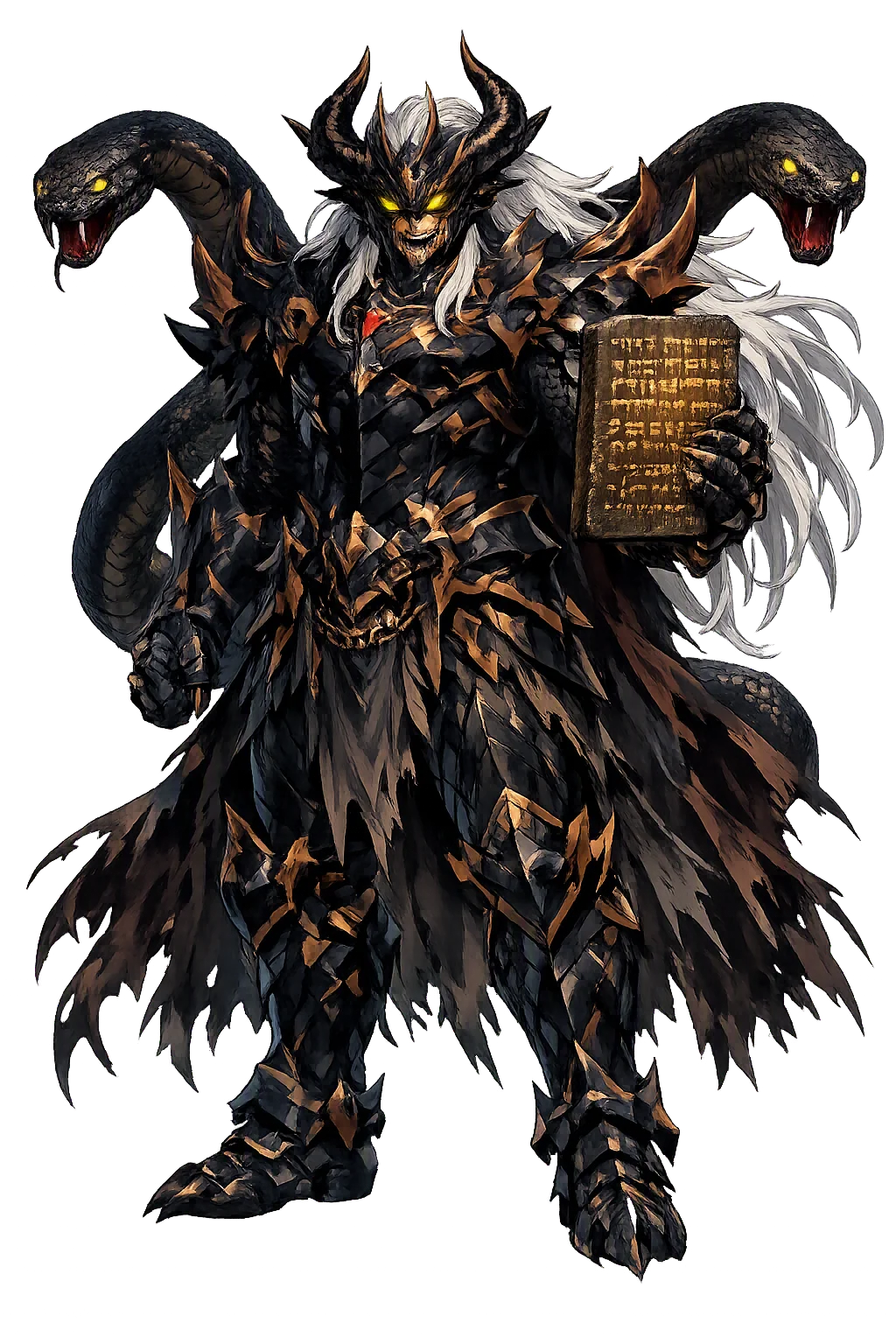
Kingu is the dragon-god who stands at the right hand of Tiāmat in the Babylonian Enuma Elish. When the younger gods slay Apsû and disturb the primordial order, Tiāmat takes Kingu as her consort, places the Tablet of Destinies (ṭuppi šīmāti) upon his breast, and makes him commander of the monster-host that marches against the divine assembly. He is terror made general: the chaotic deep given a strategic mind and a regal badge.
Yet Kingu's defeat is the pivot on which the human world turns. Marduk kills him, strips away the Tablets, and from Kingu's blood the gods create humankind to bear the toil of heaven and earth. The dragon who would have unmade order becomes, unwillingly, the raw material of civilization. This temple tracks that double identity: the consort of chaos and the substrate of humanity.
PuniCodex restores the name as Kingu and serves its temple at its temple. The restoration needs no distinctive letters or diacritics its ASCII form would lose, which places the name in Tier 2. The plain ASCII form kingu survives as a modern convenience imposed by the early domain-name system; the restoration, not the fallback, is the form the project defends as philologically complete.
The Name
The name is attested in Cuneiform as 𒀭𒆥𒄖. Etymologically it means "Unknown".
The ASCII form kingu survives only because the early domain-name system could not carry diacritics; it is a technological compromise, not an ancient spelling. The Unicode restoration Kingu recovers the full diacritic detail of the scholarly transliteration directly in the address bar. The restoration needs no distinctive letters or diacritics its ASCII form would lose, which places the name in Tier 2.
The letter-by-letter transformation runs:
- k → K — Same, capitalized
- i → i — Same
- n → n — Same
- g → g — Same
- u → u — Same
The Original Script
The name is preserved in Cuneiform as 𒀭𒆥𒄖 — Sumero-Akkadian cuneiform, attested Old Babylonian – Neo-Babylonian, c. 1800–600 BCE, in Mesopotamia. The script is written left-to-right / top-to-bottom.
The scholarly transliteration is ᵈqin-gu (Akkadian scholarly), giving the normalized reading /ˈqiːŋɡu/.
The rendering proceeds step by step:
- The most widespread spelling is ᵈqin-gu; sporadic variants dqi-in-gu, dqin-ga and dqin-gi occur (Krebernik, RlA 11)
- Modern scholarship prefers the form Qingu, of Sumerian origin
Pronunciation
The reconstructed pronunciation of the name is /ˈkiŋɡu/ — Akkadian Reconstruction.
Phoneme by phoneme:
- Ki- — Voiceless velar stop [k] followed by close front vowel [i] — the first syllable is light and sharp, like a command.
- -ŋ- — Voiced velar nasal [ŋ] — the g in Kingu represents this single nasal sound in the Akkadian cluster, not a stop-g.
- -gu — Voiced velar stop [g] plus close back rounded vowel [u] — the final syllable closes the name with weight.
For the modern speaker, the closest approximation is: 'KEENG-goo' — stress the first syllable; the middle consonant is a soft ng-sound, and the final vowel is rounded and firm.
Kindred and historical forms of the name:
- Akkadian — Kingu, the name of Tiamat's consort and commander in the Enuma Elish
- Etymology — Unknown; no certain Sumerian or Semitic etymology is established (Black-Green). The name may be foreign or archaic.
Kingu is Tier 2: the Unicode restoration 'Kingu' is simply the ASCII form capitalized, with no preserved diacritic or distinctive non-ASCII letter. The name's etymology is unknown, so there is no reconstructed vowel length or accent to mark. Standard Assyriology writes Kingu; PuniCodex displays the canonical capitalized form while acknowledging that the name remains philologically opaque.
Mythology
Kingu enters the Enuma Elish not as a primordial element like Apsû or Tiāmat, but as a response — the consort Tiāmat chooses after her first partner is destroyed. He is chaos with a general's mind: the one who turns Tiāmat's grief into organized war. His story moves from elevation to defeat to transformation, because in Mesopotamian cosmology the slain enemy does not simply disappear; he is reworked into the world.
Tiāmat Makes Kingu Her Consort (Elevation)
After Ea kills Apsû, Tiāmat resolves to avenge the primordial freshwater abyss. She takes Kingu as her consort and sets him over the gods she has assembled: 'She placed him in the front, leader of the host, to direct the battle, to gain the victory' (Enuma Elish II:122–124, trans. Foster). Kingu is not the source of the rebellion but its appointed head — the dragon who gives tactical shape to Tiāmat's formless rage.
The Tablet of Destinies (Authority)
To legitimate Kingu's command, Tiāmat fastens the Tablet of Destinies (ṭuppi šīmāti) upon his breast. The tablet is the inscribed record of fates and decrees; to hold it is to hold the power to confirm or cancel the destinies of gods and worlds. Kingu thus briefly becomes a rival sovereign, and the younger gods are thrown into terror because fate itself seems to have defected to chaos.
Marduk Defeats Kingu (Conflict)
Marduk of Babylon accepts single combat with Tiāmat on the condition that the assembly grant him kingship. After he splits Tiāmat and creates heaven and earth from her body, he turns to her army. Kingu is captured, stripped of the Tablets, and killed. Marduk takes the Tablet of Destinies from Kingu and fixes it to his own breast, so that the power of fate now serves the order of Babylon.
The Creation of Humankind (Transformation)
With Kingu dead, Ea proposes a solution to the gods' need for servants: 'Let one of the gods be handed over; he alone will be slaughtered, and the gods be created from his flesh' (Enuma Elish VI:5–8, trans. Foster). Kingu is chosen. From his blood Ea fashions humankind, charging them with the service of the gods so that the divine assembly may rest. The enemy's life-fluid becomes the clay of civilization.
Symbols & Iconography
The iconography associated with Kingu concentrates in a small set of recurring attributes, each a compressed statement about the name:
- Dragon body — The monstrous form that opposes Marduk's cosmic order
- Tablet of Destinies — The ṭuppi šīmāti, the badge of supreme authority Tiāmat briefly grants to Kingu
- Blood — The material from which humanity is created after Kingu's defeat
- Crescent blade — Kingu's martial role as general of Tiamat's army
Archaeology & Evidence
Archaeological evidence for Kingu comes primarily from cuneiform copies of the Enuma Elish found at Nineveh, Ashur, Babylon, and Sippar, where the epic was recited at the Babylonian New Year (Akitu) festival. The text's description of Kingu receiving the Tablet of Destinies and his blood being used to create humanity is preserved in the Standard Babylonian version. Visual representations of dragon-like creatures and composite monsters from the Ishtar Gate at Babylon and contemporary cylinder seals give artistic context to the monster-host Kingu leads, even though no securely identified image of Kingu himself survives.
Realm & Domain
Kingu is the dragon-god who stands at the right hand of Tiāmat in the Babylonian Enuma Elish. When the younger gods slay Apsû and disturb the primordial order, Tiāmat takes Kingu as her consort, places the Tablet of Destinies (ṭuppi šīmāti) upon his breast, and makes him commander of the monster-host that marches against the divine assembly. He is terror made general: the chaotic deep given a strategic mind and a regal badge.
Yet Kingu's defeat is the pivot on which the human world turns. Marduk kills him, strips away the Tablets, and from Kingu's blood the gods create humankind to bear the toil of heaven and earth. The dragon who would have unmade order becomes, unwillingly, the raw material of civilization. This temple tracks that double identity: the consort of chaos and the substrate of humanity.
The Dragon
Kingu is described as a god of dragon-form, the monstrous counterpart to Marduk's storm-order.
Tablet of Destinies
Tiāmat fastens the ṭuppi šīmāti on Kingu's breast, making his command authoritative over fate itself.
Blood of Origin
From Kingu's blood the gods fashion humankind — a stark myth of life arising from the defeated enemy.
The Monster Host
Serpents, dragons, and scorpion-men follow Kingu into battle against Marduk and the younger gods.
Across Cultures
Kingu is a specifically Babylonian figure, but his narrative pattern — the defeated dragon whose body becomes the stuff of human life — echoes across Near Eastern and later mythologies.
The closest parallel is Tiāmat herself: where she becomes the physical cosmos, Kingu becomes the biological substrate of humanity. In later Jewish and Christian demonology, the figure of a rebel dragon or fallen angel bound and stripped of authority (Leviathan, Satanail, Azazel) partially replays Kingu's defeat and degradation. Gnostic and Manichaean traditions similarly describe the creation of human bodies from the blood or matter of rebellious powers. In modern fantasy and games, Kingu survives as a dragon-general or dark consort archetype, often conflated with Tiamat's own monstrous form. PuniCodex preserves the capitalized form 'Kingu' not as a reconstruction but as a philological placeholder: the name's etymology is unknown, and the ASCII form is the only form currently attested.
Within the Mesopotamian tradition, closely related names in the corpus include Adad, Anû, Apsû, Aššur, Dumuzid, and Ēa.
Cultural Legacy
The myth of Kingu encodes several durable ideas: that chaos can be organized, that authority depends on the symbols of fate, and that human life is made from the remains of a defeated enemy.
The Tablet of Destinies — briefly worn by Kingu, then permanently by Marduk — became a template for later images of the book of fate, the sealed scroll, and the tablets of law. The idea that humanity was created from the blood or clay of a slain god or rebel appears in Greek (the Titan Prometheus fashions humans from clay), Norse (the giants Ymir and Ask/Embla), and biblical traditions shaped by Mesopotamian models. In popular culture, Kingu appears in role-playing games, trading cards, and fantasy novels as a dragon-lord or dark consort, often stripped of his original cosmological function. PuniCodex keeps the name in its plain Assyriological form because there is no reconstructed diacritic to add; the unknown etymology is itself part of the entry's scholarly honesty.
The Scholarly Record
The account of Kingu given in this edition rests on the witnesses and reference works listed below. Lexica and etymological dictionaries secure the form and meaning of the name; the literary and religious texts supply the narrative evidence.
- Enuma Elish (Akkadian creation epic, Tablets I–VI).
- CAD (Chicago Assyrian Dictionary), s.v. Kingu, ṭuppu šīmāti.
- Dalley, Myths from Mesopotamia.
- Foster, Before the Muses: An Anthology of Akkadian Literature.
- Black-Green, Gods, Demons and Symbols of Ancient Mesopotamia.
A Meditation
To contemplate Kingu is to hold the idea of dragon, Consort of Tiamat in the mind and to ask what of it endures. The name means "Unknown" — and a name that carries its meaning so openly invites meditation rather than mere recollection. The tradition remembers the name as dragon, Consort of Tiamat · Unknown.
Sit with the restored form — Kingu — and the diacritics themselves become the practice: each mark is a small act of attention, a refusal to let the plain ASCII form kingu stand in for the whole. What the tradition preserved in this name, the restoration asks the reader to preserve in turn.
The Unicode Restoration
Kingu is classified as Tier 2: the restoration needs no distinctive letters or diacritics its ASCII form would lose. The ASCII fallback kingu still resolves everywhere, but it is the restored form that carries the name's full information. That is the whole thesis of this temple: the marks are the message.
Character by Character
The journey from kingu to Kingu, one character at a time:
- k → K — Same, capitalized
- i → i — Same
- n → n — Same
- g → g — Same
- u → u — Same
The Mesopotamian Pantheon
Kingu is one of 30 entries the PuniCodex lexicon catalogues under the Mesopotamian pantheon. The Pantheon page gathers the tradition's major figures in one place, and the Lexicon lets you filter all 980 restorations by tradition, tier, or script — the fastest way to see where this name sits among its kin.
Frequently Asked Questions
What does Kingu mean? The traditional gloss is "Unknown."
Which tradition does Kingu belong to? Kingu is catalogued in the Mesopotamian pantheon of the PuniCodex lexicon.
Why is Kingu classified as Tier 2? Because the restoration needs no distinctive letters or diacritics its ASCII form would lose — and the marks in the restored spelling preserve exactly that evidence.
Can I use Kingu in a normal browser? Yes. The DNS resolves the punycode form automatically, and the type tool on this site converts kingu to Kingu for copying and pasting.
Where does the scholarly information come from? The entry is built from lexica, inscriptional evidence, and reviewed scholarly sources listed in the Scholarly Edition. Every claim is traceable to a canonical source.
Typing Kingu
You do not need a special keyboard to use this restoration. The PuniCodex Type Tool converts the ASCII form kingu into Kingu as you type, and the browser extension offers the same conversion inside any text field. Copy the restored form, paste it into the address bar, and the DNS does the rest.
Sister Temples
Other temples in the Mesopotamian pantheon include Anšar, Anû, and Apsû — each with its own restoration story, its own scholarly record, and its own place in the lexicon.
Why This Restoration Matters
The story of Kingu did not end in antiquity; it changed medium. Names that survive for millennia do so because each generation finds a new carrier for them — clay, papyrus, print, and now DNS. The PuniCodex restoration simply makes the carrier honest: the spelling that resolves is the spelling the evidence supports. If this post showed anything, it is that kingu and Kingu are not the same name with different styling. They are a summary and the text it summarizes. The web can now serve the text.
Explore Further
This post is one doorway into the temple. The home page carries the full character breakdown and the ambient canvas; the lore page tells the myths in long form; the Scholarly Edition preserves the sources, pronunciation data, and revision history; and the patron wall supports the restoration directly. For the wider map, browse the Lexicon, explore the Pantheon, or return to the PuniCodex blog.
A Closer Look at the Marks
A restored name is a small map. In the case of Kingu, the map does not lead through diacritics or special letters, because the source tradition wrote the name in Cuneiform rather than in the Latin alphabet. The ASCII form kingu and the restored form share the same letters; the restoration is a decision about which conventional spelling should serve as the public reference.
That decision is not cosmetic. The original script attestation carries semantic and phonetic information that no romanization can fully reproduce. By fixing one conventional spelling as the canonical domain form, the project prevents the drift that happens when a name is romanized differently in every article, map, and database. The breakdown still lists each character — k, i, n, g, u — so visitors can see exactly what is being carried forward and what is not. What looks like "no change" is, in fact, a deliberate choice to keep the name stable, searchable, and addressable.
Kingu in Its Tradition
Kingu does not stand alone. It belongs to the Mesopotamian tradition, where it is counted among 30 names in the PuniCodex lexicon. Its sphere — Dragon, Consort of Tiamat — places it beside other figures who govern similar aspects of experience. The restored spelling is therefore not only a philological decision; it is a way of keeping the name in the company of its kin. When the address bar shows Kingu, it marks the boundary between a generic search term and a named entry in a living catalog of myth. That catalog is the point of the project. Every restored name is a vote for specificity: the web should know the difference between a figure and a keyword, between a tradition and a trend. Kingu is one such vote.
Related Names
Sources
The full scholarly apparatus — every citation, revision, and review — lives in the Scholarly Edition. Key references for this post:
- Enuma Elish: The Babylonian Epic of Creation, Standard Babylonian version, 1200 BCE.
- Enuma Elish (Akkadian creation epic, Tablets I–VI).
- CAD (Chicago Assyrian Dictionary), s.v. Kingu, ṭuppu šīmāti.
- Dalley, Myths from Mesopotamia.
- Krebernik, RlA 11 s.v. Qingu.
- Lexicon authorities for this entry: Enuma Elish, Black-Green.