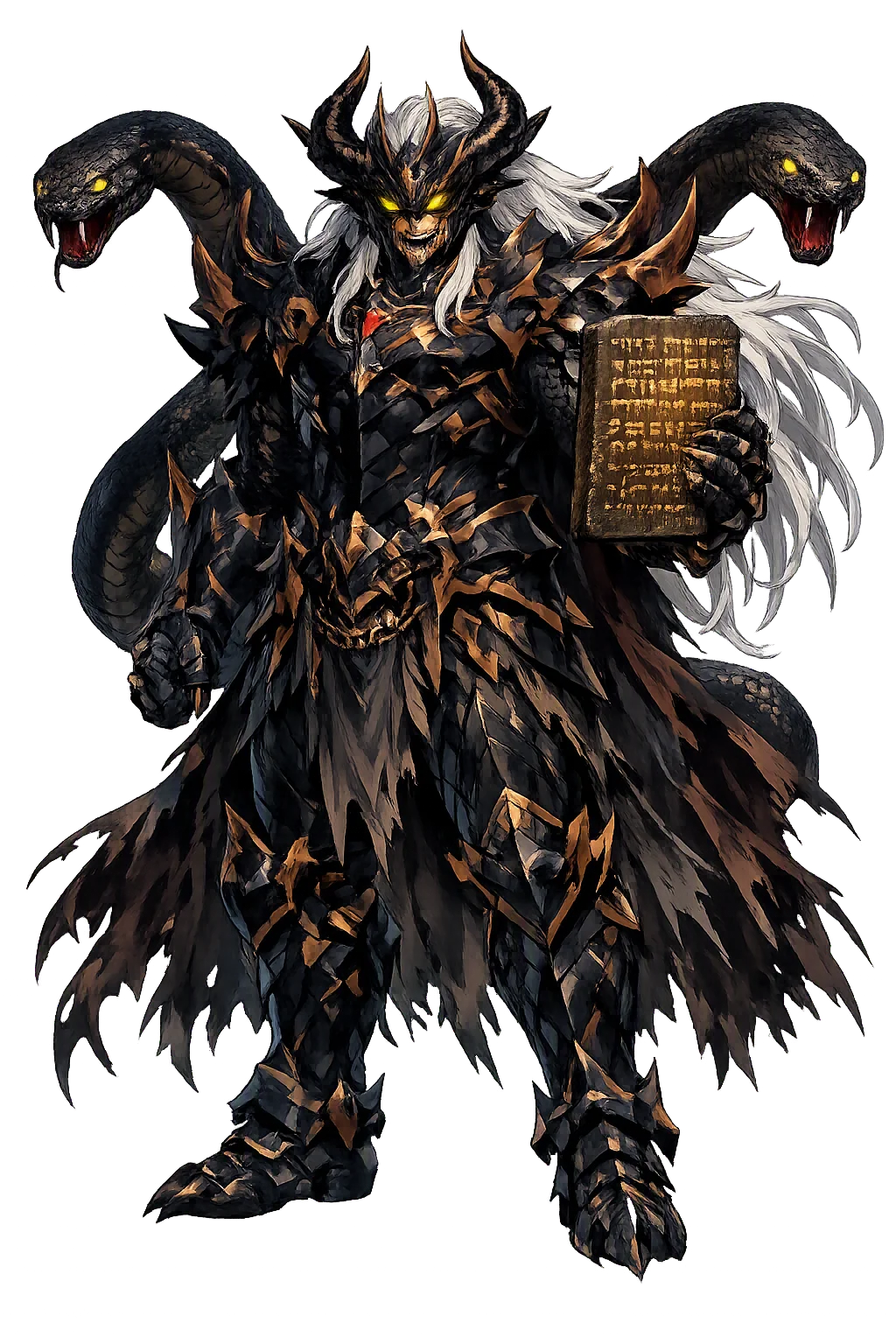
Stories of Kingu
Kingu enters the Enuma Elish not as a primordial element like Apsû or Tiāmat, but as a response — the consort Tiāmat chooses after her first partner is destroyed. He is chaos with a general's mind: the one who turns Tiāmat's grief into organized war. His story moves from elevation to defeat to transformation, because in Mesopotamian cosmology the slain enemy does not simply disappear; he is reworked into the world.
The epic's first tablets set the stage in catastrophe. Apsû, the primordial freshwater, cannot sleep for the noise of the young gods and plots to destroy them; Ea preempts him, wraps Apsû in sleep, and kills him, building his own sanctuary on the still waters (Enuma Elish I). Tiāmat, the salt sea, endures this in silence — until her own offspring drive her to fury. She raises an army of monsters, 'the viper, the dragon, and the lahmu-hero, the great storm-demon, the mad dog, and the scorpion-man' (Enuma Elish I, trans. Foster), and to lead them she takes a new consort: Kingu. 'She exalted him among the assembly of the gods... set him to arms, let the host go at his side' — a figure promoted precisely because he is not one of the old order, and therefore cannot be expected to spare it. Kingu is chaos given a chain of command.
To legitimate Kingu's command, Tiāmat performs the epic's most consequential gesture short of battle: she fastens the Tablet of Destinies — the ṭuppi šīmāti, the inscribed register by which fates are decreed and confirmed — upon his breast. To hold the tablet is to hold the power to bind and loose the destinies of gods and worlds; Kingu is thus briefly made a rival sovereign, and the younger gods are thrown into terror, because fate itself seems to have defected to chaos. In Mesopotamian thought the tablet was no metaphor: legitimate kingship meant the gods' confirmation of a ruler's decrees, and its seizure marks every true transfer of power in the mythic record — as the Anzu poem shows when the lion-headed bird steals the same authority from Enlil. Kingu's elevation is therefore legible to every Babylonian listener as a constitutional crisis: the wrong being now held the seal of heaven.
The divine assembly, helpless, offers kingship to any god who can answer the threat — and Marduk of Babylon answers, on a chilling condition: 'When I speak, let my word be confirmed; the command I utter, let the gods fulfill it' (Enuma Elish III). The gods test him by destroying a garment and commanding him to restore it; he does, and they arm him with the flood-weapon and the storm-wind. In single combat Marduk splits Tiāmat with an arrow, fashions heaven and earth from her body, and then turns to her army. Kingu is seized, bound, stripped of the Tablet of Destinies, and counted among the dead — 'Marduk took the Tablet of Destinies from Kingu and fastened it upon his own breast' (Enuma Elish IV). The usurper's badge becomes the victor's legitimacy, in one motion: Babylon's god now confirms fates, and the poem that sings it was recited in Babylon's New Year festival to say exactly that.
With Kingu dead, the gods face a quieter problem: who will do the world's work? They have built the cosmos, but its service is unending, and they complain of their toil (Enuma Elish VI). Ea proposes the solution, and Marduk adds the justice of it: the rebellion had a first cause, and the first cause should pay. The assembly convenes, and Kingu is condemned — 'the one who made war, suborned Tiāmat, and prepared the onslaught: he shall be given over to slaughter' — and from his blood, mixed with clay, Ea fashions humankind. The charge laid on the new species is the service of the gods, that the divine assembly may rest. Few cosmogonies are so unsentimental: humanity is not fashioned from the victor's generosity but from the rebel's sentence, and our mortality is the leftover of a war we did not fight. The myth's ending is the epic's warrant — the gods divide the offices of heaven and earth, and Marduk's fifty names close the hymn.
Dragon · Consort of Tiamat · Bearer of the Tablets of Destiny
Kingu is the dragon-god who stands at the right hand of Tiāmat in the Babylonian Enuma Elish. When the younger gods slay Apsû and disturb the primordial order, Tiāmat takes Kingu as her consort, places the Tablet of Destinies (ṭuppi šīmāti) upon his breast, and makes him commander of the monster-host that marches against the divine assembly. He is terror made general: the chaotic deep given a strategic mind and a regal badge.
Yet Kingu's defeat is the pivot on which the human world turns. Marduk kills him, strips away the Tablets, and from Kingu's blood the gods create humankind to bear the toil of heaven and earth. The dragon who would have unmade order becomes, unwillingly, the raw material of civilization. This temple tracks that double identity: the consort of chaos and the substrate of humanity.
Kingu is arrayed among the monster-gods — the general of Tiāmat's horde of serpents, dragons, and scorpion-men.
Tiāmat fastens the ṭuppi šīmāti on Kingu's breast, making his command authoritative over fate itself (Enuma Elish II).
From Kingu's blood the gods fashion humankind — a stark myth of life arising from the defeated enemy (Enuma Elish VI).
Serpents, dragons, and scorpion-men follow Kingu into battle against Marduk and the younger gods (Enuma Elish I–IV).
From the original script to the living URL
𒀭𒆥𒄖
The name in its original Mesopotamian form. Kingu (𒀭𒆥𒄖) is attested in the source tradition — “Unknown”. Its original diacritics and script distinctions carry the full phonetic and orthographic weight of the source tradition.
kingu
The plain kingu form is identical to the Unicode restoration. Because this name is already written in Latin letters, no diacritics, stress, or script information were lost — only capitalization differs.
Kingu
The Unicode restoration does not need to recover lost marks for Kingu. Its value is canonical spelling and consistent cataloguing, not the reconstruction of erased orthography. The domain is readable as-is to both DNS and humanity.
Kingu.com
This restoration is written entirely in ASCII letters — no Punycode encoding stands between Kingu and the DNS. The domain reads identically to machines and to human eyes.
Owned, ideal, and ASCII forms of Kingu
Kingu
Restores 𒀭𒆥𒄖. The full Unicode restoration. kingu.com is not in the PuniCodex collection — it is watched for release; if it drops, this temple upgrades to an owned flagship.
How Kingu was spoken
How Kingu travels from ancient script to the modern URL
The lore you have read is the living myth. Extended Lore opens the scholarly vault beneath it: the cult and its material remains, a history of the image, the name after antiquity, a meditation on what the name still means, and the full scholarly apparatus — etymology, orthography, sources.
Enter Extended Lore