
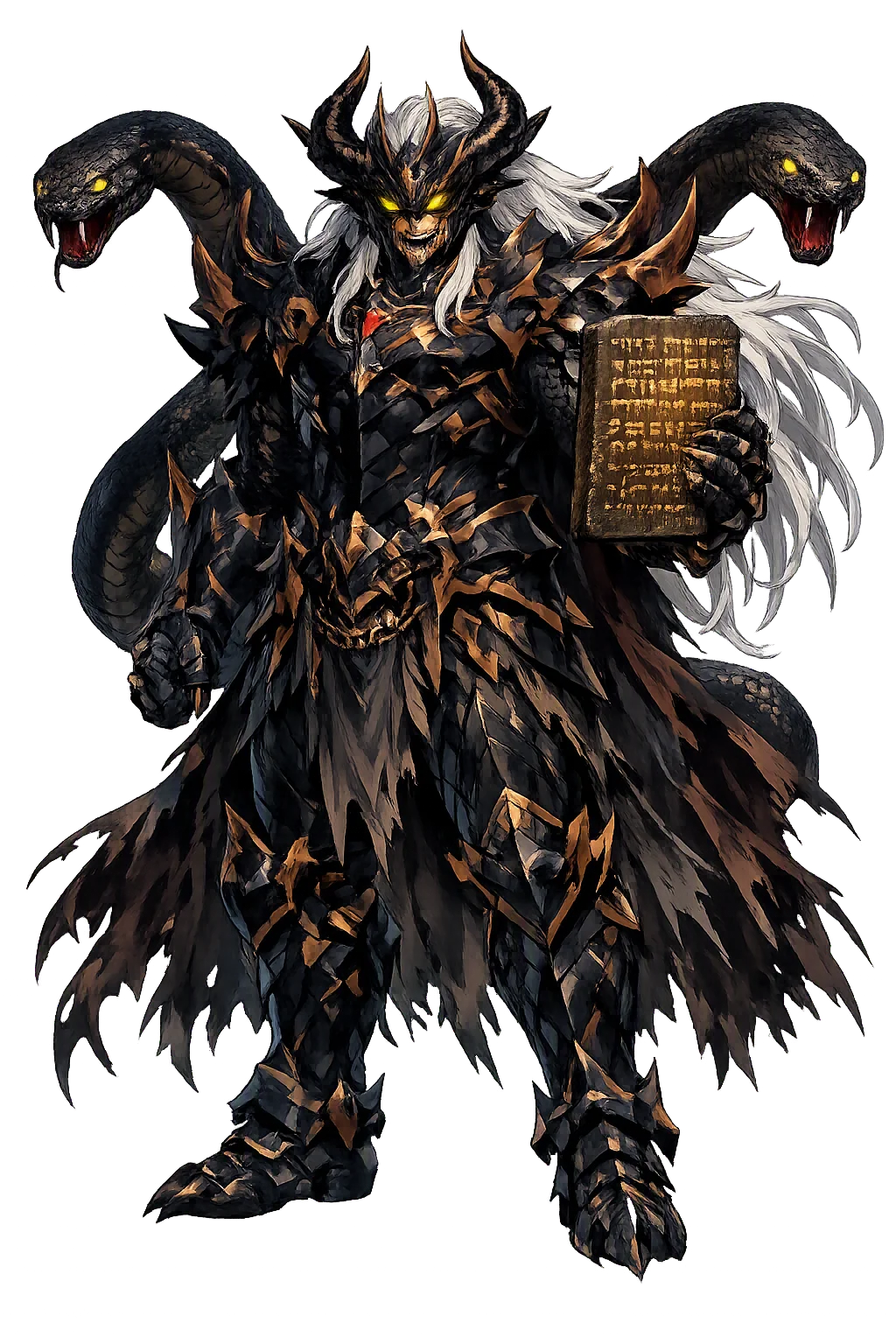
Kingu: the stories first, then the spelling
The marks in Kingu make the most sense standing next to the myths they have to carry. So the myths come first.
The Stories That Carry the Name
Tiāmat Makes Kingu Her Consort. The epic's first tablets set the stage in catastrophe. Apsû, the primordial freshwater, cannot sleep for the noise of the young gods and plots to destroy them; Ea preempts him, wraps Apsû in sleep, and kills him, building his own sanctuary on the still waters (Enuma Elish I). Tiāmat, the salt sea, endures this in silence — until her own offspring drive her to fury.
The Tablet of Destinies. To legitimate Kingu's command, Tiāmat performs the epic's most consequential gesture short of battle: she fastens the Tablet of Destinies — the ṭuppi šīmāti, the inscribed register by which fates are decreed and confirmed — upon his breast. To hold the tablet is to hold the power to bind and loose the destinies of gods and worlds; Kingu is thus briefly made a rival sovereign, and the younger gods are thrown into terror, because fate itself seems to have defected to chaos. In Mesopotamian thought the tablet was no metaphor: legitimate kingship meant the gods' confirmation of a ruler's decrees, and its seizure marks every true transfer of power in the mythic record — as the Anzu poem shows when the lion-headed bird steals the same authority from Enlil.
Marduk Defeats Kingu. The divine assembly, helpless, offers kingship to any god who can answer the threat — and Marduk of Babylon answers, on a chilling condition: 'When I speak, let my word be confirmed; the command I utter, let the gods fulfill it' (Enuma Elish III). The gods test him by destroying a garment and commanding him to restore it; he does, and they arm him with the flood-weapon and the storm-wind. In single combat Marduk splits Tiāmat with an arrow, fashions heaven and earth from her body, and then turns to her army.
And Here Is What the Spelling Preserves
At a Glance
- Restored name: Kingu
- ASCII form: kingu
- Meaning: "Unknown"
- Domain of influence: Dragon, Consort of Tiamat
- Pantheon: Mesopotamian
- Classification: Tier 2
- Original script: 𒀭𒆥𒄖
- Series: The Restoration Files, No. 261 of 548
The Name Travels
Kingu is a specifically Babylonian figure, but his narrative pattern — the defeated dragon whose body becomes the stuff of human life — echoes across the Near East and beyond. The closest parallel is Tiāmat herself: where she becomes the physical cosmos, Kingu becomes the biological substrate of humanity.
The Address It Earned
The temple of Kingu stands at /kingu/ — lore, scholars, patterns — because a name carrying this much story deserves more than a parking page. The restoration keeps one feature the ASCII form drops. One is enough to matter, and the label says so plainly: Tier-2.
The Sources Are Open
The myths above are retold from the temple's record; the primary voices are in the Sacred Texts: Enūma Eliš and The Epic of Gilgamesh. Nothing in this file outranks them.
The File Continues
Read the founding dispatch for the name's full story, the Resonance File for the archetype at work — or the whole archive in one sitting.
Continue the series — previous file: Keraunós (read it here) · next file: Kleiṓ (read it here).
The Restoration Files are written from the same canonical record as the temples themselves: the lexicon, the lore catalog, the pattern atlas, and the cited scholarly sources. If a file ever disagrees with its temple, the temple is right — tell us, and the file will be corrected.