
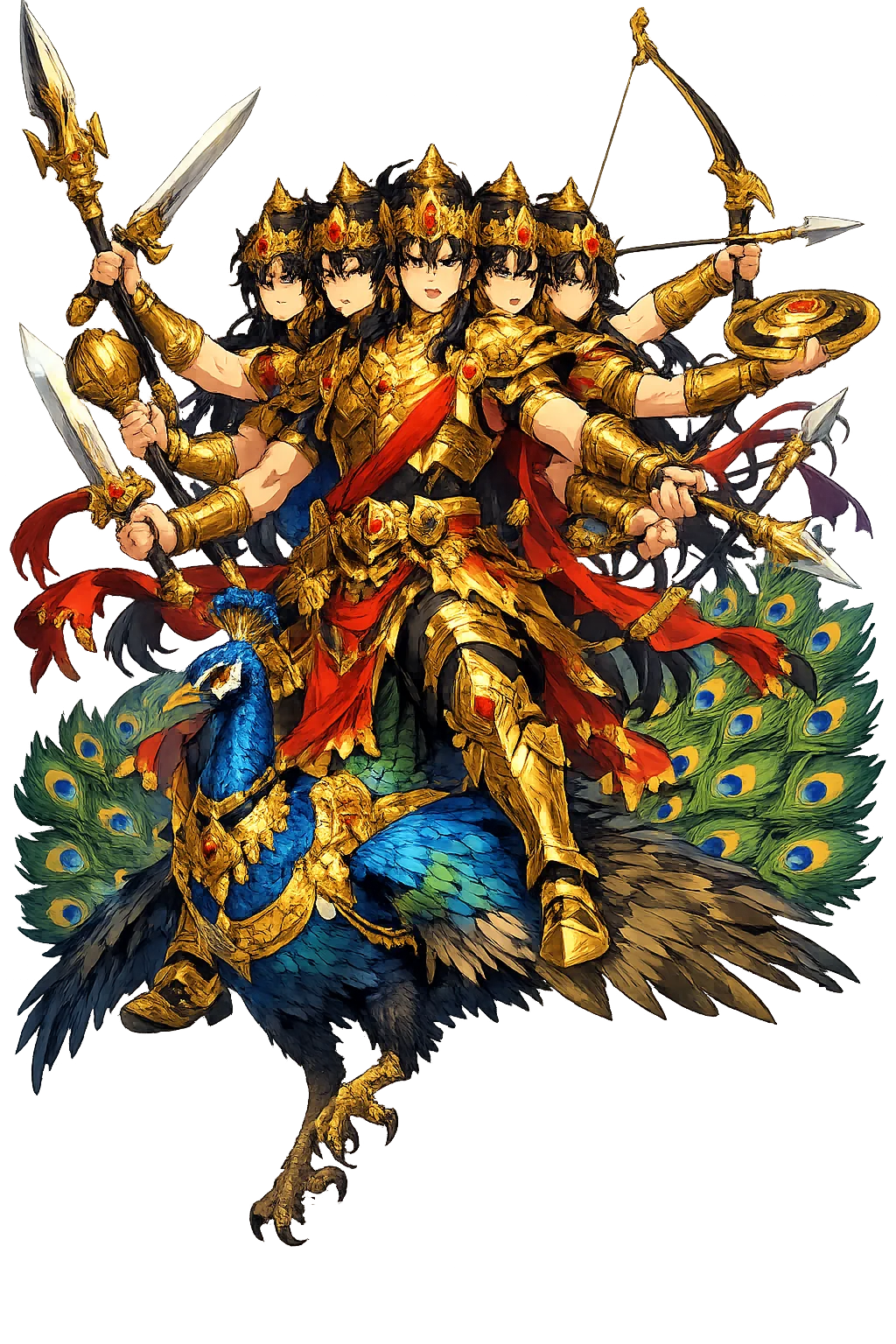
Why Kārttikeya is spelled that way — and what it costs to get it right
There is a version of this name the early internet had to settle for: kartikeya. This is the file on how Kārttikeya replaced it.
Kārttikeya's myths are the war-god's perfect résumé: born of fire and stars for one battle, victorious at seven days old, and never outgrown by the cults that made him their own. The Sanskrit epics and Kālidāsa give the north's version; the Tamil Sangam and the Kanda Purāṇam give the south his second, greater career.
At a Glance
- Restored name: Kārttikeya
- ASCII form: kartikeya
- Meaning: "Son of Krittika"
- Domain of influence: War, Commander of Gods
- Pantheon: Sanskrit
- Classification: Tier 1
- Original script: कार्त्तिकेय
- Series: The Restoration Files, No. 257 of 546
The Name Before the Marks
Strip Kārttikeya to kartikeya and one piece of evidence vanishes:
- a → ā — Long vowel: the vowel length the ASCII form cannot show.
A reader who knows the marks hears the name correctly on the first try. A reader who never sees them never gets the chance.
Spoken, the name runs `/kaːr.t̪i.keː.jɐ/` — kAHR-tih-kay-yah — the first vowel long, e always long in Sanskrit.
The Temple That Stands Now
The restored name is not a plaque; it is an address. The temple of Kārttikeya lives at /kartikeya/, with its mythology in the lore halls, its peer-reviewed record in the Scholarly Edition, and its place in the pattern atlas on the patterns floor.
Tier-1 is not a compliment; it is a measurement. This restoration keeps something the ASCII form provably loses, and the measurement is repeatable.
Where the Name Stood First
His iconography is fixed from the Kushan horizon: the six-headed Shanmukha appears on the coinage of the Yaudheya republic (Punjab-Haryana, ca. 2nd century BCE – 3rd century CE), among the oldest datable named god-images in India. The Palani temples of Tamil Nadu, the Kataragama complex in Sri Lanka, and Malaysia's Batu Caves (272 steps, the world's tallest Murugan statue at 42.7 m) map his living empire. The Yaudheya coinage is the crucial witness: a republic, striking a six-headed god on its money a century and more before most of his temples were built — proof that the commander enlisted human devotees before he had any stone. The temple on the web is the newest of these addresses — the first one that fits in a pocket.
The Archetype at Work
The pattern atlas seats this temple in 4 industries, each match argued and weighted: Defense, Military & Security (the commander of the gods armies; the week-old general.); Faith & Spiritual Organizations (the six-faced war god who rides his peacock still through the temples of two nations that call him their own.); Travel, Tourism & Place Branding (palani, Kataragama, Batu Caves — his hills are pilgrimage infrastructure.). The Resonance File reads those seats through the myths themselves.
In the Sacred Texts
The Sanskrit tradition is not a vibe; it is a library. The Sacred Texts collection holds Rig Veda and Ramayana — the primary sources the temple's scholarship is built on. The temple is the argument; the texts are the evidence.
The File Continues
The temple's founding dispatch tells the name's story; its Resonance File reads the myths into the industries; the blog index holds the whole archive.
Continue the series — previous file: Kannon (read it here) · next file: Kēr (read it here).
The Restoration Files are written from the same canonical record as the temples themselves: the lexicon, the lore catalog, the pattern atlas, and the cited scholarly sources. If a file ever disagrees with its temple, the temple is right — tell us, and the file will be corrected.