The Living Myth
War, Commander of Gods · The Commander of the Gods
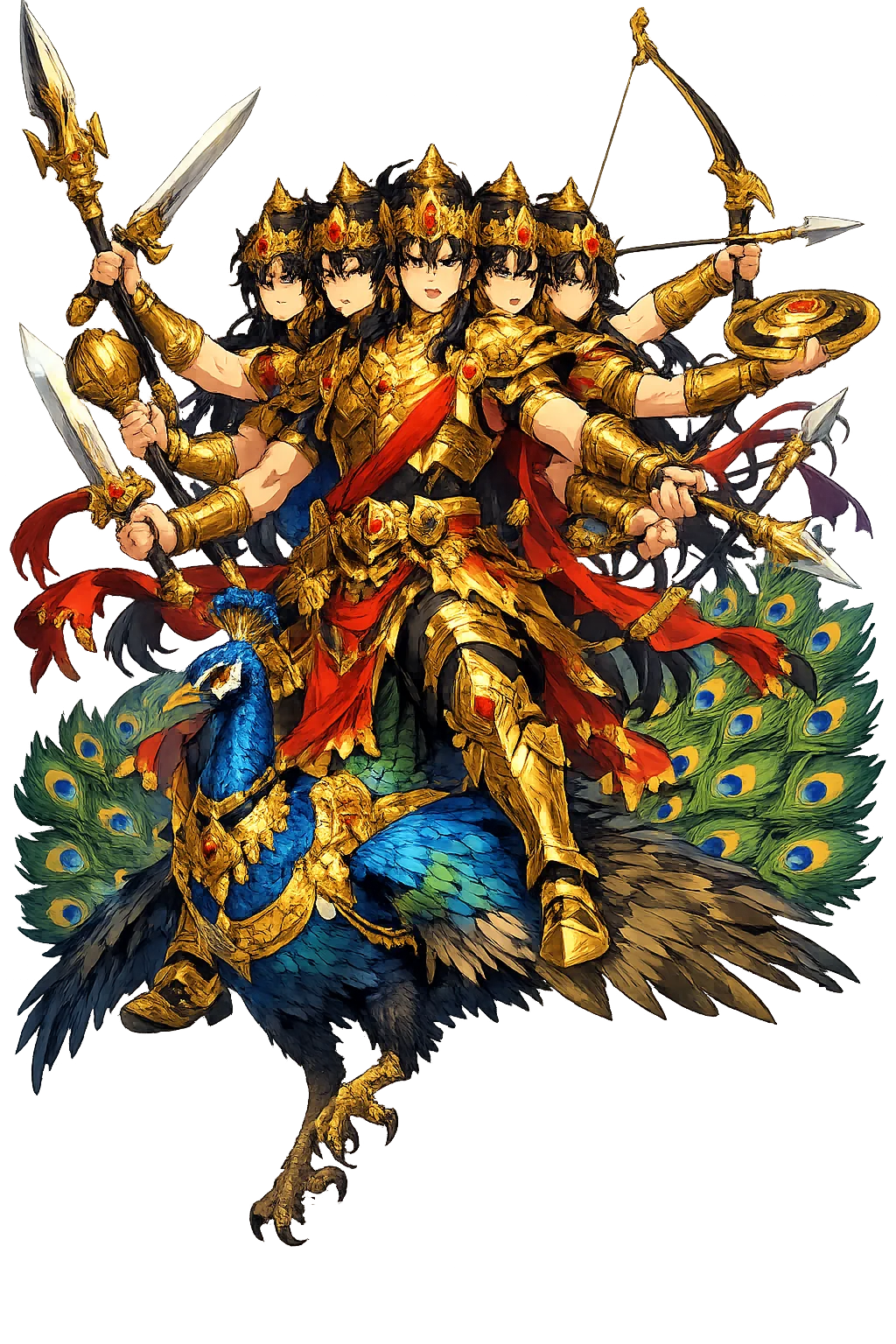
Stories of Kārttikeya
Kārttikeya's myths are the war-god's perfect résumé: born of fire and stars for one battle, victorious at seven days old, and never outgrown by the cults that made him their own. The Sanskrit epics and Kālidāsa give the north's version; the Tamil Sangam and the Kanda Purāṇam give the south his second, greater career.
The demon Tārakāsura had ravaged heaven for a thousand years under a boon: only a son of Śiva could kill him — and Śiva sat in ascetic mourning for his dead wife Satī, unmoved by gods, weapons, or time. The gods dispatched Kāma, god of desire, to shoot the ascetic; Śiva burned Kāma to ash with his third eye — and the seed of the awakened god was too hot for any bearer. Agni swallowed it and could not hold it; Gaṅgā took it and laid it in a thicket of reeds (śaravana); there the seed became six infants, found and suckled by the six Kṛttikā stars, the Pleiades (Mahābhārata, Vana Parvan's account of Skanda's birth; Kālidāsa, Kumārasambhava 13–15). Pārvatī pressed the six babies into one child with six heads — Ṣaṇmukha. Born of fire, carried by water, raised by stars, and fused by a mother's hands: no single parent could hold him, because every element conspired to make him.
While he was yet a week old, the gods elected the child senāpati — commander-in-chief of the armies of heaven — and his mother gave him the spear, the vel, that is his name and his body in every temple (the Mahābhārata's Skanda cycle; the Purāṇic accounts; Kālidāsa closes the Kumārasambhava with the gods' acclamation, canto 17). At the head of the gods' host he assaulted Tārakāsura's mountain fortress. The demon who had beaten Indra's thunderbolt and every weapon of the pantheon fell to a week-old general with his mother's spear; the thousand-year war ended in a single engagement. The tradition means the arithmetic exactly: the war the adults could not win, the infant finished, because force without freshness is only habit. The war-god who was never young enough to be underestimated is the pantheon's permanent argument that readiness is a decision, not an age.
His second great myth is his own migration. The Tamil Sangam anthology praises Murukan — 'the Beautiful' — in the Tirumurukāṟṟuppaṭai, one of the earliest long poems in the language, which maps his six hill-abodes (the later Arupadai Veedu) and already knows him as lord of love as well as war. In the south he wooed and won two wives: Devayānai, daughter of Indra, given to him for the Tāraka victory — the court marriage; and Vaḷḷi, the huntress of the hills, won by disguise and persistence in the telling preserved by the Kanda Purāṇam — the mountain marriage. The fuller cycle makes the theology explicit: the Sanskrit war-god and the Tamil hill-god are one, and his household itself marries the two civilizations. The commander who conquered Tāraka's fortress with one spear conquered a whole second civilization without drawing it — conquest by being loved, the one victory his father never managed.
His living myth is the most extreme devotion in Hinduism. The temple legends of Palani tell its charter: Śiva ordered the asura Idumban to carry two hills — Śivagiri and Śaktigiri — slung on a shoulder-pole like a milkman's yoke, from Kailasa to the far south. Resting at Palani, Idumban found the hills suddenly occupied by a child who would not move them back; he fought the boy, fell, and was restored to life and made the guardian of the hill — and the pole-and-burden he carried became the kavadi his devotees still bear. At Thaipusam, at the Kṛttikā-star full moon, millions carry milk-pots and wooden kavadis, some pulling chariots with hooks in their skin, some piercing cheeks and tongues with small spears — the body offered to match the god's gift. From Palani to Sri Lanka's Kataragama to Malaysia's Batu Caves, the war-god's festival is among the largest religious gatherings on earth, and its charter is a demon taught that what the god asks you to carry, he will help you carry.
War, Youth, the Spear, and the Six-Faced One
Kārttikeya is India's god of war at his most beautiful: the six-faced son of Śiva, raised by six star-mothers, who took the spear at seven days old and destroyed the demon no god could touch — and who rides his peacock still through the temples of two nations that call him their own.
His spear — the lance of victory over the unconquerable, given by his mother and sharp at seven days.
The Kṛttikās — the Pleiades who found him in the reed-thicket and nursed him, giving him his name.
Ṣaṇmukha: the six-faced god who sees every direction at once — the commander's total field of view.
His mount — the war-bird that eats serpents, whose dance is also a weapon.
From the original script to the living URL
कार्त्तिकेय
The name in its original Sanskrit form. Kārttikeya (कार्त्तिकेय) is attested in the source tradition — “Son of Krittika”. Its macron-length vowels carry the full phonetic and orthographic weight of the source tradition.
kartikeya
Reduced to plain kartikeya, the name loses everything that made it specific: macron-length vowels. What remains is an ASCII string that machines can parse but that no longer speaks with its original voice.
Kārttikeya
The Unicode restoration recovers what ASCII flattened. Kārttikeya restores macron-length vowels, returning the name to its original written dignity. The domain encodes to Punycode, but the browser displays the truth.
Kārttikeya.com → xn--krttikeya-5bb.com
The non-ASCII characters in Kārttikeya are encoded while the ASCII remains visible. To the DNS, it is Punycode. To humanity, it is Kārttikeya.
Owned, ideal, and ASCII forms of Kārttikeya
Kārttikeya
Restores कार्त्तिकेय. The live temple domain — kārttikeya.com.
kartikeya
Flattens कार्त्तिकेय. The plain ASCII fallback — what DNS and legacy systems see.
How Kārttikeya was spoken
How Kārttikeya travels from ancient script to the modern URL
The lore you have read is the living myth. Extended Lore opens the scholarly vault beneath it: the cult and its material remains, a history of the image, the name after antiquity, a meditation on what the name still means, and the full scholarly apparatus — etymology, orthography, sources.
Enter Extended Lore