PuniCodex

Extended Lore

कार्त्तिकेय Kārttikeya

Etymology · Orthography · Cult · Iconography · Reception · Sources

Tier 1 Kārttikeya.com
Kārttikeya — War, Commander of Gods
01

Quick Facts

Essential information about Kārttikeya, War, Commander of Gods

Original Scriptकार्त्तिकेय
Unicode RestorationKārttikeya
Reconstructed Pronunciation/kaːr.t̪i.keː.jɐ/
PantheonSanskrit
DomainWar, Commander of Gods
MeaningSon of Krittika
ClassificationTier 1
Primary DomainKārttikeya.com
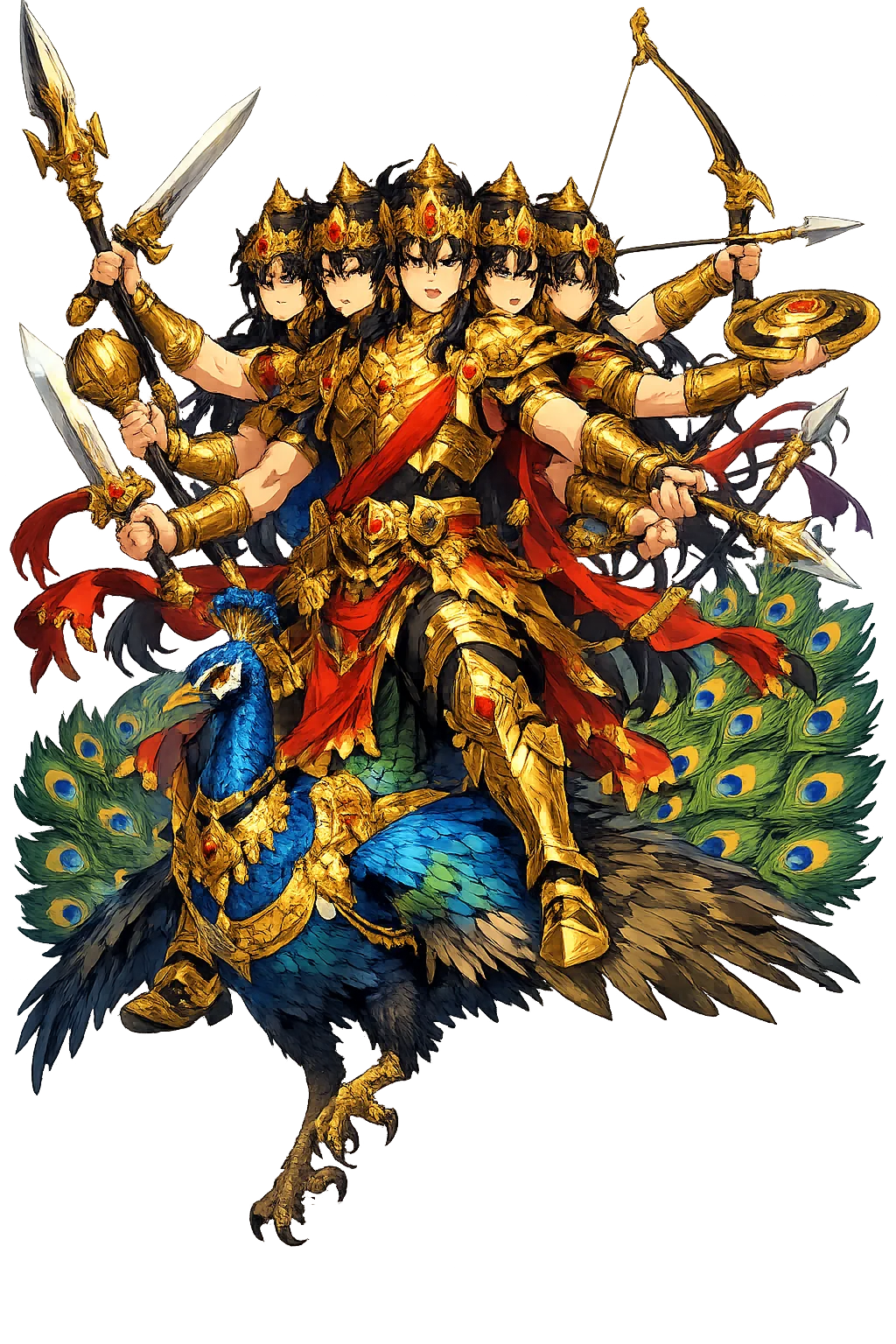
Sacred SymbolsThe vel (spear), The six faces, The peacock, The Kṛttikās, the Pleiades, The rooster on his banner
02

Etymology & Word Family

From original script to Unicode restoration

Original Script कार्त्तिकेय Kārttikeya — "Son of Krittika"
Unicode Restoration Kārttikeya Restored stress, length, and script
Modern ASCII kartikeya Plain-ASCII fallback

The name Kārttikeya carries the orthographic signature of the sanskrit tradition: कार्त्तिकेय. Unicode restoration recovers what ASCII flattens.

03

Unicode Character Breakdown

Character-by-character philological analysis

CharacterUnicodeNameBlockPhonetic Role
KU+004BLatin Capital Letter KBasic LatinSame, capitalized
āU+0101Latin Small Letter A with MacronLatin Extended-ALong vowel
rU+0072Latin Small Letter RBasic LatinSame
ttU+0074Character U+0074Basic LatinGeminate tt of क्त (Kārttikeya)
iU+0069Latin Small Letter IBasic LatinSame
kU+006BLatin Small Letter KBasic LatinSame
eU+0065Latin Small Letter EBasic LatinSame
yU+0079Latin Small Letter YBasic LatinSame
aU+0061Latin Small Letter ABasic LatinSame

The Tier 1 classification reflects how much of the original phonology this restoration preserves — stress and vowel length for Greek names, distinctive letters and diacritics for every other tradition.

04

Cult & Worship

How the sacred was kept — rites, sanctuaries, remains

The Cult

Murugan is worshipped through an intense Tamil devotional calendar: Vaikasi Visakam marks his birth, Skanda Shasti celebrates the defeat of Surapadma, and Thai Pusam draws millions of devotees carrying kavadi to Palani and Batu Caves. The six-headed Shanmukha is tended by hereditary priests at temples from Tamil Nadu to Sri Lanka and Malaysia, where daily abhishekam, flower offerings, and the recitation of the Kanda Purāṇam bind local shrines into a single sacred geography. His consorts Valli and Deivanai share the sanctum and the festival processions.

In the Earth

His iconography is fixed from the Kushan horizon: the six-headed Shanmukha appears on the coinage of the Yaudheya republic (Punjab-Haryana, ca. 2nd century BCE – 3rd century CE), among the oldest datable named god-images in India. The Palani temples of Tamil Nadu, the Kataragama complex in Sri Lanka, and Malaysia's Batu Caves (272 steps, the world's tallest Murugan statue at 42.7 m) map his living empire. The Yaudheya coinage is the crucial witness: a republic, striking a six-headed god on its money a century and more before most of his temples were built — proof that the commander enlisted human devotees before he had any stone.

05

Iconography

How Kārttikeya was imaged across the ages

The Image

The Kushan-era Yaudheya coins give the earliest named image: a six-headed youth with a spear, already marked by the name Skanda. Later Chola bronzes refine the type into a graceful standing warrior holding the vel, mounted on a peacock and attended by his divine consorts Valli and Deivanai. The 42.7-meter Batu Caves colossus in Malaysia translates this iconography into modern monumental scale, while Southeast Asian images adapt Skanda/Murugan into local Buddhist and Hindu visual programs across Thailand, Cambodia, and Indonesia.

06

Reception & Transformation

The name after its own age — transmission, translation, survival

Afterlives

Kārttikeya moved from the Sanskrit epics into Tamil bhakti literature, above all the Tirumurukāṟṟuppaṭai, which mapped his shrines and praise across the Tamil landscape. The Palani and Kataragama traditions carried him to Sri Lanka and then to the Tamil diaspora in Malaysia, Singapore, Mauritius, and the West. Colonial scholars classified him as a Dravidian war god, while modern temples, cinema, television serials, and global Hindu festivals have made Murugan a transnational deity. Contemporary musicians and diaspora youth organizations now broadcast his festivals online, extending the devotional network beyond its historic geography. His reception thus records both the regional Sanskritization of a local mountain god and the dispersal of Tamil religion overseas, increasingly mediated by temple tourism, digital devotion, and diaspora philanthropy.

Identifications Across Traditions

His Tamil identity (Murugan) is the subcontinent's great syncretic achievement: a Sanskrit god fully naturalized in Dravidian soil — the Sangam poems praise him centuries before most Purāṇas were compiled — then exported with Tamil migration to Sri Lanka (Kataragama, where Hindu, Buddhist, and Vedda devotees share one altar), Malaysia, Singapore, Mauritius, South Africa, and Fiji. The Kataragama pilgrimage's multifaith congregation is his unique achievement among the gods: the commander of everyone's armies. In the north he was gradually absorbed by the rising cult of Gaṇeśa — the two sons of Śiva trading popularity century by century — while in the deep south the balance never shifted: Murugan is the most-loved male deity of Tamil Nadu, and his cult never needed to migrate, because the land itself adopted him.

Modern Legacy

Murugan is the most-loved male deity of Tamil Nadu; his six Palani hill-temples are among India's busiest, and Thaipusam at Batu Caves draws well over a million pilgrims annually past a 42.7-metre statue — the tallest Murugan image in the world. His vel decorates everything from Tamil school emblems to the Kataragama flag, and the rooster on his banner announces the hour of worship in a hundred towns. The war-god who was born in a week is also the one who never grew old — the eternal youth of two civilizations, still riding the peacock, his spear still the first word of the Tamil schoolchild's prayer and the last word of the grandmother's blessing.

07

The Meditation

What Kārttikeya means — beyond the dictionary

Kārttikeya is the god of arriving exactly as needed. Six mothers, one spear, seven days: nothing in his story wastes a moment. He asks the commander's question, which is also every late-starter's and every young team's: what are you waiting to grow up for — and what would you take on, if you knew you were already enough?

The spear has not dulled: the six hills still fill, the milk-pots still rise, and the Pleiades still rise over Palani in his season, the six star-mothers keeping their appointment with the son. Astronomy and affection never separated in his cult: look up, the stars; look down, the hills; look inward, the spear. The peacock deserves its own line — the war-bird that eats the serpent, dancing at his approach — pride made useful, display made dangerous. His whole household is like that: six mothers, six faces, one spear, zero hesitation. One battle, properly timed, permanently won; and then, like a good commander, letting the calendar do the remembering.

08

Frequently Asked Questions

Common questions about Kārttikeya, War, Commander of Gods, and Unicode restoration

01How do you pronounce Kārttikeya?

In reconstructed pronunciation, Kārttikeya is /kaːr.t̪i.keː.jɐ/ — approximately KAHR-tih-kay-yah — the first vowel long, e always long in Sanskrit.

02What does Kārttikeya mean?

Kārttikeya means Son of Krittika in the sanskrit tradition.

03What are the symbols of Kārttikeya?

Kārttikeya is associated with The vel (spear) (Focused force — the weapon that ends what the assembled gods could not), The six faces (Total sight — the commander who misses nothing on any battlefield), The peacock (Pride harnessed to war — beauty made battle-standard), The Kṛttikās, the Pleiades (Foster-motherhood raised to the heavens — the stars that named him), The rooster on his banner (The war-crow announcing dawn — vigilance that never sleeps).

04Why restore Kārttikeya in Unicode?

Plain ASCII kartikeya strips the stress, length, and script that make the name specific. Unicode restoration returns the name to its original written dignity.

05What is the most important myth about Kārttikeya?

“The Son of Fire and Stars” — the Mahabharata · Kumārasambhava story that anchors the mythology of Kārttikeya, told in full on the lore page.

09

Scholarly Sources

The philological foundations of this restoration

Every claim on this page is grounded in established scholarship. The orthographic restorations follow disciplinary convention. The etymological chain follows the best available reference works. This is not invention — it is resurrection through scholarship.

◈

Lexicography & Philology

  • MW
  • RV
◎

Primary Texts

  • Skanda Purāṇa; Kanda Purāṇam (Tamil)
◉

Archaeology & Art History

  • Material evidence — iconography, inscriptions, and temple archaeology — for Kārttikeya and related cults.
✦

Religious Studies

  • Mahābhārata, Vana Parvan (the birth and deeds of Skanda)
  • Kālidāsa, Kumārasambhava, cantos 13–17
  • Tirumurukāṟṟuppaṭai (Sangam anthology)
  • Fred W. Clothey, The Many Faces of Murukan (1978)
  • Monier-Williams, Sanskrit-English Dictionary, s.v. kārttikeya
Return

The Surface Awaits

You have traced the name from its earliest attestation to its Unicode restoration. Now return to the myth. The story is where the name lives.

Back to Lore
Kārttikeya mascot