The Living Myth
Temple Complex, Amun · The Fortified Village, Temple of Amun · Fortified village
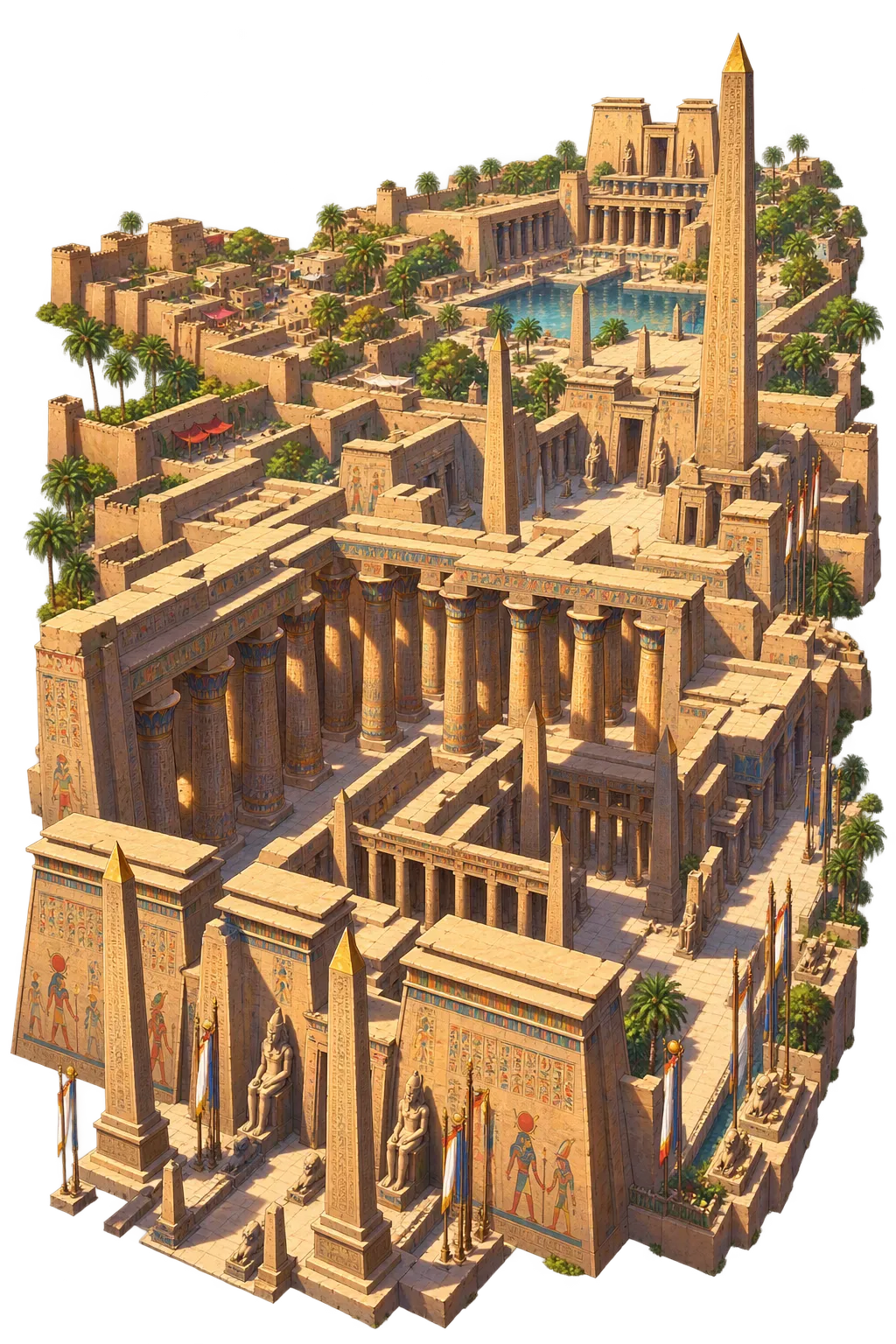
Stories of Karnak
Karnak’s ‘mythology’ is architectural: every pylon is a cosmogonic statement, every obelisk a frozen sunbeam, every festival route a replay of the gods’ first processions. The complex’s ancient name, Ipet-isut, names the selection of this ground out of all possible grounds — the one place the god chose.
The temple theology held that Amun’s staff, planted in the ground of Thebes at the world’s beginning, designated Ipet-isut as his estate — ‘the most select of places’. Each new king’s building programme was framed not as innovation but as the staff’s ancient will, finally fulfilled.
In the great Opet festival, Amun’s barque sailed the canal from Karnak to Luxor temple and back — the Theban gods’ annual renewal of their own marriage with the city. The avenue of ram-headed sphinxes, restored today, was the procession’s road; the festival’s reliefs cover Karnak’s walls.
Seti I’s gallery of kings, the Karnak King List, names the legitimate succession from the ancestors — a theology of history in stone, in which every true king is one who kept the ‘Most Select of Places’ in repair. The list omits the heretics, editing eternity.
Cleared by the French expedition of 1799, Karnak became the first Egyptian temple to be systematically published — the Description de l’Égypte’s plates fixed its image in the world’s imagination. Champollion walked its halls reading the walls aloud; the decipherment of Egypt effectively happened here.
Ipet-isut, the Most Select of Places
Karnak is not a god but a god’s address: the ‘fortified village’ whose ancient Egyptian name — Ipet-isut, ‘the Most Select of Places’ — declared it the estate where Amun-Ra kept his chosen ground. As a lexicon entry it stands for the temple-complex itself, the largest religious structure ever built, accumulated by thirty pharaohs over two thousand years.
A forest of 134 columns under one roof — the largest columned hall ever raised.
The god’s ‘mansion’ on earth; the cult image dwelt here in a daily liturgy of waking, washing, and feeding.
Every dynasty added a pylon, an obelisk, a hall — the temple is Egypt’s history carved in sequence.
Its rectangular lake staged the primeval waters for the priests’ dawn ablutions.
From the original script to the living URL
Karnak
The name survives in scholarly transliteration. Karnak is the standard Egyptian romanisation, documented in academic sources — “Fortified village”. Because the spelling uses only Latin letters, the form is the same in both ASCII and Unicode.
The original script for this egyptian name has not yet been added to PUNICODEX. The form shown is a scholarly transliteration.
karnak
The plain karnak form is identical to the Unicode restoration. Because this name is already written in Latin letters, no diacritics, stress, or script information were lost — only capitalization differs.
Karnak
The Unicode restoration does not need to recover lost marks for Karnak. Its value is canonical spelling and consistent cataloguing, not the reconstruction of erased orthography. The domain is readable as-is to both DNS and humanity.
Karnak.com
This restoration is written entirely in ASCII letters — no Punycode encoding stands between Karnak and the DNS. The domain reads identically to machines and to human eyes.
The attested spelling family of Karnak
Karnak
The full Unicode restoration. karnak.com is not in the PuniCodex collection — it is watched for release; if it drops, this temple upgrades to an owned flagship. Attested by Egyptology, Faulkner.
How Karnak was spoken
How Karnak is preserved in writing
A bespoke provenance study for Karnak is being prepared by the PUNICODEX scholarly team.
Contribute scholarly provenance →The lore you have read is the living myth. Extended Lore opens the scholarly vault beneath it: the cult and its material remains, a history of the image, the name after antiquity, a meditation on what the name still means, and the full scholarly apparatus — etymology, orthography, sources.
Enter Extended Lore