
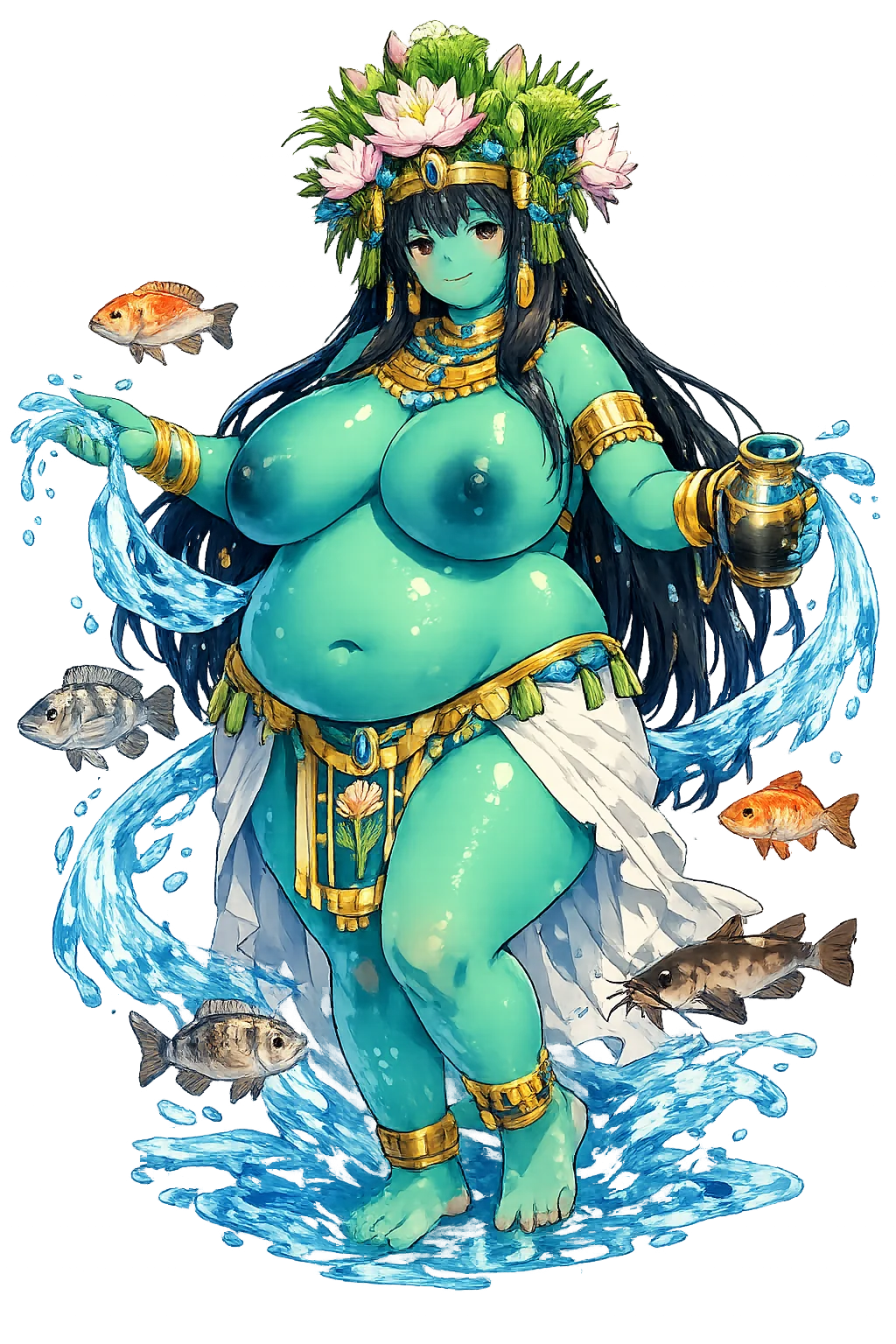
Ḥꜥpy walks into a agriculture, food & harvest firm
Walk into any agriculture, food & harvest outfit and watch for ten minutes. You will see a very old act performed with newer props. The act has a name. It is Ḥꜥpy.
Before the Office, the Story
The Hymn to Hapi. The great Hymn to Hapi — copied by schoolboys for a thousand years, its finest witnesses New Kingdom papyri (Lichtheim, Ancient Egyptian Literature, vol. 1) — is the flood's own voice. It calls him 'lord of fish and fowl, maker of barley, creator of wheat,' and praises the land's dependence in the plainest economics ever put into verse: when he rises, 'the whole land rejoices'; when he fails or arrives thin, 'the whole land is in panic' and the granaries stand empty.
The Tying of the Two Lands. On temple walls from Karnak to Dendera, ḥp appears doubled: one figure crowned with the papyrus of the Delta, one with the lotus of the south, the two of them knotting the plants around the hieroglyph of the windpipe — sema-tawy, 'the uniting of the Two Lands. ' The image is everywhere because it says everything: Egypt is not two countries with a god each but one body with one flood. The device is already Old Kingdom; it climbs onto royal thrones, onto the sides of ceremonial footstools, into the ground-plans of temples, until the nation's founding act — the union of Upper and Lower Egypt — is performed annually by the rising water.
At a Glance
- Temple: Ḥꜥpy
- Pantheon: Egyptian
- Domain of influence: Nile, Inundation, Abundance
- Pattern seats: 3
- Sectors touched: Energy & Natural World · Commerce & Governance
- Strongest seat: Agriculture, Food & Harvest
- Series: The Resonance Files, No. 218 of 546
The Reveal, Seat by Seat
Agriculture, Food & Harvest
Now read the why-line with the office in mind: The flood that feeds; silt, season, and harvest as one god. The people doing this work did not borrow the archetype. They re-derived it — the way Ḥꜥpy was always going to be re-derived wherever nile, inundation, abundance matters.
Freshwater & Hydrology
The flood itself, metered by nilometers for three thousand years. Nobody in that trade worships at this temple. They just keep its hours.
Disaster Resilience & Recovery
Flood as the thing to measure and survive, not merely praise. Nobody in that trade worships at this temple. They just keep its hours.
Not the First Rebrand
The Greeks called him Neilos and gave the river-god a Greek biography — making him, in some accounts, father of Memphis and ancestor of the Danaid line that returned to Argos. The word "Nile" itself descends through this identification. The office is only the latest translation.
The Method, Stated Plainly
None of this is numerology. A seat exists only where the match can be argued from the deity’s documented domains and deeds — weighted, published, and falsifiable. The derivation, the weights, and the challenge process are public on the methodology page. If a seat in this file reads wrong, the atlas itself tells you how to prove it — and the correction becomes part of the record.
For the Ones Who Work There
For a sponsor in agriculture, food & harvest, the fit here is not adjacency — it is inheritance. Your trade already tells this story every working day; the temple simply holds the original. The patron tier and the advertising terms carry the mechanics; the myths above carry the reason.
The File Continues
This is one of 546 Resonance Files — the third dispatch from every flagship temple, where the myths meet the markets. The temple's founding dispatch tells the name's story; its Restoration File tells the spelling's; the blog index holds the whole archive.
Continue the series — previous: Hòuyì (read it) · next: Hrungnir (read it).
The Resonance Files are argued from the same canonical record as the pattern atlas itself: the lexicon, the lore catalog, and the cited sources. Every seat can be challenged at the methodology page — and the challenge is the point.