
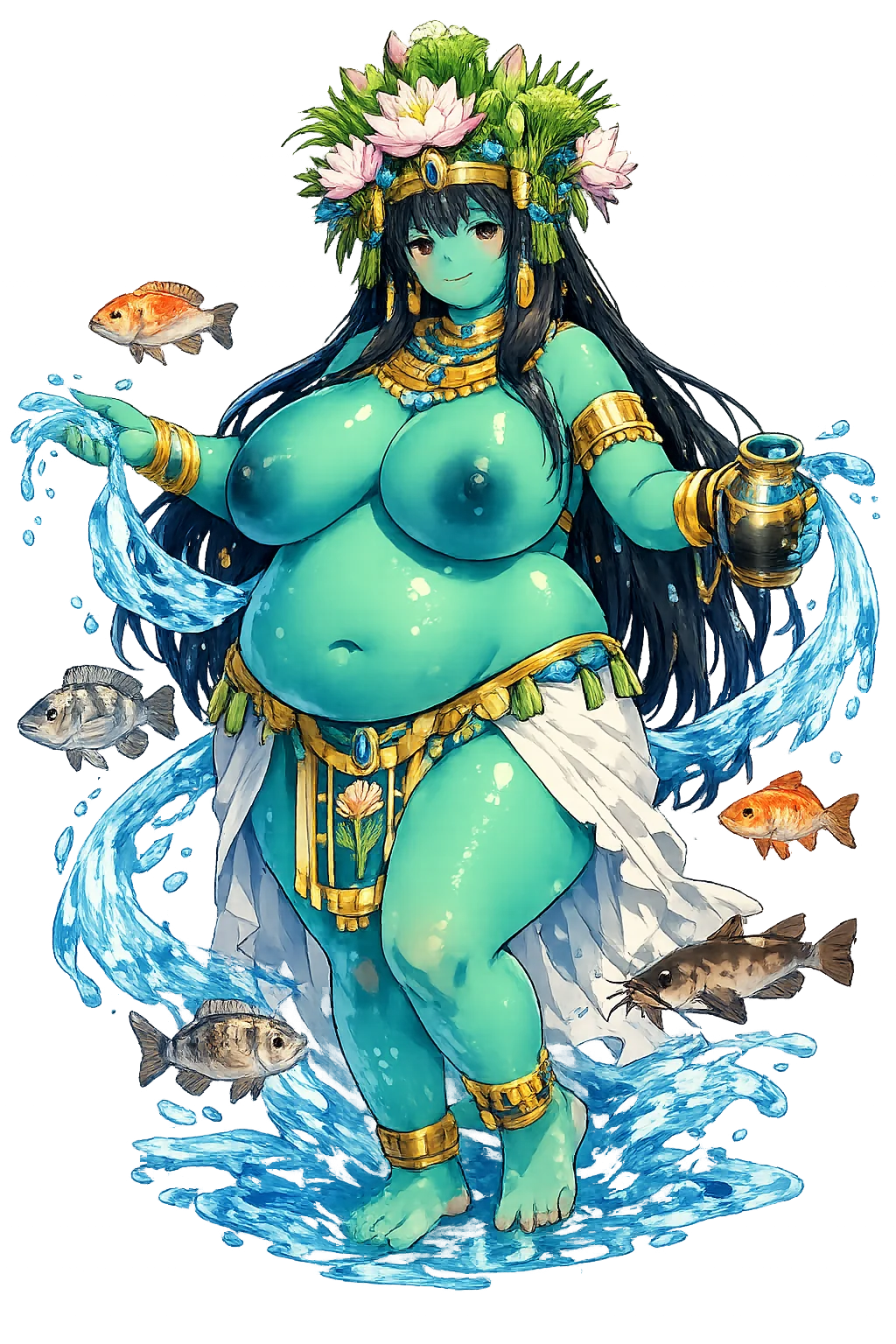
Ḥꜥpy: the stories first, then the spelling
The marks in Ḥꜥpy make the most sense standing next to the myths they have to carry. So the myths come first.
The Stories That Carry the Name
The Hymn to Hapi. The great Hymn to Hapi — copied by schoolboys for a thousand years, its finest witnesses New Kingdom papyri (Lichtheim, Ancient Egyptian Literature, vol. 1) — is the flood's own voice. It calls him 'lord of fish and fowl, maker of barley, creator of wheat,' and praises the land's dependence in the plainest economics ever put into verse: when he rises, 'the whole land rejoices'; when he fails or arrives thin, 'the whole land is in panic' and the granaries stand empty.
The Tying of the Two Lands. On temple walls from Karnak to Dendera, ḥp appears doubled: one figure crowned with the papyrus of the Delta, one with the lotus of the south, the two of them knotting the plants around the hieroglyph of the windpipe — sema-tawy, 'the uniting of the Two Lands. ' The image is everywhere because it says everything: Egypt is not two countries with a god each but one body with one flood. The device is already Old Kingdom; it climbs onto royal thrones, onto the sides of ceremonial footstools, into the ground-plans of temples, until the nation's founding act — the union of Upper and Lower Egypt — is performed annually by the rising water.
The Caverns of the Nile. Where did the flood come from? Egyptian geography said the First Cataract at Elephantine, and Egyptian imagination supplied the rest: subterranean caverns beneath the island where the ram-headed potter Khnum sat at his wheel, shaping the flood and with it the bodies of kings — the tale of Khnum's claim is enshrined on the Ptolemaic Famine Stela at Sehel Island. ḥp dwelt in those cavern-waters with the earth-god and the abyss; the cataract's granite roar was the sound of the flood's door opening.
And Here Is What the Spelling Preserves
At a Glance
- Restored name: Ḥꜥpy
- ASCII form: hp
- Meaning: "The Nile flood god Hapi; from ḥꜥpj"
- Domain of influence: Nile, Inundation, Abundance
- Pantheon: Egyptian
- Classification: Tier 1
- Original script: 𓎛𓂝𓊪𓏭𓈘
- Series: The Restoration Files, No. 218 of 546
The Name Travels
The Greeks called him Neilos and gave the river-god a Greek biography — making him, in some accounts, father of Memphis and ancestor of the Danaid line that returned to Argos. The word "Nile" itself descends through this identification.
The Address It Earned
The temple of Ḥꜥpy stands at /hp/ — lore, scholars, patterns — because a name carrying this much story deserves more than a parking page. The restoration preserves more than the ASCII form can express — stress, length, or a letter the Latin keyboard lost — which places it, mechanically, in Tier-1.
The Sources Are Open
The myths above are retold from the temple's record; the primary voices are in the Sacred Texts: The Book of the Dead. Nothing in this file outranks them.
The File Continues
Read the founding dispatch for the name's full story, the Resonance File for the archetype at work — or the whole archive in one sitting.
Continue the series — previous file: Hòuyì (read it here) · next file: Hrungnir (read it here).
The Restoration Files are written from the same canonical record as the temples themselves: the lexicon, the lore catalog, the pattern atlas, and the cited scholarly sources. If a file ever disagrees with its temple, the temple is right — tell us, and the file will be corrected.