
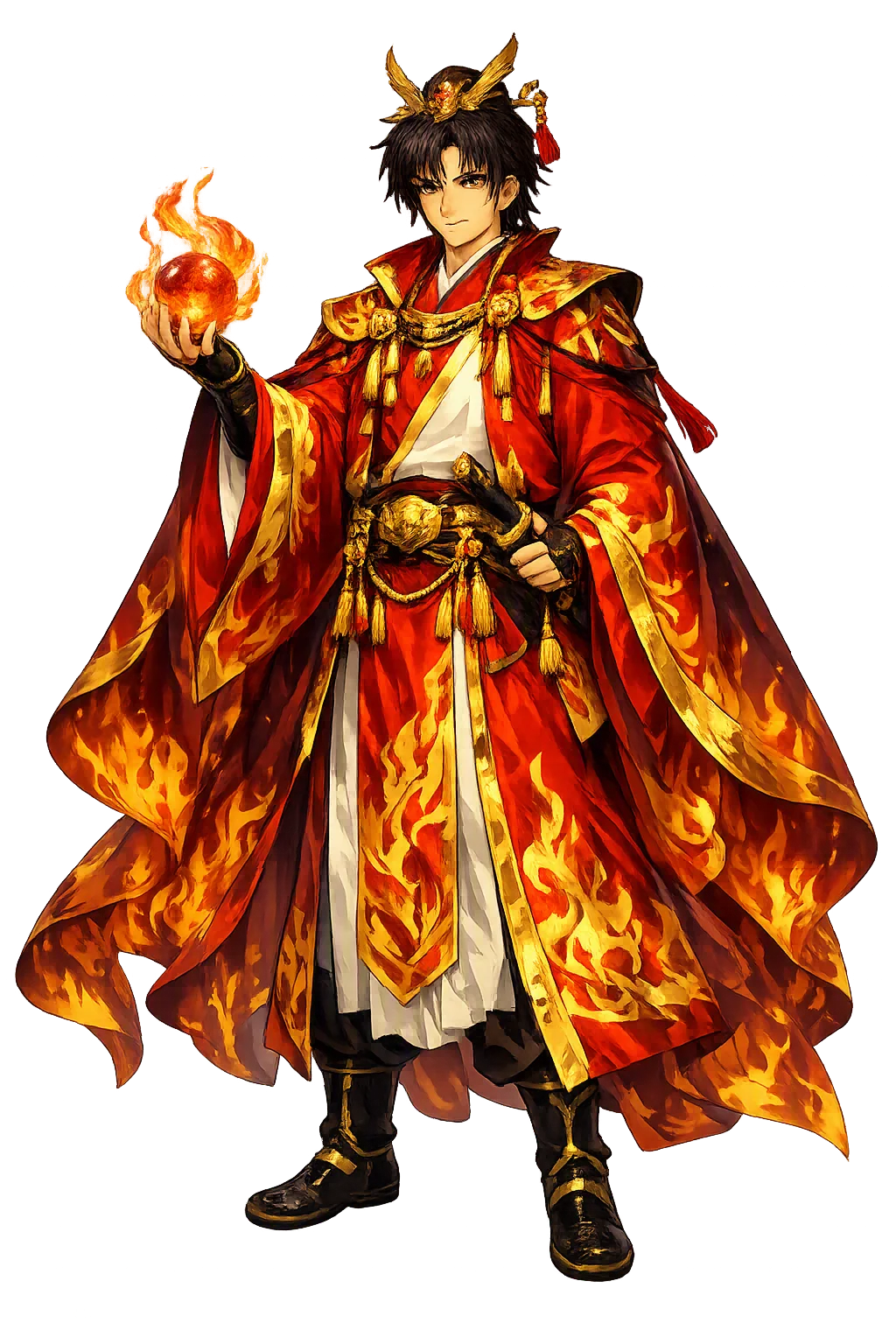
Pronouncing Hoderi: a guide for the curious
Saying Hoderi aloud requires more than reading Latin letters on a screen. The conventional spelling is only the entry point into a reconstructed sound and a much older tradition. This post unpacks that sound, the Japanese characters evidence, the kindred forms, and the mythological record, then shows how the temple preserves the whole argument without pretending that a diacritic was ever lost.
At a Glance
- Canonical name: Hoderi
- ASCII form: hoderi
- Meaning: "Fire-shining"
- Domain of influence: Fire, Fisherman
- Pantheon: Japanese
- Restoration: ASCII-equivalent form
- Original script: 火照命 (Japanese characters)
Overview
Hoderi (hoderi) — Fire, Fisherman · Fire-shining — belongs to the Japanese tradition, where it is catalogued under the domain "Fire, Fisherman". The name means "Fire-shining".
Hoderi is the elder son of the heavenly grandson Ninigi and the blossom princess Konohana-Sakuya-hime. His name means 'Fire-Shining,' and he was gifted with the fishhook that made him master of the sea. His story turns on the rivalry with his younger brother Hoori, a conflict that costs him his birthright and sets the imperial line on a new path.
PuniCodex records the canonical scholarly spelling Hoderi and serves its temple at its temple. The displayed form is ASCII-equivalent — a description computed from the displayed form itself. The plain ASCII form hoderi contains the same letters: no recovered diacritics or special encoding is claimed. The work here is consistent citation, capitalization, provenance, and cultural context.
The Name
The name is attested in Japanese characters as 火照命. Etymologically it means "Fire-shining".
The canonical spelling Hoderi matches the conventional scholarly romanization. The plain ASCII form hoderi contains the same letters, so no lost diacritics or encoding transition is claimed. The editorial work is to fix one reviewed reference spelling, preserve capitalization and provenance, and keep the original evidence visible. The displayed form is ASCII-equivalent — a description computed from the displayed form itself.
The letter-by-letter transformation runs:
- h → H — Same, capitalized
- o → o — Same
- d → d — Same
- e → e — Same
- r → r — Same
- i → i — Same
The Original Script
The name is written in Japanese characters as 火照命. That attested script remains the primary evidence for the conventional romanization Hoderi. The canonical Latin spelling does not pretend to recover marks it never contained: it fixes one reviewed reference form while leaving the original script visible for comparison.
The Kojiki writes 火照命 (Hoderi-no-mikoto) — 火 'fire' + 照 'to shine' + 命 'lord': 'the fire-shining lord'. His brother is 火折命 (Hoori), 'fire-subduing lord', and the pair form a deliberate semantic antithesis — one name burns steady, the other breaks the burning. The characters are the chronicle's own gloss on a rivalry between sea-harvest and mountain-hunt; whether the brothers' names preserve an older ritual pairing is plausible but unprovable.
Pronunciation
The reconstructed pronunciation of the name is /ho.de.ɾi/ — Modern Standard Japanese (Hepburn).
Phoneme by phoneme:
- Ho- — Voiceless glottal [h] plus open-mid back [o]; from 火 'fire'
- -de- — Voiced alveolar stop [d] plus close-mid [e]
- -ri — Alveolar tap [ɾ] plus close front [i]; from 照 'shining'
For the modern speaker, the closest approximation is: 'HOH-deh-ree' — the 'r' is a light tap, and all vowels are short and clear.
Kindred and historical forms of the name:
- Japanese — 火照命 (Hoderi-no-mikoto), 'Fire-Shining Prince'
- Brother — Hoori (Fire-Subduing Prince), his younger brother
- Parents — Son of Ninigi and Konohana-Sakuya-hime
Hoderi keeps its restoration plain: plain Hepburn. He is a minor but structurally important figure in the imperial genealogy.
Mythology
Hoderi's story in the Kojiki is a tale of sibling rivalry, the exchange of gifts, and the transfer of sovereignty from the sea to the land. He is the elder son, the firstborn of Ninigi, destined to be bypassed — and Japan's two oldest histories tell his falling-short with different temperaments, and the difference is itself instructive.
The Exchange of Gifts (Kojiki)
When Ninigi's sons grew up, he divided the world's livelihood between them: to Hoderi, the elder, he gave the fishhook that rules the sea; to Hoori, the younger, the bow and arrow that rule the mountains (Kojiki, age of the gods). Hoori proposed that they exchange — he would try the sea, Hoderi the chase — and Hoderi agreed. But the sea resisted the stranger: Hoori fished for days and caught nothing, and in a fury he flung the precious hook into the waves. Hoderi's response was absolute: he would sooner lose a kingdom than his hook, and he demanded its return on pain of their brotherhood itself. Cornered, Hoori walked into the sea to answer for the loss. The exchange looks innocent but is the hinge of the whole cycle: a fisherman's tool, lost and owed, becomes the lever that moves sovereignty from elder to younger, from sea to land.
Hoori's Triumph (Kojiki)
Beneath the waves Hoori found not punishment but fortune: the palace of the sea god Watatsumi, and marriage to the god's daughter Toyotama-hime. From the sea's depths he sent the lost hook back to land — recovered, in the Kojiki's wry detail, from the throat of a sea bream — bearing a curse that turned against its owner: whatever it touched would fail and wither. Struck by the curse, Hoderi saw his stores dwindle and his luck collapse, until he came barefoot to his younger brother, begging terms. Hoori took the submission and the precedence; Hoderi gave him his daughter and his allegiance, and the elder line bent to the younger. The myth's meaning is economical and severe: legitimacy in the age of the gods does not follow birth order but the flow of fortune, and the sea, for all its plenty, could not hold the future that was gathering on the land.
Ancestor of the Hayato (Genealogy)
The Kojiki closes Hoderi's line not with extinction but with a dignified office: his descendants are the Hayato, a people of southern Kyūshū remembered in early Japanese records as warriors and as ritual specialists at the imperial court. Historically the Hayato appear in the eighth-century chronicles as a military people whose sons served the throne — an echo, scholars have long suspected, of a pre-Yamato population of the south absorbed into the imperial order on terms its own myth explains. The genealogy does double work: it gives the defeated elder brother a posterity, and it gives the victorious court a way to honor the people it absorbed, as ritualists rather than rebels. In Hoderi's house the myth means: the bypassed line is not erased but employed — the memory of the elder brother kept on the payroll of the younger's descendants.
The Tide Jewels of the Other History (Nihon Shoki)
The Nihon Shoki (720 CE) tells the same feud with different names and sharper weapons: the brothers are called Umisachihiko, Sea-Luck Lad, and Yamasachihiko, Mountain-Luck Lad, and the sea god arms the younger with the two tide jewels — one that floods, one that ebbs. When the elder attacks, the flooding jewel drowns him; when he begs, the ebbing jewel spares him, and he swears service to his brother's line, becoming — the genealogy agrees — ancestor of the Hayato. The Shoki's variant notes are harsher still: in one alternate account the elder brother does not survive the feud at all. Two official histories, two temperaments: the Kojiki converts defeat into service, the Shoki leaves the sea prince gasping on the tideline. Read together they show the early court arguing with itself about what to do with the elder line — absorb it lovingly, or drown it and call it law.
Symbols & Iconography
The iconography associated with Hoderi concentrates in a small set of recurring attributes, each a compressed statement about the name:
- Fishhook — The gift from Ninigi that gave him dominion over the sea
- Fire — His name associates him with shining heat and the brilliance of the sun
- Sea — The realm he was to master, contrasted with Hoori's mountains and fields
- Bow — The weapon by which he and Hoori disputed precedence
- Sea — The realm he was to master, contrasted with Hoori's mountains and fields
- Bow — The weapon by which he and Hoori disputed precedence
Archaeology & Evidence
Hoderi has no independent archaeological attestation — no shrine, image, or inscription names him — and his importance is textual and genealogical, preserved in the Kojiki's account of the imperial lineage and in the Nihon Shoki's parallel version. The historical echo of his myth is the documentary record of the Hayato themselves: the early chronicles (Shoku Nihongi and its predecessors) register Hayato delegations, military service, and ritual office at court from the eighth century, and southern Kyūshū place names and burial remains attest the ancient populations the genealogy claims as his children. The 'evidence' for Hoderi is thus a people remembered, not a stone inscribed.
Realm & Domain
Hoderi is the elder son of the heavenly grandson Ninigi and the blossom princess Konohana-Sakuya-hime. His name means 'Fire-Shining,' and he was gifted with the fishhook that made him master of the sea. His story turns on the rivalry with his younger brother Hoori, a conflict that costs him his birthright and sets the imperial line on a new path.
Master of the Sea
He received the fishhook and was meant to rule the waters.
Elder Brother
Firstborn of Ninigi, but destined to lose precedence to Hoori.
Tragic Competitor
His attempts to best Hoori end in the loss of his hook and his inheritance.
Ancestral Figure
Ancestor of the Hayato, a people of southern Kyūshū.
Across Cultures
Hoderi is primarily a genealogical figure, and his afterlife is interpretive. Shinto scholarship has long read him as the mythic signature of the sea peoples and older lineages of southern Japan folded into the Yamato order — his 'Fire-Shining' name suggests a solar brilliance eclipsed by the mountain brother's steady fire. The myth's structure invites comparison with other younger-son-victories in the imperial line (Ninigi himself was passed over for rule of heaven in favor of the narrative's landward mission), making Hoderi one link in a chain where sovereignty repeatedly detours around seniority. Buddhist and Confucian readers of later centuries found in him a lesson in the submission of fortune to virtue; modern folklorists find an ethnographic memory. He absorbed no foreign cult — the traffic ran the other way, his story naturalizing an absorbed people.
Kindred figures in the PuniCodex cross-tradition index include Hoori (elder and younger fire brothers), Ašeratu (sea / water), Ọbalúayé (sea / water), Benzaiten (sea / water), Brigid (fire / forge / craft), and Ēa (sea / water).
Cultural Legacy
Hoderi is little known outside scholarly and ritual contexts, but his story underlies one of the key narratives of Japanese origins: the transfer of legitimacy from sea to land, from elder to younger, and the inclusion of older peoples within the imperial frame. His name survives in Kojiki retellings, in schoolbook summaries of the age of the gods, and in the quiet pride of communities in southern Kyūshū whose traditions remember the Hayato. For modern readers he is the necessary counterweight to the imperial success story — the elder brother whose loss makes the victory legible, and whose descendants' service reminds us that Japanese identity was assembled, not simply inherited.
The Scholarly Record
The account of Hoderi given in this edition rests on the witnesses and reference works listed below. Lexica and etymological dictionaries secure the form and meaning of the name; the literary and religious texts supply the narrative evidence.
- Kojiki (Hoderi and Hoori cycle; Philippi, Donald L., Kojiki, Princeton University Press, 1969).
- Nihon Shoki (Aston, W. G., Nihongi: Chronicles of Japan from the Earliest Times to A.D. 697, 1896).
- Philippi, Kojiki.
A Meditation
Hoderi is the one who was passed over. Every national mythology crowns a winner; few pause over the brother who held the older claim. His story asks us to notice the elder — the sea, the firstborn, the rival who does not win — and to see how myths of defeat are woven into national identity. The Kojiki is gentle with him: he keeps his life, his daughter marries into the victor's house, his descendants hold honored office at the court that displaced him. Defeat, properly mythologized, becomes service; the bypassed line becomes the ritual memory that legitimizes the bypassing. Not every ancestor becomes emperor; some become memory — and memory, as the court understood, can be a more durable inheritance than the throne itself.
The Canonical Spelling
Hoderi is the canonical spelling used by this temple. The plain ASCII form hoderi contains the same letters, so there are no lost diacritics to recover and no special encoding transition to explain. What the temple preserves is the reviewed reference form: capitalization, conventional romanization, original evidence, and a stable place to inspect them. The value here is not added decoration; it is fidelity to the attested record.
Character by Character
The canonical form Hoderi and the plain ASCII form hoderi share the same letters. The character list therefore documents continuity rather than recovery: every character is carried forward deliberately, with capitalization serving as the proper-noun convention. No additional mark is inserted merely to make the restoration appear more elaborate.
The Japanese Pantheon
Hoderi is one of 45 entries the PuniCodex lexicon catalogues under the Japanese pantheon. The Pantheon page gathers the tradition's major figures in one place, and the Lexicon lets you filter all 983 restorations by tradition or script — the fastest way to see where this name sits among its kin.
Frequently Asked Questions
What does Hoderi mean? The traditional gloss is "Fire-shining."
Which tradition does Hoderi belong to? Hoderi is catalogued in the Japanese pantheon of the PuniCodex lexicon.
Does this name need recovered diacritics? No. Hoderi is already an ASCII-form canonical spelling. The scholarly work is to preserve the attested convention and its evidence, not to add marks.
Can I use Hoderi in a normal browser? Yes. The spelling works directly in an ordinary browser, and the type tool can confirm and copy the canonical form.
Where does the scholarly information come from? The entry is built from lexica, inscriptional evidence, and reviewed scholarly sources listed in the Scholarly Edition.
Typing Hoderi
You do not need a special keyboard to use this name. Hoderi already uses ordinary Latin letters. The PuniCodex Type Tool lets you confirm the canonical spelling and copy it cleanly, while the original-script notes in the temple show the evidence behind the romanization.
Sister Temples
Other temples in the Japanese pantheon include Ninigi, Raijin, and Susanō — each with its own restoration story, its own scholarly record, and its own place in the lexicon.
Why This Record Matters
Pronunciation turns out to be central to the matter. The canonical spelling of Hoderi is a guide to the voice, not an incomplete shell awaiting marks. The temple hands the instructions back: say the name as the evidence suggests, write it as the scholarly convention records it, and let the original sources remain visible beside it. That is the work of preservation here — and every reader can inspect it.
Explore Further
This post is one doorway into the temple. The home page carries the full character breakdown and the ambient canvas; the lore page tells the myths in long form; the Scholarly Edition preserves the sources, pronunciation data, and revision history; and the patron wall supports the restoration directly. For the wider map, browse the Lexicon, explore the Pantheon, or return to the PuniCodex blog.
A Closer Look at the Spelling
A canonical name is a small map. In the case of Hoderi, the route does not lead through diacritics or special letters, because the conventional scholarly spelling already uses the Latin alphabet. The original evidence — 火照命 in Japanese characters — carries semantic and phonetic information that no romanization can fully reproduce.
By fixing one reviewed spelling as the public reference, the project prevents the drift that occurs when a name is romanized differently in every article, map, and database. The character list shows exactly what is carried forward. "No change" here means a deliberate choice to keep the name stable, searchable, and faithful to the record.
Hoderi in Its Tradition
Hoderi does not stand alone. It belongs to the Japanese tradition, where it is counted among 45 names in the PuniCodex lexicon. Its sphere — Fire, Fisherman — places it beside other figures who govern similar aspects of experience. The canonical spelling keeps the name in the company of its kin and gives researchers one stable reference across the temples, the APIs, and the scholarly record.
Related Names
Sources
The full scholarly apparatus — every citation, revision, and review — lives in the Scholarly Edition. Key references for this post:
- Kojiki (Hoderi and Hoori cycle; Philippi, Donald L., Kojiki, Princeton University Press, 1969).
- Nihon Shoki (Aston, W. G., Nihongi: Chronicles of Japan from the Earliest Times to A.D. 697, 1896).
- Philippi, Kojiki.
- Lexicon authorities for this entry: Kojiki, Nihon Shoki.