
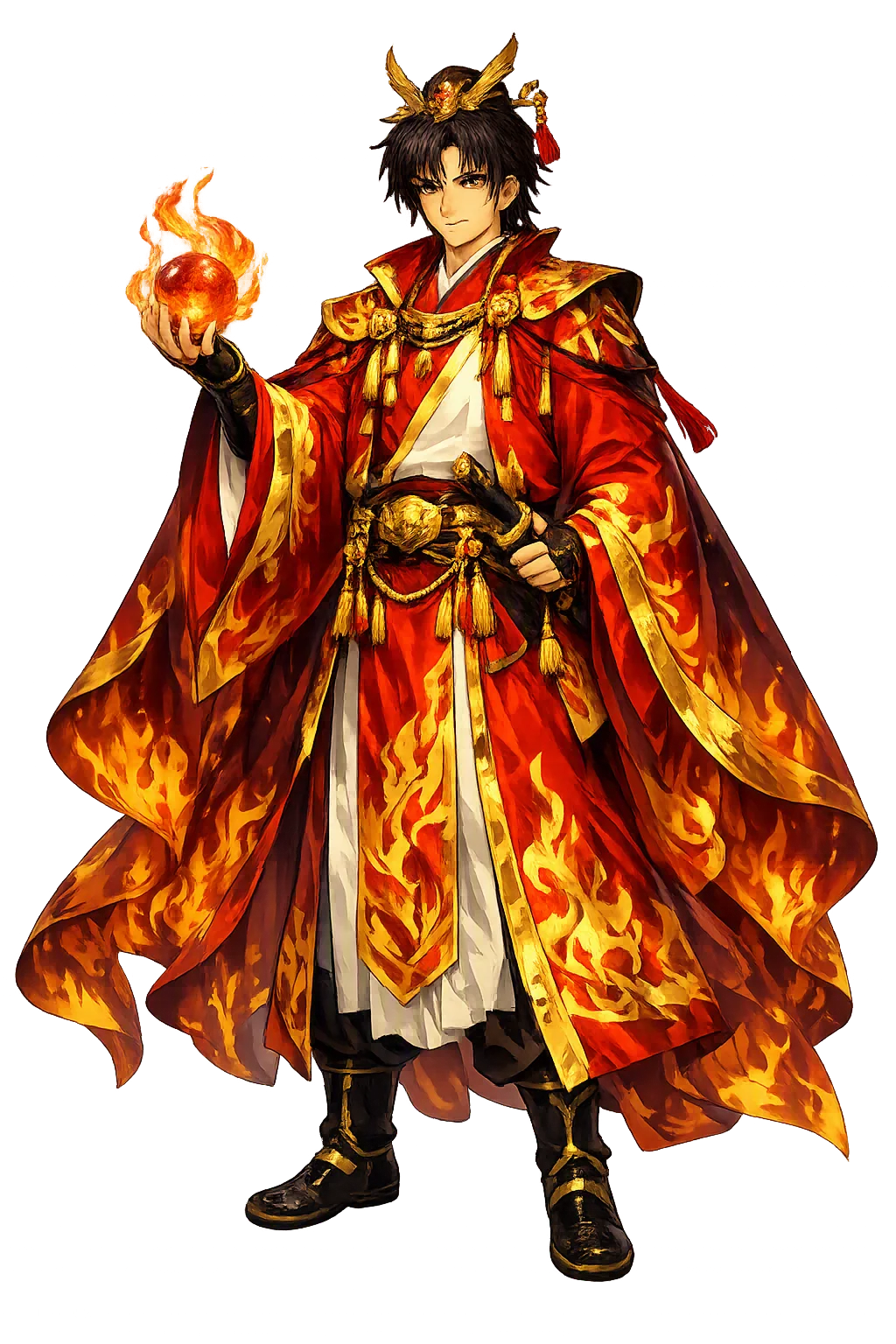
How Hoderi was rebuilt, mark by mark
Bench notes, Hoderi: what we found, what we rejected, and what we finally set down. Kept in the open, because a restoration you cannot audit is just a spelling with confidence.
What We Found
The attestation, as Kojiki (Hoderi and Hoori cycle; Philippi, Donald L., Kojiki, Princeton University Press, 1969) and Nihon Shoki (Aston, W. G., Nihongi: Chronicles of Japan from the Earliest Times to A.D. 697, 1896) preserve it: 火照命. Meaning: "Fire-shining".
The figure behind the name: Hoderi's story in the Kojiki is a tale of sibling rivalry, the exchange of gifts, and the transfer of sovereignty from the sea to the land.
What the Name Carried In
The Exchange of Gifts. When Ninigi's sons grew up, he divided the world's livelihood between them: to Hoderi, the elder, he gave the fishhook that rules the sea; to Hoori, the younger, the bow and arrow that rule the mountains (Kojiki, age of the gods). Hoori proposed that they exchange — he would try the sea, Hoderi the chase — and Hoderi agreed.
Hoori's Triumph. Beneath the waves Hoori found not punishment but fortune: the palace of the sea god Watatsumi, and marriage to the god's daughter Toyotama-hime. From the sea's depths he sent the lost hook back to land — recovered, in the Kojiki's wry detail, from the throat of a sea bream — bearing a curse that turned against its owner: whatever it touched would fail and wither.
A spelling that has to carry stories like these is not a label. It is equipment.
Where It Stood Before Us
Hoderi has no independent archaeological attestation — no shrine, image, or inscription names him — and his importance is textual and genealogical, preserved in the Kojiki's account of the imperial lineage and in the Nihon Shoki's parallel version. The historical echo of his myth is the documentary record of the Hayato themselves: the early chronicles (Shoku Nihongi and its predecessors) register Hayato delegations, military service, and ritual office at court from the eighth century, and southern Kyūshū place names and burial remains attest the ancient populations the genealogy claims as his children. The 'evidence' for Hoderi is thus a people remembered, not a stone inscribed. The bench inherits all of it — the web temple is the newest site, not the first.
What We Rejected
Any form invented for availability. The rule on the bench: if the evidence does not carry it, the domain does not get it — whatever the registrar has in stock.
What We Set Down
Hoderi — One decisive feature survives — a single, honest mark — which places the restoration in Tier-2: exact, and exactly labeled.
For the voice: 'HOH-deh-ree' — the 'r' is a light tap, and all vowels are short and clear.
The temple stands at /hoderi/ — the notes above are public in its Scholarly Edition, sources and all.
At a Glance
- Restored name: Hoderi
- ASCII form: hoderi
- Meaning: "Fire-shining"
- Domain of influence: Fire, Fisherman
- Pantheon: Japanese
- Classification: Tier 2
- Original script: 火照命
- Series: The Restoration Files, No. 212 of 548
The File Continues
The temple's founding dispatch tells the name's story; its Resonance File reads the myths into the industries; the blog index holds the whole archive.
Continue the series — previous file: Hiiaka (read it here) · next file: Hokkaidō (read it here).
The Restoration Files are written from the same canonical record as the temples themselves: the lexicon, the lore catalog, the pattern atlas, and the cited scholarly sources. If a file ever disagrees with its temple, the temple is right — tell us, and the file will be corrected.