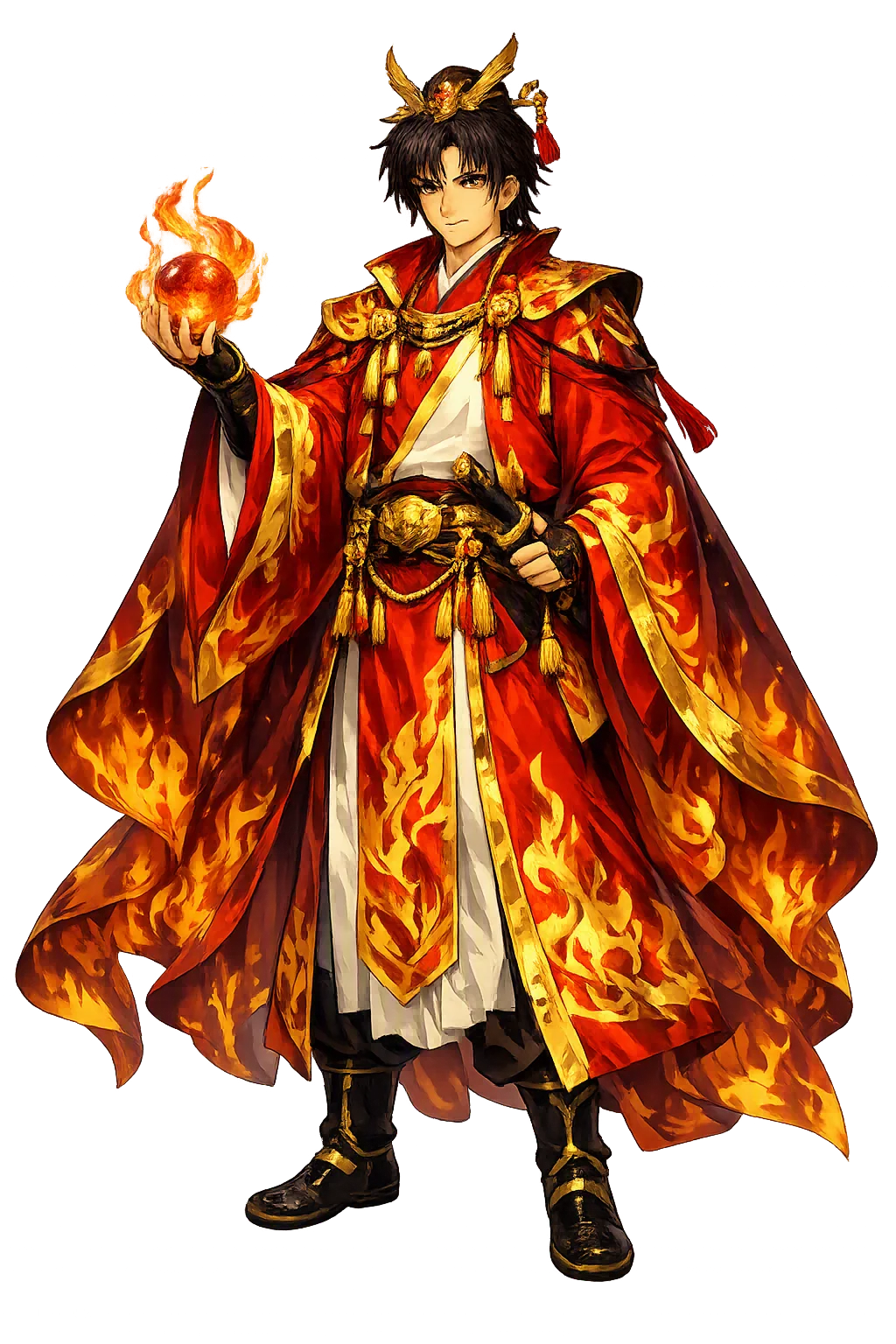
Stories of Hoderi
Hoderi's story in the Kojiki is a tale of sibling rivalry, the exchange of gifts, and the transfer of sovereignty from the sea to the land. He is the elder son, the firstborn of Ninigi, destined to be bypassed — and Japan's two oldest histories tell his falling-short with different temperaments, and the difference is itself instructive.
When Ninigi's sons grew up, he divided the world's livelihood between them: to Hoderi, the elder, he gave the fishhook that rules the sea; to Hoori, the younger, the bow and arrow that rule the mountains (Kojiki, age of the gods). Hoori proposed that they exchange — he would try the sea, Hoderi the chase — and Hoderi agreed. But the sea resisted the stranger: Hoori fished for days and caught nothing, and in a fury he flung the precious hook into the waves. Hoderi's response was absolute: he would sooner lose a kingdom than his hook, and he demanded its return on pain of their brotherhood itself. Cornered, Hoori walked into the sea to answer for the loss. The exchange looks innocent but is the hinge of the whole cycle: a fisherman's tool, lost and owed, becomes the lever that moves sovereignty from elder to younger, from sea to land.
Beneath the waves Hoori found not punishment but fortune: the palace of the sea god Watatsumi, and marriage to the god's daughter Toyotama-hime. From the sea's depths he sent the lost hook back to land — recovered, in the Kojiki's wry detail, from the throat of a sea bream — bearing a curse that turned against its owner: whatever it touched would fail and wither. Struck by the curse, Hoderi saw his stores dwindle and his luck collapse, until he came barefoot to his younger brother, begging terms. Hoori took the submission and the precedence; Hoderi gave him his daughter and his allegiance, and the elder line bent to the younger. The myth's meaning is economical and severe: legitimacy in the age of the gods does not follow birth order but the flow of fortune, and the sea, for all its plenty, could not hold the future that was gathering on the land.
The Kojiki closes Hoderi's line not with extinction but with a dignified office: his descendants are the Hayato, a people of southern Kyūshū remembered in early Japanese records as warriors and as ritual specialists at the imperial court. Historically the Hayato appear in the eighth-century chronicles as a military people whose sons served the throne — an echo, scholars have long suspected, of a pre-Yamato population of the south absorbed into the imperial order on terms its own myth explains. The genealogy does double work: it gives the defeated elder brother a posterity, and it gives the victorious court a way to honor the people it absorbed, as ritualists rather than rebels. In Hoderi's house the myth means: the bypassed line is not erased but employed — the memory of the elder brother kept on the payroll of the younger's descendants.
The Nihon Shoki (720 CE) tells the same feud with different names and sharper weapons: the brothers are called Umisachihiko, Sea-Luck Lad, and Yamasachihiko, Mountain-Luck Lad, and the sea god arms the younger with the two tide jewels — one that floods, one that ebbs. When the elder attacks, the flooding jewel drowns him; when he begs, the ebbing jewel spares him, and he swears service to his brother's line, becoming — the genealogy agrees — ancestor of the Hayato. The Shoki's variant notes are harsher still: in one alternate account the elder brother does not survive the feud at all. Two official histories, two temperaments: the Kojiki converts defeat into service, the Shoki leaves the sea prince gasping on the tideline. Read together they show the early court arguing with itself about what to do with the elder line — absorb it lovingly, or drown it and call it law.
Fisherman, Elder Brother, and Tragic Heir
Hoderi is the elder son of the heavenly grandson Ninigi and the blossom princess Konohana-Sakuya-hime. His name means 'Fire-Shining,' and he was gifted with the fishhook that made him master of the sea. His story turns on the rivalry with his younger brother Hoori, a conflict that costs him his birthright and sets the imperial line on a new path.
He received the fishhook and was meant to rule the waters.
Firstborn of Ninigi, but destined to lose precedence to Hoori.
His attempts to best Hoori end in the loss of his hook and his inheritance.
Ancestor of the Hayato, a people of southern Kyūshū.
From the original script to the living URL
火照命
The name in its original Japanese form. Hoderi (火照命) is attested in the source tradition — “Fire-shining”. Its original diacritics and script distinctions carry the full phonetic and orthographic weight of the source tradition.
hoderi
The plain hoderi form is identical to the Unicode restoration. Because this name is already written in Latin letters, no diacritics, stress, or script information were lost — only capitalization differs.
Hoderi
The Unicode restoration does not need to recover lost marks for Hoderi. Its value is canonical spelling and consistent cataloguing, not the reconstruction of erased orthography. The domain is readable as-is to both DNS and humanity.
Hoderi.com
This restoration is written entirely in ASCII letters — no Punycode encoding stands between Hoderi and the DNS. The domain reads identically to machines and to human eyes.
Owned, ideal, and ASCII forms of Hoderi
Hoderi
Restores 火照命. The full Unicode restoration. hoderi.com is not in the PuniCodex collection — it is watched for release; if it drops, this temple upgrades to an owned flagship.
How Hoderi was spoken
How Hoderi is preserved in writing
A bespoke provenance study for Hoderi is being prepared by the PUNICODEX scholarly team.
Contribute scholarly provenance →The lore you have read is the living myth. Extended Lore opens the scholarly vault beneath it: the cult and its material remains, a history of the image, the name after antiquity, a meditation on what the name still means, and the full scholarly apparatus — etymology, orthography, sources.
Enter Extended Lore