PuniCodex

Extended Lore

火照命 Hoderi

Etymology · Orthography · Cult · Iconography · Reception · Sources

Tier 2 Hoderi
Hoderi — Fire, Fisherman
01

Quick Facts

Essential information about Hoderi, Fire, Fisherman

Original Script火照命
Unicode RestorationHoderi
Reconstructed Pronunciation/ho.de.ɾi/
PantheonJapanese
DomainFire, Fisherman
MeaningFire-shining
ClassificationTier 2
Primary DomainHoderi
Sacred SymbolsFishhook, Fire, Sea, Bow
02

Etymology & Word Family

From original script to Unicode restoration

Original Script 火照命 Hoderi — "Fire-shining"
Unicode Restoration Hoderi Canonical scholarly spelling — ASCII-identical
Modern ASCII hoderi Plain-ASCII fallback

The name Hoderi reaches the modern world through scholarly transliteration of the japanese tradition. Because the conventional spelling uses only Latin letters, its Unicode and ASCII forms coincide — the tradition it carries is in the name itself, not in diacritics.

03

Unicode Character Breakdown

Character-by-character philological analysis

CharacterUnicodeNameBlockPhonetic Role
HU+0048Latin Capital Letter HBasic LatinSame, capitalized
oU+006FLatin Small Letter OBasic LatinSame
dU+0064Latin Small Letter DBasic LatinSame
eU+0065Latin Small Letter EBasic LatinSame
rU+0072Latin Small Letter RBasic LatinSame
iU+0069Latin Small Letter IBasic LatinSame

The Tier 2 classification here reflects fidelity to the attested tradition, not recovered diacritics: every character of Hoderi already survives in ASCII. What the restoration preserves is the canonical spelling itself — the form scholarship standardised.

04

Cult & Worship

How the sacred was kept — rites, sanctuaries, remains

The Cult

No shrine to Hoderi is known, and no rite was ever performed in his name — his 'cult' belongs to the text that made him. What evidence exists is institutional echo: the Kojiki and Nihon Shoki close his line with the Hayato, and the early chronicles register Hayato delegations, guards, and ritual service at the eighth-century court. The Hayato dance (Hayato-mai), performed at court banquets and great ceremonies into later centuries, is the closest thing to a living ritual of his line — a southern people's choreography absorbed as imperial ceremonial, exactly as the myth describes the absorption itself. Beyond that, his presence in cult is the imperial genealogy itself: the congratulatory address (yogoto) recited at enthronements still traces the line from the age of the gods through the sea-brothers' covenant. If he was ever worshipped privately, every trace has vanished; what remains is ceremony.

In the Earth

Hoderi has no independent archaeological attestation — no shrine, image, or inscription names him — and his importance is textual and genealogical, preserved in the Kojiki's account of the imperial lineage and in the Nihon Shoki's parallel version. The historical echo of his myth is the documentary record of the Hayato themselves: the early chronicles (Shoku Nihongi and its predecessors) register Hayato delegations, military service, and ritual office at court from the eighth century, and southern Kyūshū place names and burial remains attest the ancient populations the genealogy claims as his children. The 'evidence' for Hoderi is thus a people remembered, not a stone inscribed.

05

Iconography

How Hoderi was imaged across the ages

The Image

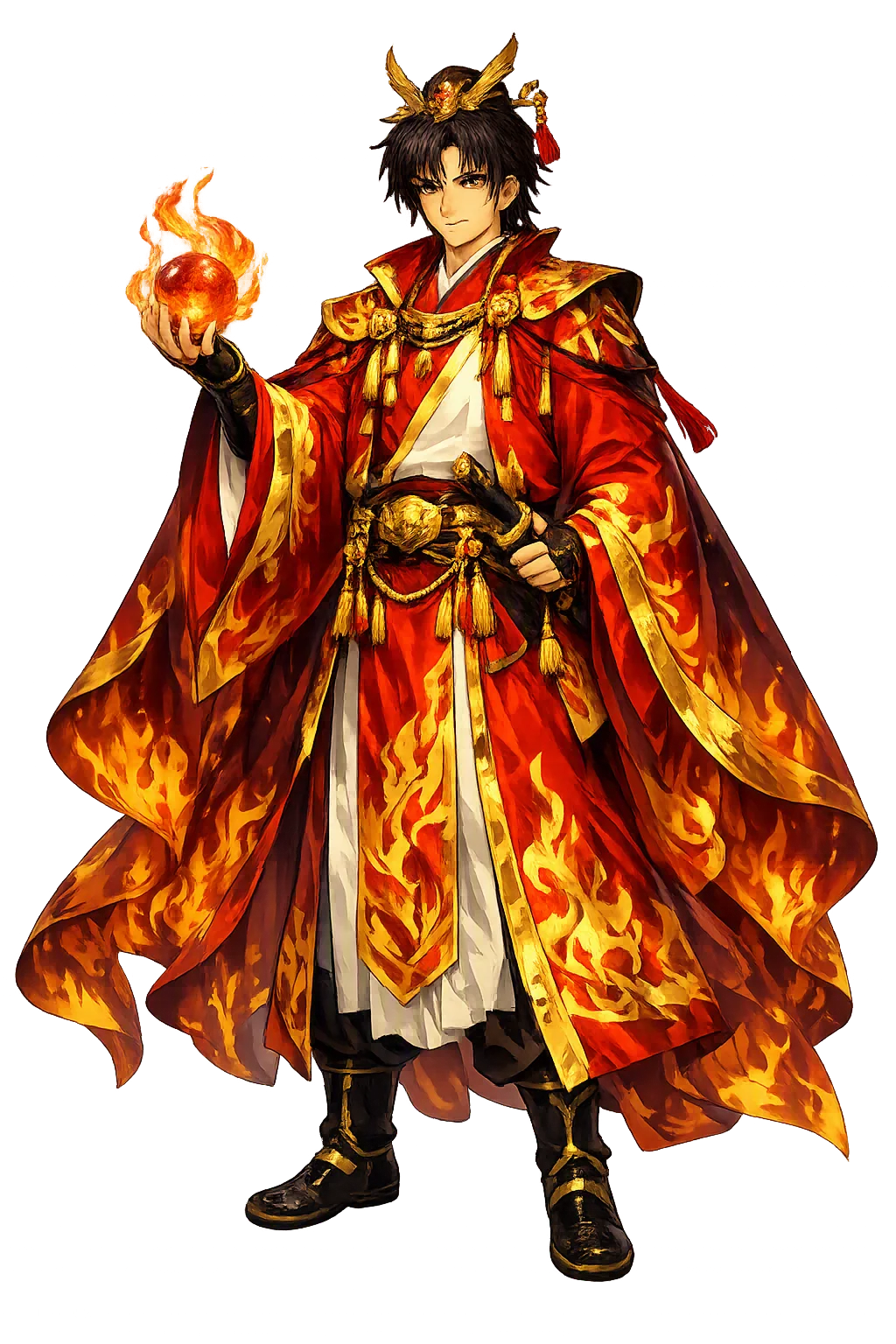
No image of Hoderi survives, and none is recorded. He is a figure of pure genealogy — his attributes exist only as plot: the fishhook that was his fortune, the bow he could not turn to purpose, the sea that refused him. Medieval and Edo artists alike ignored him; he has no face in any picture scroll, print, or votive known to survive. Modern illustration sometimes gives him a fisherman's look borrowed from Ebisu — rod, bream, sun-bright hair — but that is a back-formation from the later cult his myth fed. The honest statement is that ancient Japan pictured him not at all: the elder brother lives entirely in the words of two official histories.

06

Reception & Transformation

The name after its own age — transmission, translation, survival

Afterlives

Hoderi enters history as a committee decision: the Kojiki of 712, presented to Empress Genmei, and the Nihon Shoki of 720, whose compilers gave the feud its alternate telling — Umisachihiko, Sea-Luck Lad, against Yamasachihiko, Mountain-Luck Lad — and whose variant notes leave the elder brother gasping on the tideline. The early-Heian pseudo-chronicle Sendai Kuji Hongi reworked the genealogy for its own ends, and the early court kept the line ritually alive through the Hayato it claimed as his descendants. Edo scholarship made him a problem to be solved: Motoori Norinaga's Kojiki-den read the cycle line by line as the true history of the divine age, and Hirata Atsutane's school made it cosmology. The Meiji state printed the myth into the school primer as national prehistory; the West met it first through Basil Hall Chamberlain's Ko-ji-ki of 1882, then Aston's Nihongi (1896) and Philippi's annotated Kojiki (1969). Modern historiography reads him against the archaeology of the south — the warrior haniwa of the Saitobaru kofun cluster — the elder brother still arguing his case.

Identifications Across Traditions

Hoderi is primarily a genealogical figure, and his afterlife is interpretive. Shinto scholarship has long read him as the mythic signature of the sea peoples and older lineages of southern Japan folded into the Yamato order — his 'Fire-Shining' name suggests a solar brilliance eclipsed by the mountain brother's steady fire. The myth's structure invites comparison with other younger-son-victories in the imperial line (Ninigi himself was passed over for rule of heaven in favor of the narrative's landward mission), making Hoderi one link in a chain where sovereignty repeatedly detours around seniority. Buddhist and Confucian readers of later centuries found in him a lesson in the submission of fortune to virtue; modern folklorists find an ethnographic memory. He absorbed no foreign cult — the traffic ran the other way, his story naturalizing an absorbed people.

Modern Legacy

Hoderi is little known outside scholarly and ritual contexts, but his story underlies one of the key narratives of Japanese origins: the transfer of legitimacy from sea to land, from elder to younger, and the inclusion of older peoples within the imperial frame. His name survives in Kojiki retellings, in schoolbook summaries of the age of the gods, and in the quiet pride of communities in southern Kyūshū whose traditions remember the Hayato. For modern readers he is the necessary counterweight to the imperial success story — the elder brother whose loss makes the victory legible, and whose descendants' service reminds us that Japanese identity was assembled, not simply inherited.

07

The Meditation

What Hoderi means — beyond the dictionary

Hoderi is the one who was passed over. Every national mythology crowns a winner; few pause over the brother who held the older claim. His story asks us to notice the elder — the sea, the firstborn, the rival who does not win — and to see how myths of defeat are woven into national identity. The Kojiki is gentle with him: he keeps his life, his daughter marries into the victor's house, his descendants hold honored office at the court that displaced him. Defeat, properly mythologized, becomes service; the bypassed line becomes the ritual memory that legitimizes the bypassing. Not every ancestor becomes emperor; some become memory — and memory, as the court understood, can be a more durable inheritance than the throne itself.

08

Frequently Asked Questions

Common questions about Hoderi, Fire, Fisherman, and Unicode restoration

01How do you pronounce Hoderi?

In reconstructed pronunciation, Hoderi is /ho.de.ɾi/ — approximately 'HOH-deh-ree' — the 'r' is a light tap, and all vowels are short and clear.

02What does Hoderi mean?

Hoderi means Fire-shining in the japanese tradition.

03What are the symbols of Hoderi?

Hoderi is associated with Fishhook (The gift from Ninigi that gave him dominion over the sea), Fire (His name associates him with shining heat and the brilliance of the sun), Sea (The realm he was to master, contrasted with Hoori's mountains and fields), Bow (The weapon by which he and Hoori disputed precedence).

04Why restore Hoderi in Unicode?

Hoderi is written entirely in ASCII letters, so its restoration is about canonical fidelity rather than recovered diacritics: the temple fixes the name in its scholarly standard spelling, attested in the source tradition, instead of leaving it to drift.

05What is the most important myth about Hoderi?

“The Exchange of Gifts” — the Kojiki story that anchors the mythology of Hoderi, told in full on the lore page.

09

Scholarly Sources

The philological foundations of this restoration

Every claim on this page is grounded in established scholarship. The orthographic restorations follow disciplinary convention. The etymological chain follows the best available reference works. This is not invention — it is resurrection through scholarship.

◈

Lexicography & Philology

  • Lexical and philological sources for Hoderi.
◎

Primary Texts

  • Kojiki
  • Nihon Shoki
  • Kojiki (Hoderi and Hoori cycle; Philippi, Donald L., Kojiki, Princeton University Press, 1969)
  • Nihon Shoki (Aston, W. G., Nihongi: Chronicles of Japan from the Earliest Times to A.D. 697, 1896)
  • Philippi, Kojiki
◉

Archaeology & Art History

  • Material evidence — iconography, inscriptions, and temple archaeology — for Hoderi and related cults.
✦

Religious Studies

  • Comparative studies of japanese religion and the place of Hoderi within it.
Return

The Surface Awaits

You have traced the name from its earliest attestation to its Unicode restoration. Now return to the myth. The story is where the name lives.

Back to Lore
Hoderi mascot