
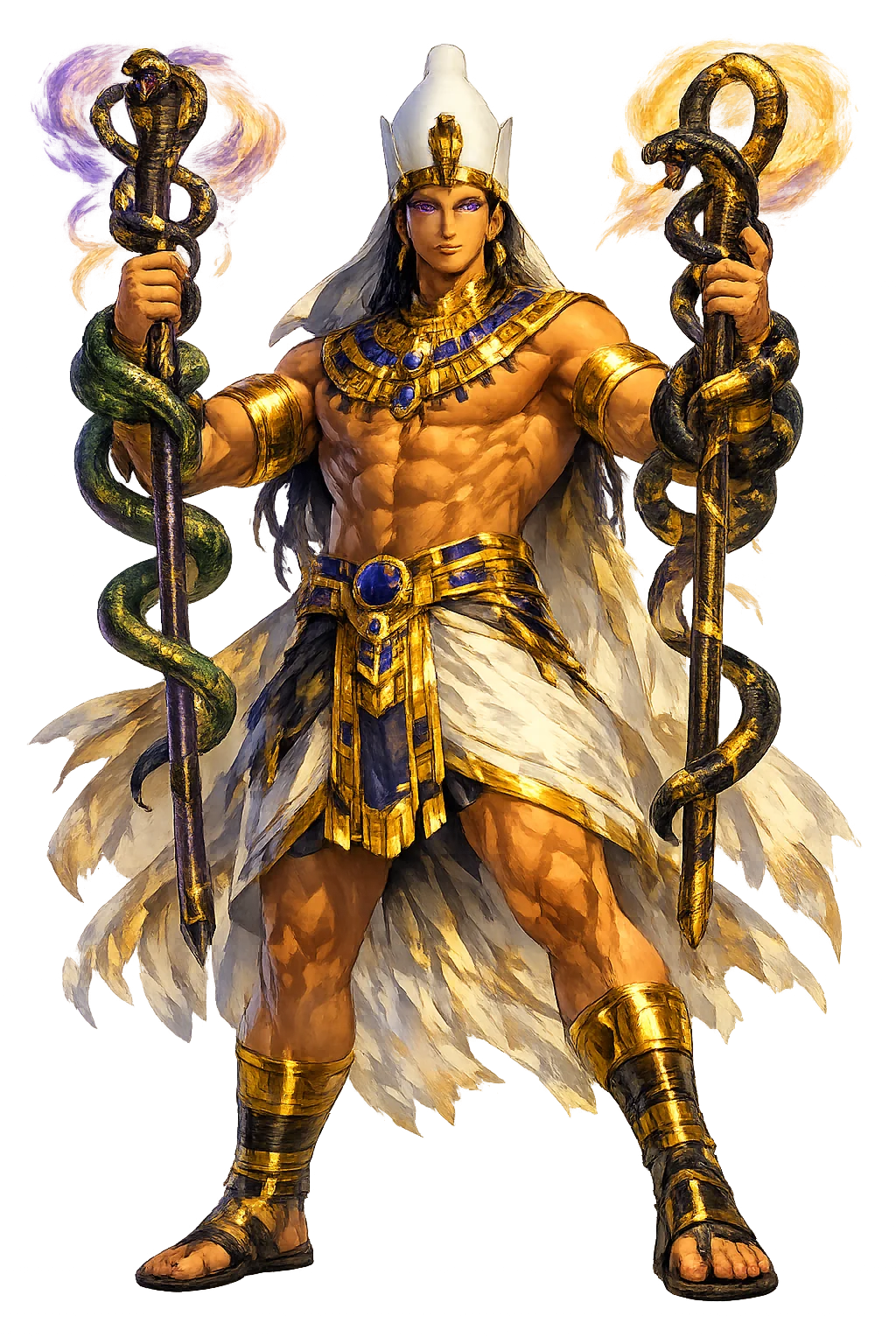
The appointments Ḥkꜣ made — and who is keeping them
One myth is a story. A cycle of myths is a specification. Read Ḥkꜣ's cycle in order and the industries fall out of it one by one.
At a Glance
- Temple: Ḥkꜣ
- Pantheon: Egyptian
- Domain of influence: Magic, Medicine
- Pattern seats: 4
- Sectors touched: Health & Wellbeing · Society & Spirit · Culture & Entertainment · Technology & Innovation
- Strongest seat: Healthcare, Pharma & Medicine
- Series: The Resonance Files, No. 197 of 546
The Cycle, Read Forward
Healthcare, Pharma & Medicine — through Spell 261: Before the Gods
In Coffin Texts spell 261, preserved on Middle Kingdom coffins and translated by R. O.
The atlas states the seat in one line: Magic and medicine as one art; Egyptian physicians worked through him. The story above is the long version of the same sentence. The trade thinks it is optimizing a process. It is re-enacting a charter.
Astrology, Tarot & Esoteric Services — through Heka in the Solar Boat
As a god, Heka serves aboard the sun barque of Re, where his presence is part of the nightly defense against Apophis. Book of the Dead spell 17 — the great commentary on creation — sets him among the powers that accompany the solar journey, and the daily temple ritual known as the Book of Overthrowing Apophis is in its entirety an act of state heka: wax effigies knifed, burned, and spat upon so that the real serpent of chaos is bound in the Duat below.
The atlas states the seat in one line: Magic as a professional force, with priests and manuals. The story above is the long version of the same sentence. That is the cycle working: story becomes duty, duty becomes trade.
Writing, Publishing & Media — through Heka, Sia, and Hu
Heka is conventionally grouped with two companion powers: Sia, divine perception or insight, and Hu, the authoritative word itself. In the mythic genealogy of the Book of the Heavenly Cow, Sia and Hu are born from a drop of Re's blood — they are faculties of the creator given independent existence.
The atlas states the seat in one line: The written spell as the physical vehicle of power; publishing's premise that words on a page do work. The story above is the long version of the same sentence. Industries do not invent their archetypes; they inherit them and call them best practice.
Software, Cloud & Developer Infrastructure — through Isis and the Secret Name of Ra
The Late Period Legend of Isis and the Name of Ra (Papyrus Vandier) is the mythology of heka in action. Isis, desiring power equal to the sun god's, models a serpent from the earth mixed with Ra's own spittle and sets it on the great god's daily path.
The atlas states the seat in one line: Spells are programs: words correctly spoken compel reality — the oldest description of code. The story above is the long version of the same sentence. Industries do not invent their archetypes; they inherit them and call them best practice.
The Theme That Runs the Cycle
Heka appears in the oldest strata of Egyptian theology as a force rather than a character, personified only gradually as the creator's eldest son. His mythology is the story of how a word became a god — and of what Egyptians believed words could still do.
The Method, Stated Plainly
The atlas is not a horoscope. Seats are earned from the sources — argued, weighted, published — and every one of them can be challenged at the methodology page. A match that cannot survive an argument does not survive review. That is the whole trick: the patterns are claims, and claims can be tested.
For the Ones Who Work There
If you work in healthcare, pharma & medicine, astrology, tarot & esoteric services, or any trade this temple holds a seat in, this is the honest version of what a placement means: your industry beside the story it has been re-telling all along — on the temple floor itself, before an audience that came specifically to read it. The patron tier and the advertising terms describe the mechanics; the resonance above describes the fit.
The File Continues
One of 546 Resonance Files — the series where the pantheon goes to work. Read the founding dispatch for the name, the Restoration File for the spelling, or the whole archive end to end.
Continue the series — previous: Heimdallr (read it) · next: Hekátē (read it).
The Resonance Files are argued from the same canonical record as the pattern atlas itself: the lexicon, the lore catalog, and the cited sources. Every seat can be challenged at the methodology page — and the challenge is the point.