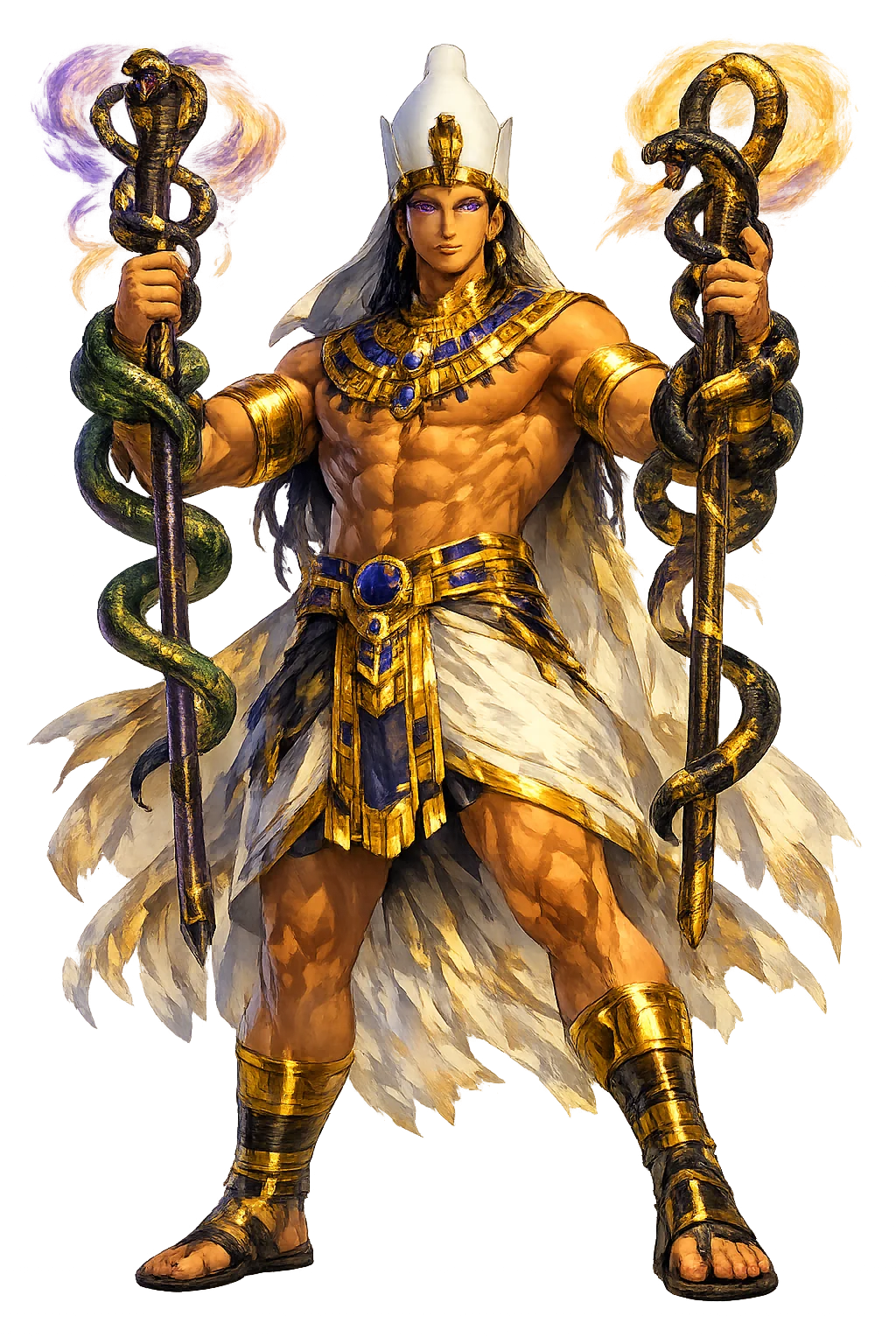
Stories of Ḥkꜣ
Heka appears in the oldest strata of Egyptian theology as a force rather than a character, personified only gradually as the creator's eldest son. His mythology is the story of how a word became a god — and of what Egyptians believed words could still do.
In Coffin Texts spell 261, preserved on Middle Kingdom coffins and translated by R. O. Faulkner, the personified power introduces himself in the first person with startling claims: he is Heka, brought into being by Atum; he is the son of Atum who came forth before the gods existed; he was 'when there was no heaven, when there was no earth'. The spell is not mythological narrative but self-declaration — the power to be effective introducing itself as prior to every other divine power. The claim has a precise logic. Creation, for the Egyptians, was an act of effective speech: Atum spoke, and the cosmos separated. But speech can only create if it works — and the quality of working is heka itself. Heka therefore cannot be a product of creation, any more than the capacity of a tool can be manufactured by the tool. The spell makes the oldest argument in Egyptian theology: that efficacy is older than the gods who wield it, and that every priest who speaks a spell stands at the head of the same genealogy.
As a god, Heka serves aboard the sun barque of Re, where his presence is part of the nightly defense against Apophis. Book of the Dead spell 17 — the great commentary on creation — sets him among the powers that accompany the solar journey, and the daily temple ritual known as the Book of Overthrowing Apophis is in its entirety an act of state heka: wax effigies knifed, burned, and spat upon so that the real serpent of chaos is bound in the Duat below. The same theology runs through the protection of the dead: tomb inscriptions, amulets, and the spells of the Book of the Dead are heka applied on behalf of the individual, extending to the private person the same power the sun god uses to keep the cosmos alive. The boundary between 'religion' and 'magic' dissolves on the barque. What Re does nightly with the whole universe, every Egyptian hoped to do at the scale of one life and one tomb.
Heka is conventionally grouped with two companion powers: Sia, divine perception or insight, and Hu, the authoritative word itself. In the mythic genealogy of the Book of the Heavenly Cow, Sia and Hu are born from a drop of Re's blood — they are faculties of the creator given independent existence. The trio describes the anatomy of a divine act: Sia perceives what should be, Hu speaks it, and Heka makes the speech take effect. Creation narratives keep the three together because none suffices alone. A word that is not understood (without Sia) is noise; understanding that is not spoken (without Hu) is silent; and speech without efficacy (without Heka) is a prayer the universe declines to answer. The Egyptians built, in these three small gods, a complete theory of how intention becomes world — one that modern pragmatics of language still half-recognizes every time we say 'words have power'.
The Late Period Legend of Isis and the Name of Ra (Papyrus Vandier) is the mythology of heka in action. Isis, desiring power equal to the sun god's, models a serpent from the earth mixed with Ra's own spittle and sets it on the great god's daily path. The serpent bites him; no physician and no god can cure the agony, for the poison carries Ra's own essence turned against him. Isis alone can help, and her price is knowledge: Ra must tell her the secret name, the one he has hidden from all the gods, the name in which his very being consists. Bound by oath, the god whispers it to her; Isis departs with power over him and passes the name to her son Horus. The tale dramatizes heka's central axiom: knowledge of the true name is control of the thing named. Egyptian spell collections overflow with lists of names — of gates, ferrymen, guardians, organs — each one a key. The myth explains why. In a universe held together by effective speech, the most dangerous weapon is the dictionary.
Magic · Medicine · Efficacious Speech
Ḥkꜣ is the power that makes intention effective — the force by which the gods created the world and by which human beings, with the right knowledge, can protect, heal, curse, or transform. Heka is both a god and a faculty, a substance and a technique. In Egyptian thought there is no sharp line between prayer, medicine, and magic: all align human action with the creative power that sustains ma'at.
The primordial energy Atum used to shape Shu and Tefnut and to call the cosmos into being.
Medical papyri prescribe spells alongside herbs; healing is the practical, beneficent face of heka.
Amulets, execration figurines, and tomb inscriptions all depend on heka-words to bind or repel.
As a god, Heka accompanies Re and is invoked by pharaohs and lector-priests as the eldest son of Atum.
From the original script to the living URL
𓎛𓂓𓏛
The name in its original Egyptian form. Ḥkꜣ (𓎛𓂓𓏛) is attested in the source tradition — “Magic, first work”. Its Egyptological ain and alef letters and emphatic consonants carry the full phonetic and orthographic weight of the source tradition.
heka
Reduced to plain heka, the name loses everything that made it specific: Egyptological ain and alef letters and emphatic consonants. What remains is an ASCII string that machines can parse but that no longer speaks with its original voice.
Ḥkꜣ
The Unicode restoration recovers what ASCII flattened. Ḥkꜣ restores Egyptological ain and alef letters and emphatic consonants, returning the name to its original written dignity. The domain encodes to Punycode, but the browser displays the truth.
Ḥkꜣ.com → xn--k-xnm1886d.com
The non-ASCII characters in Ḥkꜣ are encoded while the ASCII remains visible. To the DNS, it is Punycode. To humanity, it is Ḥkꜣ.
Owned, ideal, and ASCII forms of Ḥkꜣ
Ḥkꜣ
Restores 𓎛𓂓𓏛. The live temple domain — ḥkꜣ.com.
heka
Flattens 𓎛𓂓𓏛. The plain ASCII fallback — what DNS and legacy systems see.
How Ḥkꜣ was spoken
How Ḥkꜣ travels from ancient script to the modern URL
Egyptian Ḥkꜣ “magic"; the personification of magic and creative speech, “the first work".
Magic, Medicine
The Unicode restoration Ḥkꜣ uses Egyptological characters registrable in .com; hieroglyphs are outside the .com IDN table.
The lore you have read is the living myth. Extended Lore opens the scholarly vault beneath it: the cult and its material remains, a history of the image, the name after antiquity, a meditation on what the name still means, and the full scholarly apparatus — etymology, orthography, sources.
Enter Extended Lore