
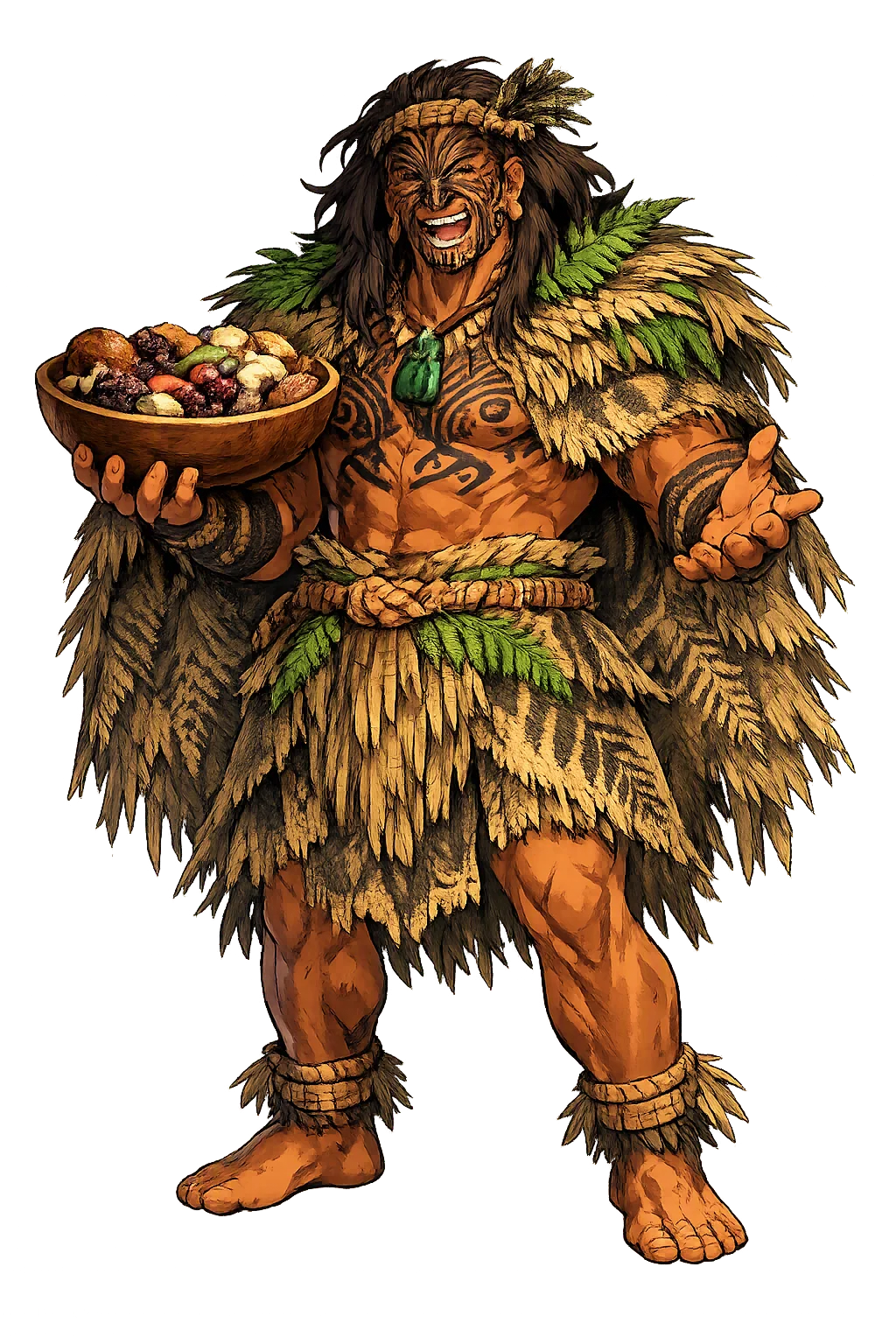
The appointments Haumiatiketike made — and who is keeping them
The mistake is reading myths as entertainment. Haumiatiketike's cycle reads more like a charter — each story assigning a duty the modern world still pays for.
At a Glance
- Temple: Haumiatiketike
- Pantheon: Polynesian
- Domain of influence: Wild Food, Fernroot
- Pattern seats: 5
- Sectors touched: Energy & Natural World · Home & Lifestyle · Culture & Entertainment
- Strongest seat: Agriculture, Food & Harvest
- Series: The Resonance Files, No. 192 of 548
The Cycle, Read Forward
Agriculture, Food & Harvest — through Child of the Sky and the Earth
In the Māori creation cycle recorded by George Grey in Polynesian Mythology (1855) and in the fuller recensions of John White's Ancient History of the Māori, the sky-father Rangi and the earth-mother Papa lay locked in an embrace that left no room for light or life. Their children — Tāne, Tangaroa, Tāwhirimātea, Tūmatauenga, Rongo-māui, Haumia-tiketike and the rest — grew cramped in the darkness between them.
The atlas states the seat in one line: Primary seat: Haumiatiketike embodies wild food, fernroot — the core of agriculture food. The story above is the long version of the same sentence. Industries do not invent their archetypes; they inherit them and call them best practice.
Environmental & Climate Services — through Hidden in the Earth-Mother
Tāne thrust his parents apart, raising the sky on his shoulders and pressing the earth down, and the world took its shape. But the separation left some children with nowhere to go.
The atlas states the seat in one line: Resonant seat: Haumiatiketike shares symbolic territory with environment climate. The story above is the long version of the same sentence. The trade thinks it is optimizing a process. It is re-enacting a charter.
Forestry, Conservation & Outdoor Industries — through The Food of the Conquered
When Tāwhirimātea's storms failed to unmake the world, Tūmatauenga — the fierce brother of humankind — took revenge on all who had sided against him. One by one he hunted his brothers down: Tāne's birds, Tangaroa's fish and seals, the very forests and waves were made food for Tū and his children, which is why people eat them to this day.
The atlas states the seat in one line: Resonant seat: Haumiatiketike shares symbolic territory with forestry conservation. The story above is the long version of the same sentence. That is the cycle working: story becomes duty, duty becomes trade.
Home, Hearth & Real Estate — through Aruhe, the Fernroot
Haumia's living cult was the gathering of aruhe. From late winter into spring the people went out to the bracken clearings, dug the starchy rhizomes of the bracken fern with the foot-driven kō, and carried them home in baskets.
The atlas states the seat in one line: Resonant seat: Haumiatiketike shares symbolic territory with real estate home. The story above is the long version of the same sentence. That is the cycle working: story becomes duty, duty becomes trade.
The Theme That Runs the Cycle
Haumia-tiketike's stories are chapters of the Māori creation cycle: the separation of sky and earth, the war among the children, and the settlement of the food quest. His single decisive act is a refusal — to leave the earth-mother's body — and from that refusal the wild food of Aotearoa takes its sanctity.
The Method, Stated Plainly
Skeptical? Good — the system is built for you. Every seat in this file carries its why-line and its weight, the full derivation is public at the methodology page, and the challenge process is part of the design. Falsifiable is not a posture here; it is the mechanism.
For the Ones Who Work There
If you work in agriculture, food & harvest, environmental & climate services, or any trade this temple holds a seat in, this is the honest version of what a placement means: your industry beside the story it has been re-telling all along — on the temple floor itself, before an audience that came specifically to read it. The patron tier and the advertising terms describe the mechanics; the resonance above describes the fit.
The File Continues
One of 548 Resonance Files — the series where the pantheon goes to work. Read the founding dispatch for the name, the Restoration File for the spelling, or the whole archive end to end.
Continue the series — previous: Hati (read it) · next: Haurvatāt (read it).
The Resonance Files are argued from the same canonical record as the pattern atlas itself: the lexicon, the lore catalog, and the cited sources. Every seat can be challenged at the methodology page — and the challenge is the point.