PuniCodex

Extended Lore

Haumiatiketike

Etymology · Orthography · Cult · Iconography · Reception · Sources

Tier 2 Haumiatiketike
Haumiatiketike — Wild Food, Fernroot
01

Quick Facts

Essential information about Haumiatiketike, Wild Food, Fernroot

Scholarly TransliterationHaumiatiketike
Unicode RestorationHaumiatiketike
Reconstructed Pronunciation/haumiatiketike/
PantheonPolynesian
DomainWild Food, Fernroot
MeaningHaumia tied to the earth
ClassificationTier 2
Primary DomainHaumiatiketike
Sacred SymbolsThe bracken frond, The digging stick (kō), The earth-mother's bosom, The earth oven (hāngī, umu tī), The uncultivated ground
02

Etymology & Word Family

From original script to Unicode restoration

Scholarly Transliteration Haumiatiketike Haumiatiketike — "Haumia tied to the earth"
Unicode Restoration Haumiatiketike Canonical scholarly spelling — ASCII-identical
Modern ASCII haumiatiketike Plain-ASCII fallback

The name Haumiatiketike reaches the modern world through scholarly transliteration of the polynesian tradition. Because the conventional spelling uses only Latin letters, its Unicode and ASCII forms coincide — the tradition it carries is in the name itself, not in diacritics.

03

Unicode Character Breakdown

Character-by-character philological analysis

CharacterUnicodeNameBlockPhonetic Role
HU+0048Latin Capital Letter HBasic LatinSame, capitalized
aU+0061Latin Small Letter ABasic LatinSame
uU+0075Latin Small Letter UBasic LatinSame
mU+006DLatin Small Letter MBasic LatinSame
iU+0069Latin Small Letter IBasic LatinSame
aU+0061Latin Small Letter ABasic LatinSame
tU+0074Latin Small Letter TBasic LatinSame
iU+0069Latin Small Letter IBasic LatinSame
kU+006BLatin Small Letter KBasic LatinSame
eU+0065Latin Small Letter EBasic LatinSame
tU+0074Latin Small Letter TBasic LatinSame
iU+0069Latin Small Letter IBasic LatinSame
kU+006BLatin Small Letter KBasic LatinSame
eU+0065Latin Small Letter EBasic LatinSame

The Tier 2 classification here reflects fidelity to the attested tradition, not recovered diacritics: every character of Haumiatiketike already survives in ASCII. What the restoration preserves is the canonical spelling itself — the form scholarship standardised.

04

Cult & Worship

How the sacred was kept — rites, sanctuaries, remains

The Cult

No named priesthood or sanctuary of Haumia is attested. His cult was the everyday practice of gathering wild food: bracken fernroot, aruhe, and other uncultivated plants cooked in earth ovens across Aotearoa. Karakia—incantations—were spoken over the digging and preparation of fernroot, and tapu restrictions governed when and how wild foods were gathered. The god was thus present in the rhythm of subsistence rather than in temple architecture. His worship was diffuse, household-based, and tied to the forest and the cooking pit.

In the Earth

No image or named shrine of Haumia survives — his was a cult of practice, not of temples. The material record is indirect but abundant: archaeobotanical studies of starch residues on prehistoric stone tools from sites across Aotearoa confirm that bracken fernroot was a dietary staple from the earliest settlement, and earth-oven (hāngī / umu tī) cooking features — fire-cracked stones in pits — are among the most common archaeological features on pre-European sites. Hardwood digging sticks (kō) survive in museum collections, their blades polished by generations of use. The archaeological signature of Haumia is, fittingly, everywhere and nowhere: not a temple to the god, but a landscape of fern country opened, dug, and steamed in his name.

05

Iconography

How Haumiatiketike was imaged across the ages

The Image

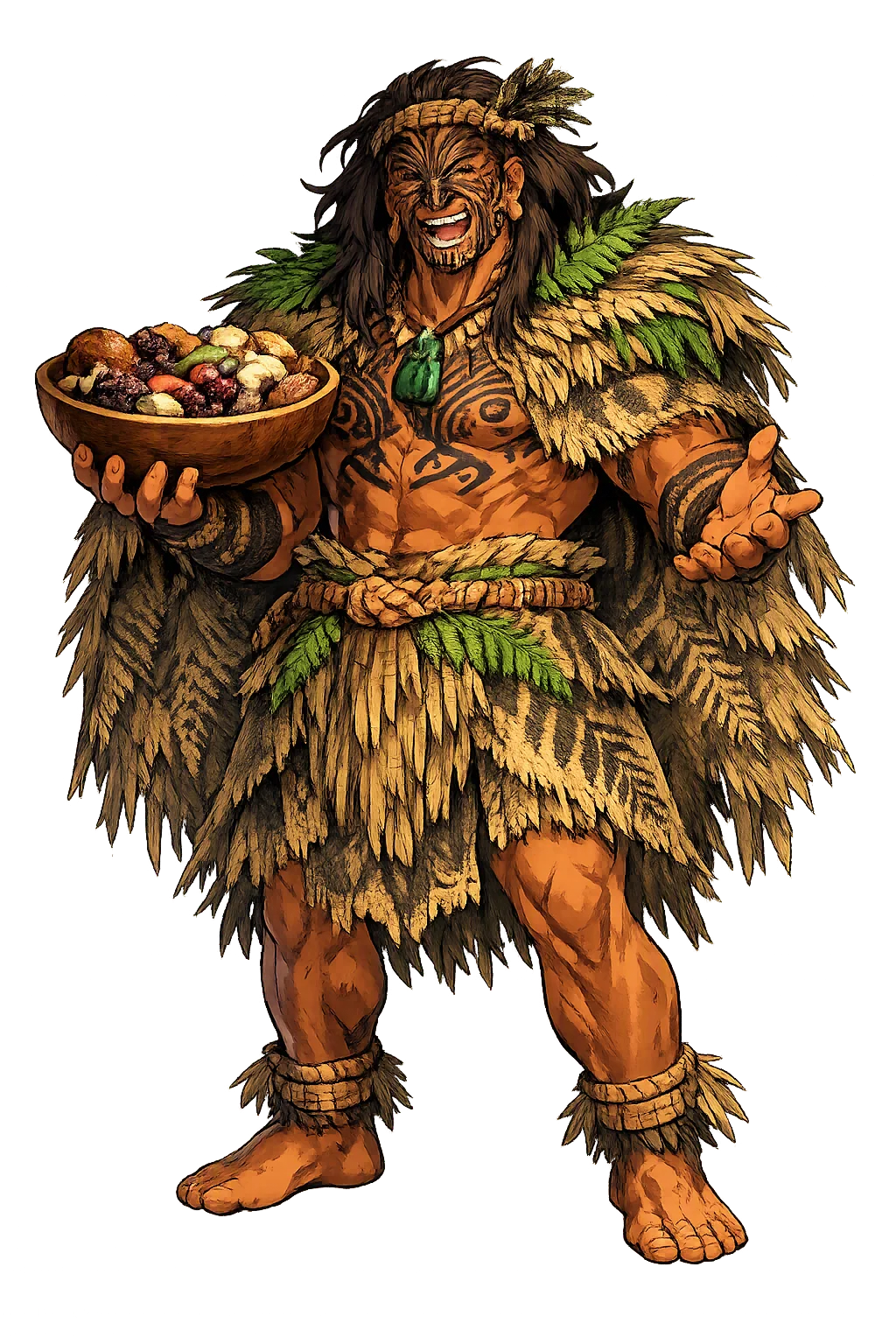
Haumia left no statues, carvings, or named images. The visual record is indirect: the bracken fern itself, the stone tools used to dig its root, and the fire-cracked stones of earth ovens recovered from archaeological sites across Aotearoa. Māori art of the classical period favored spiral, tiki, and manaia forms over narrative depictions of gods, so Haumia's image is essentially the fernroot and the tools of its preparation. Modern illustrations reconstruct him as a forest spirit, but these are later interpretations.

06

Reception & Transformation

The name after its own age — transmission, translation, survival

Afterlives

Haumia enters the written record through nineteenth-century collectors: George Grey's 1855 Polynesian Mythology, John White's Ancient History of the Māori, and Elsdon Best's ethnographic compilations preserved the war-of-the-gods narrative in which Haumia is hidden from Tāwhirimātea by Rongo. This textual transmission coincided with the colonial transformation of Māori land and diet, so the fernroot cult became a memory almost as soon as it was written down. In modern New Zealand, Haumia has been revived as a symbol of native food sovereignty, ecological knowledge, and Māori identity, and his name appears in schools, environmental education, Māori-language media, and conservation discourse. His reception thus moves from oral karakia to colonial ethnography, and onward to contemporary cultural reclamation, ecological activism, and Māori self-determination.

Identifications Across Traditions

Within Polynesia, Haumia's closest relations are his own brothers. Rongo(-māui) — in Hawai'i Lono, in the Cook Islands Rongo — rules cultivated food and agriculture, and the two are sometimes treated as aspects of one god of vegetation; Margaret Orbell notes that in some recensions Haumia barely appears apart from Rongo. The wider Polynesian pattern is consistent: Tangaroa of the sea, Tāne of the forest, Rongo of the garden, Haumia of the wild ground. No Greco-Roman equivalent maps cleanly onto him — even Demeter presides over cultivated grain and never descends into the distinction the Māori make between what is planted and what is gathered. The most instructive comparison is structural: Haumia, like the Greek deities of the wildwood, sanctifies the food that lies outside the fence. In the modern revival of mātauranga Māori he has been recovered as the emblem of the uncultivated larder — the fern country that fed Aotearoa before agriculture and still feeds its imagination.

Modern Legacy

Haumia's legacy is written into the New Zealand landscape and its food memory. Aruhe, fernroot, was the staple that carried Māori communities through winters and crop failures for centuries; the bracken clearings the digging parties made became, in places, the only open ground in the bush. The knowledge of gathering — where the fern grew thickest, how long to steam it — formed part of the mātauranga handed down within hapū, and it has returned in the modern revival of traditional foods and foraging. The digging stick (kō) he presided over survives in museum collections and in proverb: wild food is the food no one can fence, sell, or tax. Orbell's Concise Encyclopedia and Māori-medium teaching keep his name current, and the distinction he embodies — planted versus gathered — remains one of the most elegant classificatory ideas in any Polynesian pantheon.

07

The Meditation

What Haumiatiketike means — beyond the dictionary

Haumia-tiketike is the god of what the world gives freely and what we must still work to receive. The fernroot was never sown, never fenced, never owned — but it had to be found, dug, beaten, washed, and steamed for hours before it would feed anyone. His is the theology of uncultivated plenty: generosity without cultivation, labor without property. To meditate on Haumia is to ask where your own food comes from — not only the garden and the market but the ground itself, the wild margins, the places no deed encloses.

He is also the god who hid. While his brothers warred and were eaten or driven to sea, Haumia chose the earth-mother's body and stayed there, content to be the quiet portion of the world's food. In a pantheon of warriors and storm-gods, the gentle one survived by sheltering rather than fighting — and his reward was to become indispensable. The wild root outlasts the war.

08

Frequently Asked Questions

Common questions about Haumiatiketike, Wild Food, Fernroot, and Unicode restoration

01How do you pronounce Haumiatiketike?

In reconstructed pronunciation, Haumiatiketike is /haumiatiketike/ — approximately Say "haumiatiketike" with the stress and length implied by the scholarly restoration "Haumiatiketike".

02What does Haumiatiketike mean?

Haumiatiketike means Haumia tied to the earth in the polynesian tradition.

03What are the symbols of Haumiatiketike?

Haumiatiketike is associated with The bracken frond (Pteridium esculentum — the wild fern whose starchy rhizome fed the people when the kūmara crop failed), The digging stick (kō) (The foot-driven spade for unearthing fernroot — gathering rather than planting, the sign of uncultivated food), The earth-mother's bosom (Papa's body, where Haumia hid when the world was separated — wild food as the earth's own gift), The earth oven (hāngī, umu tī) (The steaming pit that leached and cooked the bitter fernroot into a staple — the 'fern oven' of tradition), The uncultivated ground (Fern country — the bracken clearings of the bush edge, territory no fence enclosed and no hand had sown).

04Why restore Haumiatiketike in Unicode?

Haumiatiketike is written entirely in ASCII letters, so its restoration is about canonical fidelity rather than recovered diacritics: the temple fixes the name in its scholarly standard spelling, attested in the source tradition, instead of leaving it to drift.

05What is the most important myth about Haumiatiketike?

“Child of the Sky and the Earth” — the Creation story that anchors the mythology of Haumiatiketike, told in full on the lore page.

09

Scholarly Sources

The philological foundations of this restoration

Every claim on this page is grounded in established scholarship. The orthographic restorations follow disciplinary convention. The etymological chain follows the best available reference works. This is not invention — it is resurrection through scholarship.

◈

Lexicography & Philology

  • Grey
  • Best
◎

Primary Texts

  • Primary sources in the polynesian tradition for Haumiatiketike.
◉

Archaeology & Art History

  • Material evidence — iconography, inscriptions, and temple archaeology — for Haumiatiketike and related cults.
✦

Religious Studies

  • George Grey, Polynesian Mythology (1855), 'The children of Heaven and Earth' and 'The war of the children'
  • John White, Ancient History of the Māori (1887–90)
  • Elsdon Best, Māori Religion and Mythology (1924)
  • Edward Tregear, The Māori-Polynesian Comparative Dictionary (1891), s.v. haumia
  • Margaret Orbell, A Concise Encyclopedia of Māori Myth and Legend (1998), s.v. Haumia-tiketike
Return

The Surface Awaits

You have traced the name from its earliest attestation to its Unicode restoration. Now return to the myth. The story is where the name lives.

Back to Lore
Haumiatiketike mascot