
How Haumiatiketike was rebuilt, mark by mark
Bench notes, Haumiatiketike: what we found, what we rejected, and what we finally set down. Kept in the open, because a restoration you cannot audit is just a spelling with confidence.
What We Found
The attestation runs through the tradition's own sources: —. Meaning: "Haumia tied to the earth".
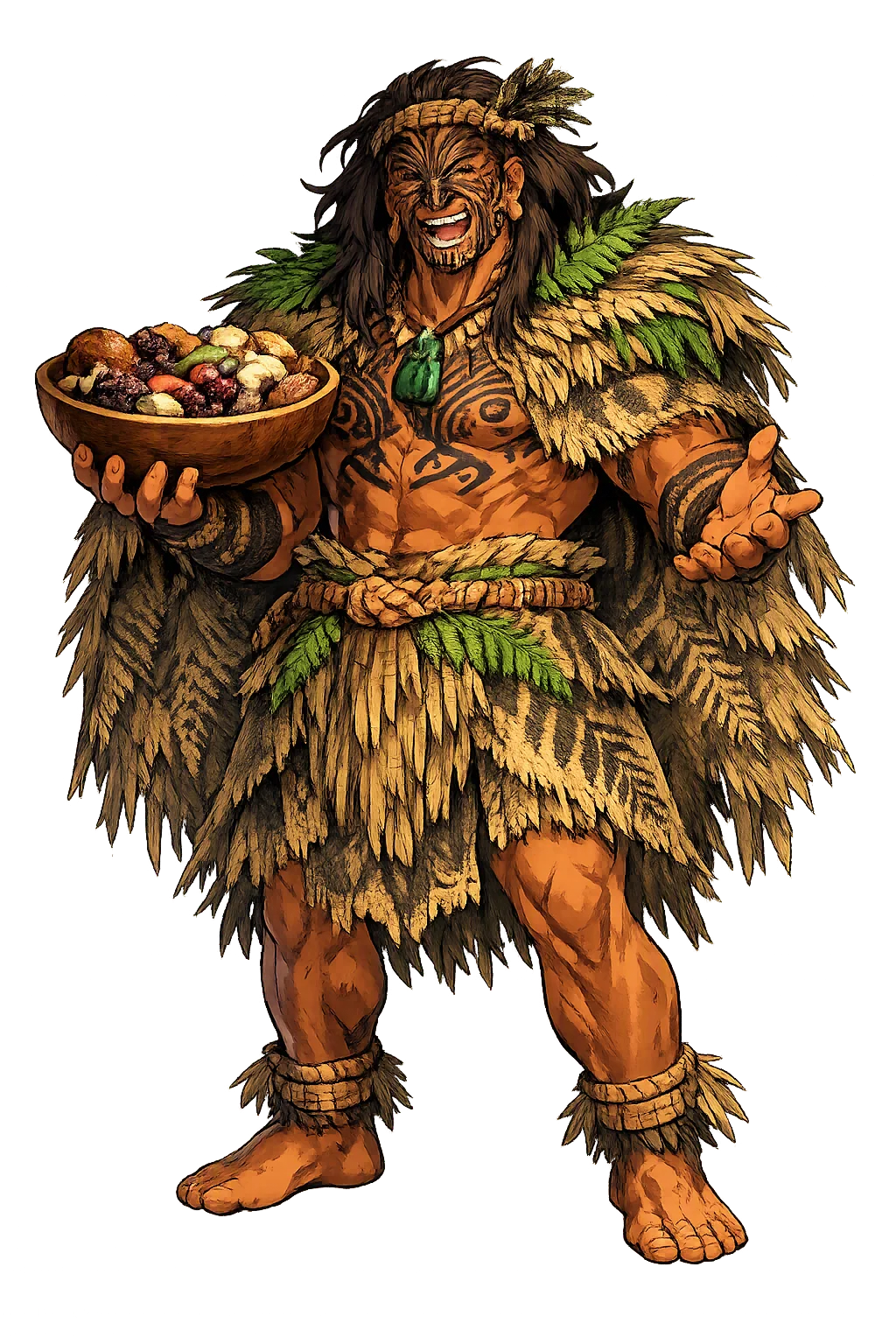
The figure behind the name: Haumia-tiketike's stories are chapters of the Māori creation cycle: the separation of sky and earth, the war among the children, and the settlement of the food quest.
What the Name Carried In
Child of the Sky and the Earth. In the Māori creation cycle recorded by George Grey in Polynesian Mythology (1855) and in the fuller recensions of John White's Ancient History of the Māori, the sky-father Rangi and the earth-mother Papa lay locked in an embrace that left no room for light or life. Their children — Tāne, Tangaroa, Tāwhirimātea, Tūmatauenga, Rongo-māui, Haumia-tiketike and the rest — grew cramped in the darkness between them.
Hidden in the Earth-Mother. Tāne thrust his parents apart, raising the sky on his shoulders and pressing the earth down, and the world took its shape. But the separation left some children with nowhere to go.
A spelling that has to carry stories like these is not a label. It is equipment.
Where It Stood Before Us
No image or named shrine of Haumia survives — his was a cult of practice, not of temples. The material record is indirect but abundant: archaeobotanical studies of starch residues on prehistoric stone tools from sites across Aotearoa confirm that bracken fernroot was a dietary staple from the earliest settlement, and earth-oven (hāngī / umu tī) cooking features — fire-cracked stones in pits — are among the most common archaeological features on pre-European sites. Hardwood digging sticks (kō) survive in museum collections, their blades polished by generations of use. The archaeological signature of Haumia is, fittingly, everywhere and nowhere: not a temple to the god, but a landscape of fern country opened, dug, and steamed in his name. The bench inherits all of it — the web temple is the newest site, not the first.
What We Rejected
Any form invented for availability. The rule on the bench: if the evidence does not carry it, the domain does not get it — whatever the registrar has in stock.
What We Set Down
Haumiatiketike — One decisive feature survives — a single, honest mark — which places the restoration in Tier-2: exact, and exactly labeled.
For the voice: say "haumiatiketike" with the stress and length implied by the scholarly restoration "Haumiatiketike".
The temple stands at /haumiatiketike/ — the notes above are public in its Scholarly Edition, sources and all.
At a Glance
- Restored name: Haumiatiketike
- ASCII form: haumiatiketike
- Meaning: "Haumia tied to the earth"
- Domain of influence: Wild Food, Fernroot
- Pantheon: Polynesian
- Classification: Tier 2
- Original script: —
- Series: The Restoration Files, No. 192 of 548
The File Continues
The temple's founding dispatch tells the name's story; its Resonance File reads the myths into the industries; the blog index holds the whole archive.
Continue the series — previous file: Hati (read it here) · next file: Haurvatāt (read it here).
The Restoration Files are written from the same canonical record as the temples themselves: the lexicon, the lore catalog, the pattern atlas, and the cited scholarly sources. If a file ever disagrees with its temple, the temple is right — tell us, and the file will be corrected.