
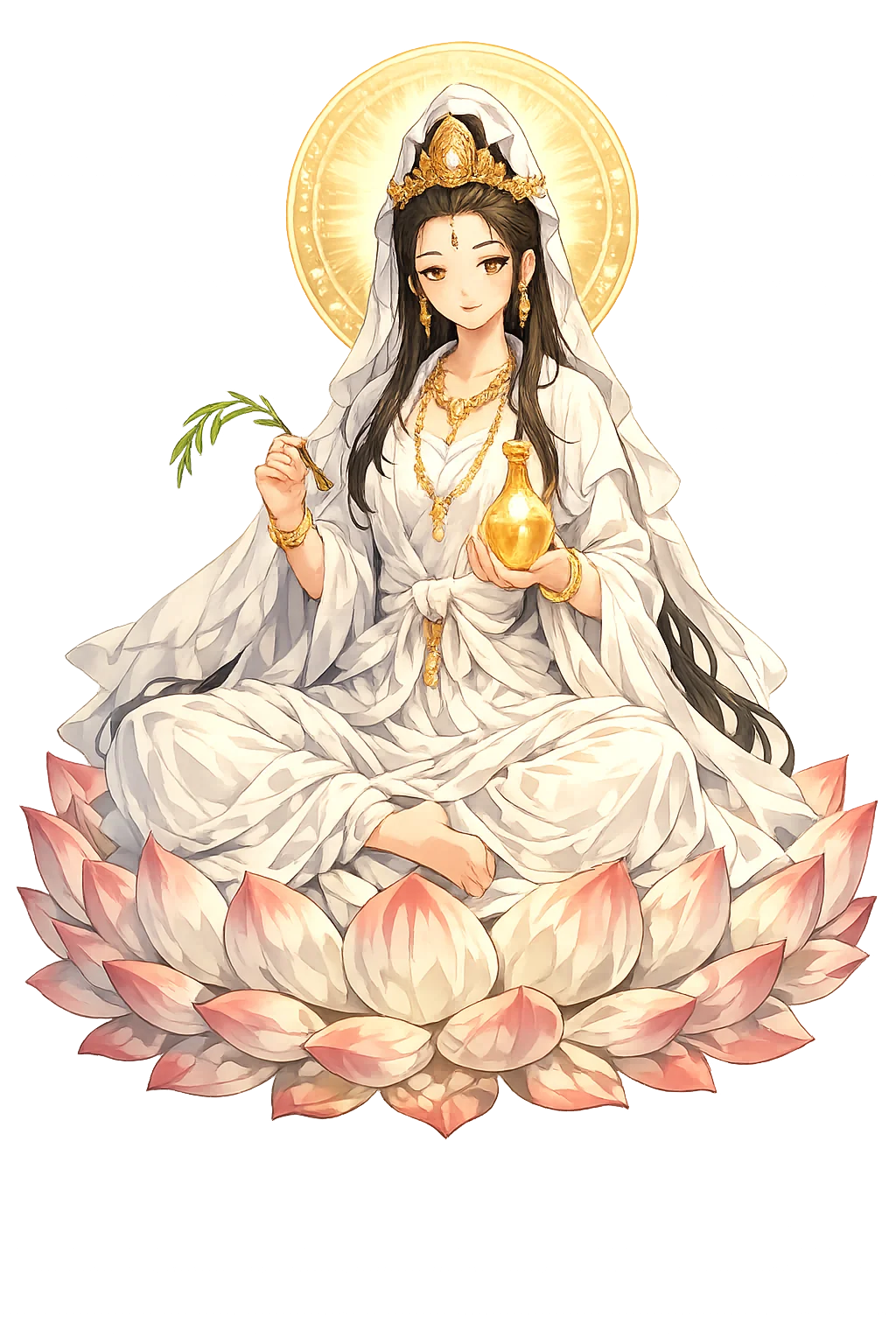
The appointments Guānyīn made — and who is keeping them
Take Guānyīn's stories in sequence. They are not episodes; they are appointments — and the modern trades are keeping them.
At a Glance
- Temple: Guānyīn
- Pantheon: Chinese
- Domain of influence: Compassion, Mercy
- Pattern seats: 3
- Sectors touched: Society & Spirit · Health & Wellbeing
- Strongest seat: Faith & Spiritual Organizations
- Series: The Resonance Files, No. 181 of 546
The Cycle, Read Forward
Faith & Spiritual Organizations — through The Universal Gateway
Chapter 25 of the Lotus Sūtra — Kumārajīva's Chinese translation of 406 CE, so widely copied on its own that it became the independent Guānyīn Jīng — makes the vow explicit: if beings caught in fire, flood, storm, demon-lands, or the executioner's blade "call in one voice upon the name of Guānshìyīn, the bodhisattva will immediately perceive the sound and free them. " The chapter names the perils one by one and then multiplies the rescue: Guānyīn appears in thirty-three forms — monk, king, celestial, even demon-queller — going wherever beings are.
The atlas states the seat in one line: East Asia’s most invoked name; the bodhisattva of the universal vow. The story above is the long version of the same sentence. Industries do not invent their archetypes; they inherit them and call them best practice.
Mental Health & Emotional Wellness — through Miàoshàn of Fragrant Mountain
The legend that made her a daughter is preserved in the Xiangshan Baojuan, a precious scroll of the twelfth–thirteenth centuries: Princess Miàoshàn refuses marriage to pursue awakening, and her enraged father commits her to a convent and then burns it down around her. Executed at last, she descends to the underworld — where her compassion turns hell into a garden of flowers, and the kings of death hasten to restore her to life.
The atlas states the seat in one line: The vow to hear every cry; the patron of listening as care. The story above is the long version of the same sentence. Industries do not invent their archetypes; they inherit them and call them best practice.
Healthcare, Pharma & Medicine — through Avalokiteśvara Comes East
The Indian Avalokiteśvara — "the lord who looks down in compassion" — entered China with the first sūtra translations, and Kumārajīva's school analyzed the Sanskrit name into exactly what Chinese could carry: guān, to observe; shì, the world; yīn, its sounds. The early art keeps the Indian body: Tang paintings and Dunhuang banners show a princely, sometimes mustached figure, and Dunhuang manuscripts even depict the pilgrim Xuanzang's celestial guardian as a masculine guide.
The atlas states the seat in one line: Compassion institutionalized; hospitals across East Asia bear her name. The story above is the long version of the same sentence. The trade thinks it is optimizing a process. It is re-enacting a charter.
The Theme That Runs the Cycle
Guānyīn's "myths" are vows and legends of response: the sūtra promises that whoever calls her name in danger will be heard, Chinese legend supplies the daughter who keeps the promise, and the great novels make her the patron of every journey. What is worshipped is attention itself — the answer that never comes too late.
The Method, Stated Plainly
None of this is numerology. A seat exists only where the match can be argued from the deity’s documented domains and deeds — weighted, published, and falsifiable. The derivation, the weights, and the challenge process are public on the methodology page. If a seat in this file reads wrong, the atlas itself tells you how to prove it — and the correction becomes part of the record.
For the Ones Who Work There
If you work in faith & spiritual organizations, mental health & emotional wellness, or any trade this temple holds a seat in, this is the honest version of what a placement means: your industry beside the story it has been re-telling all along — on the temple floor itself, before an audience that came specifically to read it. The patron tier and the advertising terms describe the mechanics; the resonance above describes the fit.
The File Continues
One of 546 Resonance Files — the series where the pantheon goes to work. Read the founding dispatch for the name, the Restoration File for the spelling, or the whole archive end to end.
Continue the series — previous: Guāndì (read it) · next: Gula (read it).
The Resonance Files are argued from the same canonical record as the pattern atlas itself: the lexicon, the lore catalog, and the cited sources. Every seat can be challenged at the methodology page — and the challenge is the point.