
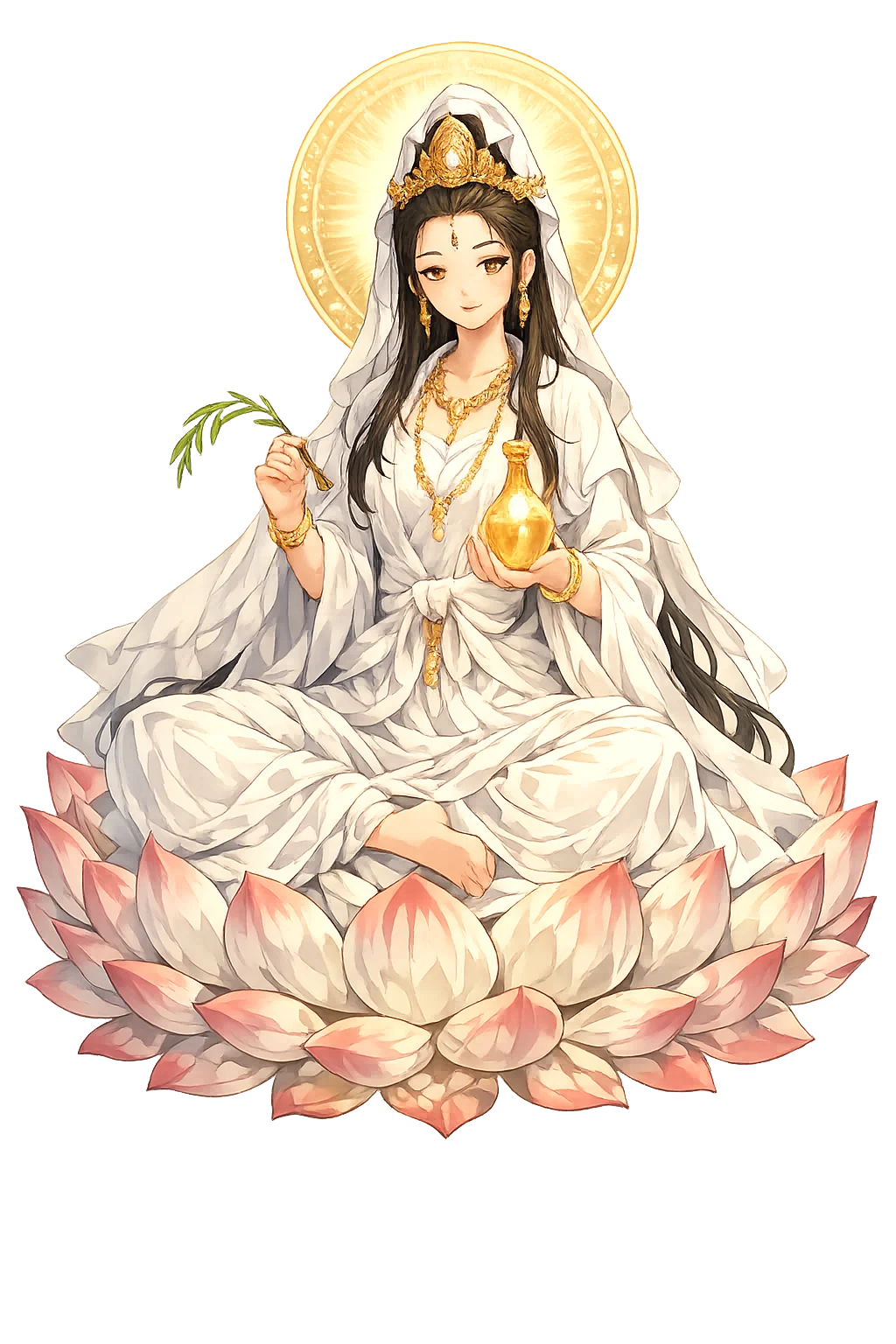
From Chinese characters to Unicode: the journey of Guānyīn
Long before it was a domain, this name traveled through scripts. Guānyīn begins in Chinese characters, passes through scholarly transliteration, and ends — for now — inside the punycode machinery of the global DNS. Each stage of that journey preserves some information and loses some, and the craft of restoration is knowing exactly which marks matter. This post follows the name stage by stage: the original script, the reconstructed pronunciation, the mythological record, the material evidence, and finally the Unicode form that carries all of it into the address bar. Think of it as a biography of a name, told through its spelling.
At a Glance
- Restored name: Guānyīn
- ASCII form: guanyin
- Meaning: "Perceiver of sounds"
- Domain of influence: Compassion, Mercy
- Pantheon: Chinese
- Classification: Tier 1
- Original script: 觀音 (Chinese characters)
- Live domain: guānyīn.com
Overview
Guānyīn (guanyin) — She Who Hears the World — belongs to the Chinese tradition, where it is catalogued under the domain "Compassion, Mercy". The name means "Perceiver of sounds".
Guānyīn is the most beloved figure of East Asian Buddhism: the bodhisattva who vows to hear every cry of suffering in the world and answer it. Born in India as the male Avalokiteśvara, she became, in China, a mother — and compassion itself found its lasting face.
PuniCodex restores the name as Guānyīn and serves its temple at guānyīn.com. The original preserves one prosodic feature — stress or vowel length — rather than both, which places the name in Tier 2. The plain ASCII form guanyin survives as a modern convenience imposed by the early domain-name system; the restoration, not the fallback, is the form the project defends as philologically complete.
The Name
The name is attested in Chinese characters as 觀音. Etymologically it means "Perceiver of sounds".
The ASCII form guanyin survives only because the early domain-name system could not carry diacritics; it is a technological compromise, not an ancient spelling. The Unicode restoration Guānyīn recovers the vowel length of the original directly in the address bar. The original preserves one prosodic feature — stress or vowel length — rather than both, which places the name in Tier 2.
The letter-by-letter transformation runs:
- g → G — Same, capitalized
- u → u — Same
- a → ā — Long vowel
- n → n — Same
- y → y — Same
- i → ī — Long vowel
- n → n — Same
The project holds the domain guānyīn.com (xn--gunyn-gwa01a.com) as the canonical home of this name.
The Original Script
The name is written in Chinese characters as 觀音. This original script is the form against which the ASCII fallback guanyin and the PuniCodex restoration Guānyīn are measured: the restoration preserves its vowel quantity of the written form, so that a reader typing the modern address still speaks the ancient name.
Written 观音 in simplified, 觀音 in traditional characters: guān (to observe, with the seeing radical) plus yīn (sound). The fuller liturgical name 观世音 (Guānshìyīn, "Perceiver of the World's Sounds") preserves the whole Sanskrit sense.
Pronunciation
The reconstructed pronunciation of the name is /kwan˥ ɥin˥/ — Mandarin (Hanyu Pinyin with tones).
For the modern speaker, the closest approximation is: gwahn-yin, high level tone on both syllables.
Kindred and historical forms of the name:
- Chinese — 觀音
- Full title — 觀世音 (Guānshìyīn)
- Sanskrit — Avalokiteśvara
- Owned form — Guānyīn
Guānyīn 观音 means "Perceiver of Sounds" — the one who hears the cries of the world, a rendering of Avalokiteśvara's name as the Chinese translators analyzed it. The level tone on guān and the falling-level yīn are among the most recognized syllables in East Asian devotion.
Mythology
Guānyīn's "myths" are vows and legends of response: the sūtra promises that whoever calls her name in danger will be heard — and Chinese legend supplies a thousand proofs.
The Universal Gateway (The Vow)
Chapter 25 of the Lotus Sūtra — circulated independently as the Guānyīn Sūtra — makes the vow explicit: if beings in danger from fire, flood, demons, or the executioner's blade call on the name of Guānshìyīn, the bodhisattva will at once perceive the sound and deliver them. It is the most recited chapter in East Asian Buddhism: compassion as a cosmic emergency line.
Miàoshàn (The Princess)
The Chinese legend that made her a daughter: Princess Miàoshàn refuses marriage to seek awakening, endures her father's destruction of her convent, and is executed — descending to hell, which her compassion turns to a paradise of flowers. When her father lies dying of a karmic illness, she gives her own eyes and arms for the medicine; revealed as the thousand-armed, thousand-eyed Guānyīn, she forgives him, and the king becomes her devotee.
Avalokiteśvara Comes East (The Crossing)
The Indian bodhisattva of compassion — "the Lord who looks down" — entered China with the first sūtras and slowly changed form: male in the early translations, androgynous in Tang art, unmistakably a white-robed woman by the Song. The transformation, among the most studied in religious history, is usually read as compassion's logic: the vow to hear suffering answered, in China, in a mother's voice.
Symbols & Iconography
The iconography associated with Guānyīn concentrates in a small set of recurring attributes, each a compressed statement about the name:
- The willow branch — Gentleness that bends and does not break — sprinkled with the dew of mercy
- The pure vase — The nectar of compassion, poured without end
- The child in her arms — The Songzi Guānyīn — giver of children, mother of the vow
Archaeology & Evidence
Putuoshan's three great monasteries (Puji, Fayu, Huiji) preserve her island cult from its 10th-century founding, when a Japanese monk's Kannon image refused to sail on and stayed. Dunhuang's Mogao caves hold her earliest Chinese icons — the guide-of-souls Guānyīn leading the dead, the thousand-armed forms of the Tang. The Northern Song colossal bronze thousand-armed Kannon cast in Japan and the Song-dynasty polychrome "Water-Moon Guānyīn" figures — of which the Nelson-Atkins example is the most celebrated — mark her iconography's golden age.
Putuoshan, the island-mountain off Zhoushan, is her Potalaka made Chinese: since the 10th century — when the Japanese monk Egaku's Kannon image refused to sail past the island — its three great monasteries (Puji, Fayu, Huiji) and the 33-metre Nanhai Guānyīn statue have drawn the largest Buddhist pilgrimage in East Asia. Beyond it, her geography is the coast itself: Ningbo's temples sent her image to Japan, Dunhuang's caves hold her oldest Chinese icons, and the Sanya Nanhai colossus of 2005 — 108 metres over the South China Sea — is the modern state's contribution to her map.
Realm & Domain
Guānyīn is the most beloved figure of East Asian Buddhism: the bodhisattva who vows to hear every cry of suffering in the world and answer it. Born in India as the male Avalokiteśvara, she became, in China, a mother — and compassion itself found its lasting face.
The Lotus
Her seat and symbol: purity flowering unsullied from the mud of the world.
The Vase
The pure vase with willow branch — the dew of compassion sprinkled on the suffering.
A Thousand Eyes
The thousand-armed form: an eye in every palm — to see and to reach, without limit.
Putuoshan
Her island mountain off Zhejiang: the Potalaka of the sūtras, anchored in the Chinese sea.
Across Cultures
She is the great syncretist of East Asia: in Tibet she is Chenrezig, patron of the land, incarnate in the Dalai Lamas; in Japan Kannon, with temples from Asakusa to Kiyomizu; in Vietnam Quan Âm. Chinese folk religion fused her with the Queen of Heaven and associated her with Mazu the sea-goddess; Daoism canonized her as Cihang Zhenren; and she entered the Journey to the West as the pilgrimage's divine patron, who recruits the pilgrims and rescues them whenever heaven's bureaucracy fails.
Within the Chinese tradition, closely related names in the corpus include [[bagua|Bāguà]], [[fuxi|Fúxī]], [[long|Lóng]], [[mengpo|Méngpó]], [[nuwa|Nǚwā]], and [[pangu|Pángǔ]].
Cultural Legacy
Her name is spoken daily by more people than perhaps any other divine name on earth: nāmó Guānshìyīn Púsà is East Asia's universal cry in fear and gratitude. Putuoshan draws millions of pilgrims yearly; her statues — from the Suma temple Kannon to the hundred-metre Guānyīn of the South Sea of Sanya — rank among the largest on earth. Vegetarian mercy, lifesaving charities, and countless hospitals across the Chinese world bear her vow.
The Scholarly Record
The account of Guānyīn given in this edition rests on the witnesses and reference works listed below. Lexica and etymological dictionaries secure the form and meaning of the name; the literary and religious texts supply the narrative evidence.
- Saddharmapuṇḍarīkasūtra (Lotus Sutra), Translated by H. Kern (SBE 21), 100. Full text
- Chinese Buddhist canon (Dàzàngjīng / Taishō Tripiṭaka), Taishō Shinshū Daizōkyō (SAT digitization), 1924.
- Chinese Buddhist texts (Hanwen Canon), CBETA / Taishō Tripiṭaka, 400. Full text
- Anne Birrell, Chinese Mythology: An Introduction, Johns Hopkins University Press, 1993.
- Chinese folklore, Oral and compiled folk tales, various.
- Buddhist canonical and commentarial literature, Pāli, Sanskrit, Chinese, and Tibetan recensions, various.
A Meditation
Guānyīn is the vow that hearing comes first. Not judgment, not power — attention: the sounds of the world, all of them, answered. She asks the question that closes every sūtra about her: in a world crying out in a billion voices, what does it take to be one who hears?
Her vow scales with the century: more cries than ever, more channels than ever — and the same first requirement. The bodhisattva's thousand arms and thousand eyes are not a fantasy of power but of capacity: to hear without triage, to reach without ranking. Every crisis line, every rescue service, every stranger who simply stays on the phone is her liturgy in action: the sounds of the world, answered one at a time.
In the clinics and charity kitchens of the Chinese world her name functions as a common noun for selfless care — the volunteer is 'a living Guānyīn.' It is the vow's final transformation: from cosmic bodhisattva to a standard any person can be measured against. The thousand eyes were never on the statue; they are the world's need, looking back at whoever will answer.
The thousand arms were never a boast; they are the arithmetic of need — a hand for every cry, an eye for every direction the cry comes from. The vow does not scale down; that is why she is asked for everything from safe passage to a child. The bodhisattva of hearing is the proof that attention, fully given, is already help.
The Unicode Restoration
Guānyīn is classified as Tier 1: the original carries both stress and length, and only one valid Unicode restoration exists. The ASCII fallback guanyin still resolves everywhere, but it is the restored form that carries the name's full information. Across the 7 characters of the name, the restoration adjusts 2: 2 marks of length (ā, ī). That is the whole thesis of this temple: the marks are the message.
Character by Character
The journey from guanyin to Guānyīn, one character at a time:
- g → G — Same, capitalized
- u → u — Same
- a → ā — Long vowel
- n → n — Same
- y → y — Same
- i → ī — Long vowel
- n → n — Same
The Domain Name
The restored name is live as a working domain: guānyīn.com, which the DNS carries in punycode form as xn--gunyn-gwa01a.com — an ASCII-compatible encoding that lets a non-ASCII name travel the global network without breaking older infrastructure. The visitor sees Guānyīn; the machines see the encoding. That duality is the engineering compromise on which the entire restoration rests, and it is why a name written the way its own tradition wrote it in Chinese characters can now be typed into any browser on earth.
The Chinese Pantheon
Guānyīn is one of 46 entries the PuniCodex lexicon catalogues under the Chinese pantheon. The Pantheon page gathers the tradition's major figures in one place, and the Lexicon lets you filter all 915 restorations by tradition, tier, or script — the fastest way to see where this name sits among its kin.
Frequently Asked Questions
What does Guānyīn mean? The traditional gloss is "Perceiver of sounds."
Which tradition does Guānyīn belong to? Guānyīn is catalogued in the Chinese pantheon of the PuniCodex lexicon.
Why is Guānyīn classified as Tier 1? Because the original carries both stress and length, and only one valid Unicode restoration exists — and the marks in the restored spelling preserve exactly that evidence.
Is Guānyīn a working domain? Yes — guānyīn.com resolves today and routes to this temple.
What is the punycode for guānyīn.com? The DNS encoding is xn--gunyn-gwa01a.com; browsers perform the translation automatically, so visitors only ever see the restored name.
Typing Guānyīn
You do not need a special keyboard to use this restoration. The PuniCodex Type Tool converts the ASCII form guanyin into Guānyīn as you type, and the browser extension offers the same conversion inside any text field. Copy the restored form, paste it into the address bar, and the DNS does the rest.
Sister Temples
Other temples in the Chinese pantheon include Pángǔ, Quánzhēn, and Shénnóng — each with its own restoration story, its own scholarly record, and its own place in the lexicon.
Why This Restoration Matters
Every stage of the journey from Chinese characters to Unicode was an act of care: the scribe who first wrote the name, the lexicographer who glossed it, the engineer who taught the DNS to carry it. The PuniCodex restoration is the latest stage, not the last word — the Scholarly Edition is revised as the evidence improves. What does not change is the principle: a name deserves to be written the way its own tradition wrote it. Guānyīn in the address bar is that principle, made routable.
Explore Further
This post is one doorway into the temple. The home page carries the full character breakdown and the ambient canvas; the lore page tells the myths in long form; the Scholarly Edition preserves the sources, pronunciation data, and revision history; and the patron wall supports the restoration directly. For the wider map, browse the Lexicon, explore the Pantheon, or return to the PuniCodex blog.
Related Names
Sources
The full scholarly apparatus — every citation, revision, and review — lives in the Scholarly Edition. Key references for this post:
- Saddharmapuṇḍarīkasūtra (Lotus Sutra), Translated by H. Kern (SBE 21), 100.
- Chinese Buddhist texts (Hanwen Canon), CBETA / Taishō Tripiṭaka, 400.
- Zurcher.
- Chinese Buddhist canon (Dàzàngjīng / Taishō Tripiṭaka), Taishō Shinshū Daizōkyō (SAT digitization), 1924.
- The Putuoshan gazetteers; Yü Chün-fang, Kuan-yin.
- Anne Birrell, Chinese Mythology: An Introduction, Johns Hopkins University Press, 1993.
- Lexicon authorities for this entry: Lotus Sutra, Chinese Buddhist texts.