PuniCodex

Extended Lore

Guānyīn — The Deeper Record

Etymology · Orthography · Cult · Iconography · Reception · Sources

Preserves vowel length Guānyīn.com
Guānyīn — Compassion, Mercy
01

At a Glance

Guānyīn — every fact links to its home

PantheonChinese
DomainCompassion, Mercy
Attested971 CE
Original Script觀音 →
Cited Works7 cited →
02

Etymology & Word Family

From original script to Unicode restoration — the full etymology page →

Original Script 觀音 Guānyīn — "Perceiver of sounds"
Unicode Restoration Guānyīn Restored stress, length, and script
Modern ASCII guanyin Plain-ASCII fallback

The name Guānyīn carries the orthographic signature of the chinese tradition: 觀音. Unicode restoration recovers what ASCII flattens.

03

Unicode Character Breakdown

Character-by-character philological analysis

CharacterUnicodeNameBlockPhonetic Role
GU+0047Latin Capital Letter GBasic LatinSame, capitalized
uU+0075Latin Small Letter UBasic LatinSame
āU+0101Latin Small Letter A with MacronLatin Extended-ALong vowel
nU+006ELatin Small Letter NBasic LatinSame
yU+0079Latin Small Letter YBasic LatinSame
īU+012BLatin Small Letter I with MacronLatin Extended-ALong vowel
nU+006ELatin Small Letter NBasic LatinSame

The restoration of Guānyīn preserves what it can of the original phonology — stress and vowel length for Greek names, distinctive letters and diacritics for every other tradition.

04

Cult & Worship

How the sacred was kept — rites, sanctuaries, remains

The Cult

Guānyīn is prayed to far more often than she is theorized. The core practice is simple and vast: chanting the 'Universal Gateway' chapter of the Lotus Sūtra — often the whole scripture is performed for this one chapter — and calling her name in fear, illness, and childbirth. Chinese temples keep three annual feast days for her (the nineteenth of the second, sixth, and ninth lunar months), marked by pilgrimage, vegetarian fasts, and processions, with the island circuit of Putuo anchoring the great sea pilgrimage. Devotion institutionalized charity: vegetarian halls run by laywomen, Guanyin societies funding medicine and rescue, and temple oracle-sets of divination slips consulted daily. The evidence of her cult is its numbers — no bodhisattva on earth receives more vows.

In the Earth

Putuoshan's three great monasteries (Puji, Fayu, Huiji) preserve her island cult from its 10th-century founding, when a Japanese monk's Kannon image refused to sail on and stayed. Dunhuang's Mogao caves hold her earliest Chinese icons — the guide-of-souls Guānyīn leading the dead, the thousand-armed forms of the Tang. The Northern Song colossal bronze thousand-armed Guānyīn of Longxing Monastery in Zhengding, China, cast in 971 CE, and the Song-dynasty polychrome "Water-Moon Guānyīn" figures — of which the Nelson-Atkins example is the most celebrated — mark her iconography's golden age.

05

Iconography

How Guānyīn was imaged across the ages

The Image

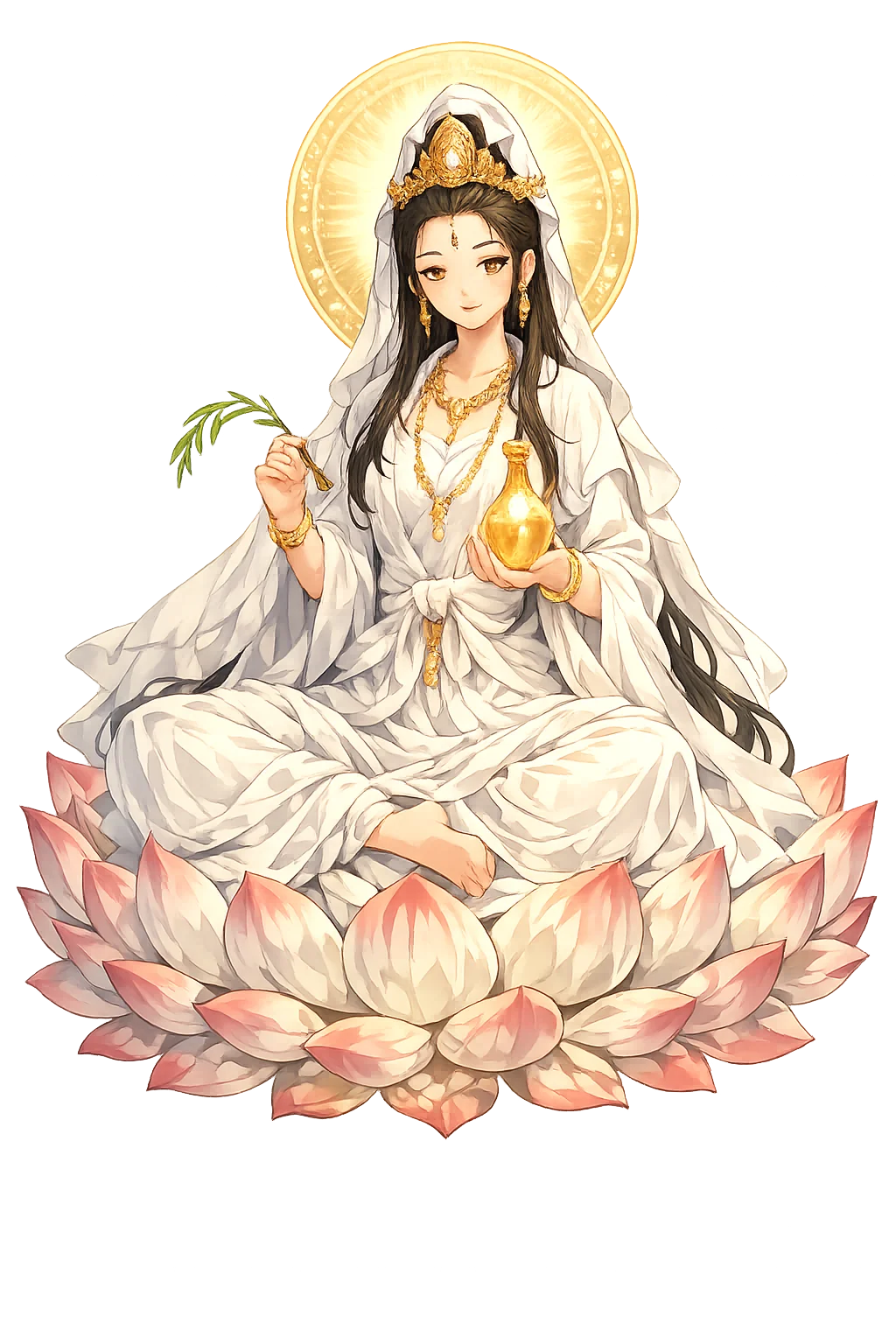
Learn the attributes and she is unmistakable: a lotus throne or rocky grotto, a vase of nectar in one hand, a willow spray in the other — the willow whose sprinkling heals — and, on crowned forms, the small seated figure of Amitabha in her headdress, her spiritual employer. The earliest Chinese images show a princely male bodhisattva in Tang murals and silk banners from the Silk Road oases; by the Song she has become unmistakably female — the great shift of her iconography — and the Song-dynasty 'Water-Moon' type, seated at ease contemplating the water's reflection, became East Asia's favorite sacred image, copied for a thousand years. Later popular forms multiply her mercy: the White-Robed Guanyin of solitary caves, the thousand-armed cosmic form codified by the Great Compassion dhāraṇī, and, from the Ming, the child-giving Songzi Guanyin with an infant in her arms. The Dazu cliff carvings in Sichuan cut her at monumental scale.

06

Reception & Transformation

The name after its own age — transmission, translation, survival

Afterlives

Her transmission is the great relay of Asian religion. The Lotus Sūtra's twenty-fifth chapter promised that whoever called Avalokiteśvara's name would be saved; Kumārajīva's Chinese rendering of 406 CE reanalyzed the name as Guānshìyīn, 'perceiver of the world's sounds,' and Xuanzang's more faithful rendering of 663, Guānzìzài, lost the debate — the compassionate misreading won China's heart. Through the Tang the figure remained male; in the Song she crossed the greatest gender boundary in sacred art, a transformation modern scholarship has made the test case of Buddhist Sinicization: Glen Dudbridge traced the Miàoshàn legend in 1978, and Chün-fang Yü's Kuan-yin (2001) mapped the whole metamorphosis. The West met her through missionaries' reports, James Legge's 1884 translation of the Lotus, Émile Guimet's museum of Asian art, and the Dunhuang banners that reached the British Museum after Aurel Stein's 1907 expedition — and scholarship has been translating her ever since.

Identifications Across Traditions

She is the great syncretist of East Asia: in Tibet she is Chenrezig, patron of the land, incarnate in the Dalai Lamas; in Japan Kannon, with temples from Asakusa to Kiyomizu; in Vietnam Quan Âm. Chinese folk religion fused her with the Queen of Heaven and associated her with Mazu the sea-goddess; Daoism canonized her as Cihang Zhenren; and she entered the Journey to the West as the pilgrimage's divine patron, who recruits the pilgrims and rescues them whenever heaven's bureaucracy fails.

Modern Legacy

Her name is spoken daily by more people than perhaps any other divine name on earth: nāmó Guānshìyīn Púsà is East Asia's universal cry in fear and gratitude. Putuoshan draws millions of pilgrims yearly; her statues — from the Suma temple Kannon to the hundred-metre Guānyīn of the South Sea of Sanya — rank among the largest on earth. Vegetarian mercy, lifesaving charities, and countless hospitals across the Chinese world bear her vow.

09

The Original Script Note

What the written record preserves — and what it does not

Original Script

Written 观音 in simplified, 觀音 in traditional characters: guān (to observe, with the seeing radical) plus yīn (sound). The fuller liturgical name 观世音 (Guānshìyīn, "Perceiver of the World's Sounds") preserves the whole Sanskrit sense.

10

The Meditation

What Guānyīn means — beyond the dictionary

Guānyīn is the vow that hearing comes first. Not judgment, not power — attention: the sounds of the world, all of them, answered. She asks the question that closes every sūtra about her: in a world crying out in a billion voices, what does it take to be one who hears?

Her vow scales with the century: more cries than ever, more channels than ever — and the same first requirement. The bodhisattva's thousand arms and thousand eyes are not a fantasy of power but of capacity: to hear without triage, to reach without ranking. Every crisis line, every rescue service, every stranger who simply stays on the phone is her liturgy in action: the sounds of the world, answered one at a time.

In the clinics and charity kitchens of the Chinese world her name functions as a common noun for selfless care — the volunteer is 'a living Guānyīn.' It is the vow's final transformation: from cosmic bodhisattva to a standard any person can be measured against. The thousand eyes were never on the statue; they are the world's need, looking back at whoever will answer.

The thousand arms were never a boast; they are the arithmetic of need — a hand for every cry, an eye for every direction the cry comes from. The vow does not scale down; that is why she is asked for everything from safe passage to a child. The bodhisattva of hearing is the proof that attention, fully given, is already help.

11

Screen & Culture

Where Guānyīn echoes through film, television, and games — and how

12

Frequently Asked Questions

Deep-dives into the cult, attestation, reception, and sources of Guānyīn

01How do we know how Guānyīn was worshipped?

Putuoshan's three great monasteries (Puji, Fayu, Huiji) preserve her island cult from its 10th-century founding, when a Japanese monk's Kannon image refused to sail on and stayed. The full cult record →

02Where do the earliest attestations of Guānyīn come from?

The record rests on Saddharmapuṇḍarīka (Lotus) Sūtra, ch. 25 — Kumārajīva's translation, 406 CE, Xiangshan Baojuan (Precious Scroll of Fragrant Mountain), 12th–13th c., Great Compassion (Nīlakaṇṭha) Dhāraṇī sūtra, 7th-c. translations, among 5 cited works. The full source apparatus →

03How did later traditions reinterpret Guānyīn?

Her transmission is the great relay of Asian religion. Reception & transformation →

04What do the surviving images of Guānyīn actually show?

Learn the attributes and she is unmistakable: a lotus throne or rocky grotto, a vase of nectar in one hand, a willow spray in the other — the willow whose sprinkling heals — and, on crowned forms, the small seated figure of Amitabha in her headdress, her spiritual employer. The iconography →

05What does the written record of Guānyīn actually preserve?

Written 观音 in simplified, 觀音 in traditional characters: guān (to observe, with the seeing radical) plus yīn (sound). The Original Script note →

13

Scholarly Sources

The philological foundations of this restoration

Every claim on this page is grounded in established scholarship. The orthographic restorations follow disciplinary convention. The etymological chain follows the best available reference works. This is not invention — it is resurrection through scholarship.

◈

Lexicography & Philology

  • Lotus Sutra
  • Chinese Buddhist texts
◎

Primary Texts

  • The Shan Hai Jing (Classic of Mountains and Seas); the Huainanzi; the Chuci.
◉

Archaeology & Art History

  • Chang, K. C. Art, Myth, and Ritual: The Path to Political Authority in Ancient China.
✦

Religious Studies

  • Saddharmapuṇḍarīka (Lotus) Sūtra, ch. 25 — Kumārajīva's translation, 406 CE
  • Xiangshan Baojuan (Precious Scroll of Fragrant Mountain), 12th–13th c.
  • Great Compassion (Nīlakaṇṭha) Dhāraṇī sūtra, 7th-c. translations
  • Wu Cheng'en (attrib.), Xīyóujì, ch. 8–14
  • Dunhuang manuscripts and murals
Return

The Surface Awaits

You have traced the name from its earliest attestation to its Unicode restoration. Now return to the myth. The story is where the name lives.

Back to Lore
Guānyīn mascot