
Pronouncing Garmr: a guide for the curious
Saying Garmr aloud requires more than reading Latin letters on a screen. The conventional spelling is only the entry point into a reconstructed sound and a much older tradition. This post unpacks that sound, the evidence assembled in the scholarly record, the kindred forms, and the mythological record, then shows how the temple preserves the whole argument without pretending that a diacritic was ever lost.
At a Glance
- Canonical name: Garmr
- ASCII form: garmr
- Meaning: "Howler"
- Domain of influence: Guardian, Underworld Hound
- Pantheon: Norse
- Restoration: ASCII-equivalent form
- Reconstructed form: ᚴᛅᚱᛘᛦ (Younger Futhark)
Overview
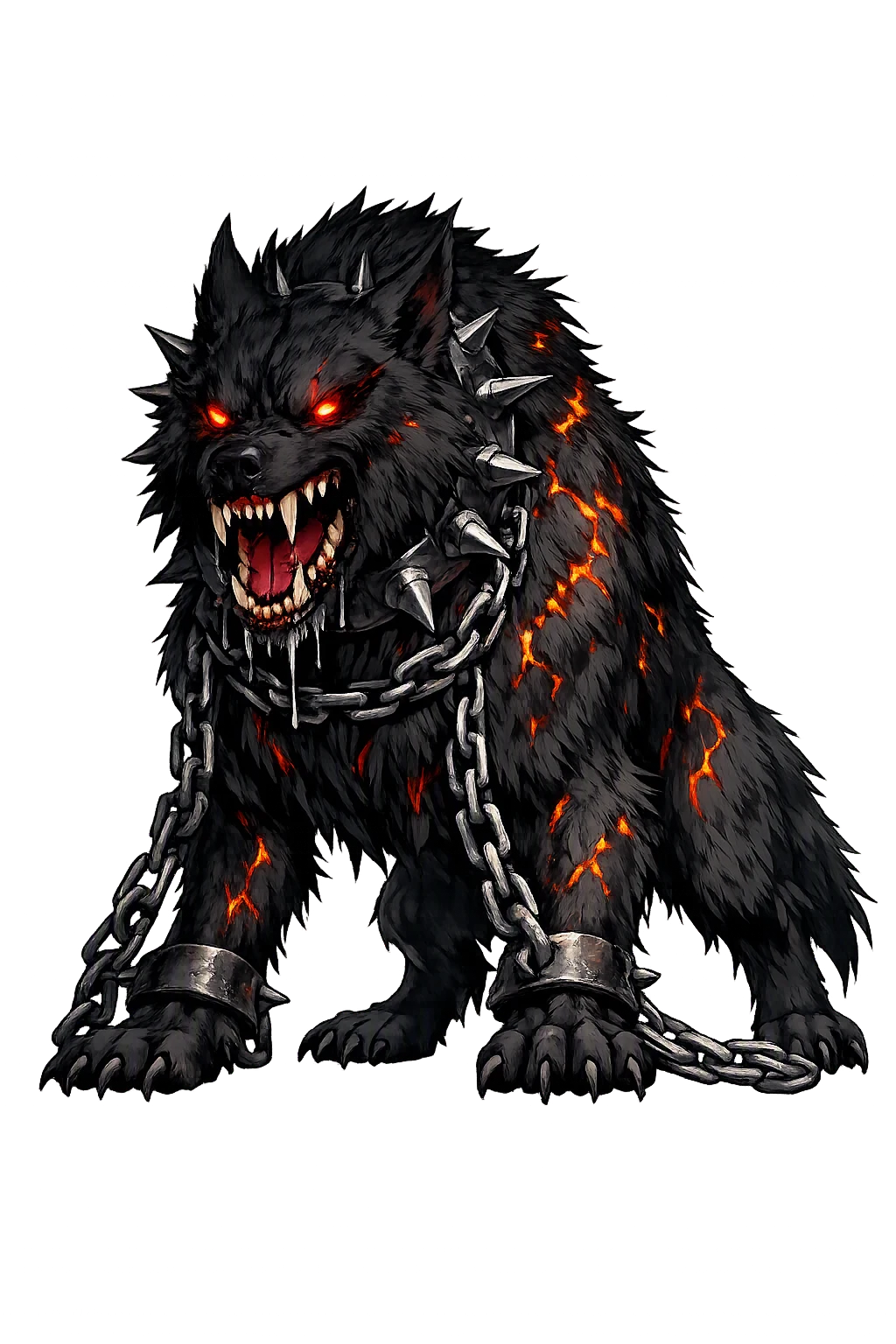
Garmr (garmr) — Guardian, Underworld Hound · the Hound of Gnipahellir — is the blood-bayed watchdog of Helheim: the hound bound before the cave of Gnipahellir whose howling, sounded three times across Vǫluspá, opens the world's last age, and who at Ragnarök breaks his fetter and fights the one-handed Týr — each becoming the other's death.
The sources give Garmr no childhood and no adventures; he exists in the corpus the way a bell exists — to sound at the appointed hour. Grímnismál numbers him, without commentary, as the best of hounds, in the same breath as Yggdrasill among trees and Sleipnir among steeds; Baldrs draumar sets a hound bloody about the breast on the Hel-road to bay at Óðinn himself; and Vǫluspá's seeress counts down the end of the world by his voice: 'Garmr bays loudly before Gnipahellir; the fetter will snap, and the wolf run free.'
PuniCodex restores the name as Garmr — identical to the ASCII input, because normalized Old Norse writes no diacritic and no distinctive letter in this name. The mechanical rule therefore leaves it a plain form: nothing distinctive is lost in transit, a statement about orthography and never about the hound. The temple is domain-less: the plain-ASCII garmr.com is registered to a third party outside the collection and is watched for release; no form of the name is currently owned.
The Name
The name is attested in Old Norse as Garmr (nominative; genitive Garms). It is a mythological proper name and essentially nothing else: Cleasby–Vigfusson record garmr only as 'the dog of the nether world' in the mythology, and the handbooks treat its etymology as unsolved — de Vries lists it among the uncertain names. The standing line of interpretation connects it with a Germanic root for growling or hoarse crying, whence the traditional gloss 'Howler'. The final -r is the Old Norse nominative ending; the genitive Garms shows the stem plainly.
The ASCII form is not a compromise here but the thing itself: normalized Old Norse writes the name in five plain Latin letters, and the ASCII alphabet loses nothing in copying them. Because the restoration preserves no distinctive feature the ASCII form loses, the name is a plain restoration — a mechanical report on orthography, not a judgment on the hound.
The letter-by-letter transformation runs:
- g → G — Same, capitalized
- a → a — Same
- r → r — Same
- m → m — Same
- r → r — Same
No domain is claimed for this name. Because garmr is pure ASCII, its domain was registered in the ordinary way decades ago: garmr.com is held by a third party outside the PuniCodex collection and is watched for release.
The Original Script
The name is preserved in medieval Icelandic manuscripts in the Latin alphabet as Garmr — Old Norse (North Germanic), attested 13th–14th c. CE in the Codex Regius of the Poetic Edda, the fourteenth-century AM 748 I 4to (Baldrs draumar), and the principal manuscripts of the Prose Edda, recording material centuries older. Before the Latin bookhand, Old Norse names were carved in the younger futhark; no runic attestation of this name survives, so the manuscript form is the primary witness.
The scholarly rendering proceeds step by step:
- The word is a mythological proper name, Garmr, with the nominative singular ending -r; the genitive Garms shows the bare stem.
- The manuscripts write no diacritic and no distinctive letter: the name is already plain ASCII, and the restoration recovers nothing because nothing was lost — hence the a plain restoration classification.
- In the Younger Futhark the name would have been carved ᚴᛅᚱᛘᛦ (g-a-r-m-R), a normalized reconstruction only.
- The canonical restoration Garmr therefore equals the ASCII input character for character; the temple's value is canonical reference, not rescued orthography.
Pronunciation
The reconstructed pronunciation of the name is /ˈɡɑrmr̩/ — Old Norse Reconstruction.
Phoneme by phoneme:
- Ga- — Voiced velar stop [g] and short open back [ɑ]; stress falls on the first syllable, as in every Old Norse word
- -rmr — Trilled [r], bilabial nasal [m], and the final syllabic nominative [r̩]; the name is nearly a single syllable, the last r carrying its own light beat as in modern Icelandic
For the modern speaker, the closest approximation is: 'GAHRM-ur' — a hard g, a short open 'ah', and a light syllabic trill to close, as in Icelandic Garmur.
Kindred and historical forms of the name:
- Old Norse — Garmr, the hound bound before Gnipahellir
- Younger Futhark — ᚴᛅᚱᛘᛦ, a normalized reconstruction of how the name would have been carved (g-a-r-m-R); no runic attestation is known
- Modern Icelandic — Garmur, the name's living form, to this day an ordinary dog's name
- Anglicized — Garm, the clipped form of the English retellings, from the Victorians to Tolkien's Farmer Giles of Ham
Garmr is a simpler restoration because the restoration preserves nothing ASCII cannot: five plain letters and a capital. The hound's fame is cosmic; his orthography is humble.
Mythology
Garmr's mythology is a dossier of four scenes, and not one of them is an adventure: he is the hound of the appointed hour, and every source knows him at his post.
The Best of Hounds (Grímnismál 44)
Grímnismál closes its catalogue of the world's first things with a litany every Norse listener could recite: Yggdrasill is the best of trees, Skíðblaðnir of ships, Óðinn of the Æsir, Sleipnir of steeds, Bifrǫst of bridges, Bragi of skalds, Hábrók of hawks — and Garmr of hounds. The hound of Hel takes his place in the superlative order of the cosmos without explanation and without rival: whatever else the poets disagreed about, the watch at the world's border had one incumbent.
The Thrice-Sounded Bay (Vǫluspá 44, 49, 58)
Vǫluspá counts down the end of the world by the hound's voice. Three times, as the vision darkens — when the bonds of the world loosen, when the armies of the end gather, and at the last, before the earth sinks into the sea — the seeress breaks off with the same refrain: 'Garmr bays loudly before Gnipahellir; the fetter will snap, and the wolf run free.' The poem never names the wolf that runs: freki, 'the ravenous one', is the word of the kennings, and Snorri reads the freed beast as Fenrir — but the refrain hangs the moment on Garmr himself, the watcher whose post is the first to fall.
The Bloodied Watcher (Baldrs draumar 2–3)
When Baldr dreams baleful dreams, Óðinn saddles Sleipnir and rides down the road to Niflhel — and the first living thing the poem sets on that road is the hound: 'it was bloody about the breast in front, and it bayed long at the Father of Spells.' The poem never names it, but the tradition has never hesitated: the watcher bloodied at Hel's gate is Garmr, doing here exactly what Gnipahellir's bound hound does in Vǫluspá — announcing that something living has crossed, and that the dead know it.
The Death of Týr (Gylfaginning 51)
Snorri's Ragnarök gives Garmr his single act and his single line of description: 'then Garmr, who is bound before Gnipahellir, breaks loose; he is the most terrible of monsters. He fights with Týr, and each becomes the other's death.' The pairing is the Edda's quiet arithmetic: Týr is the god who gave his hand to bind one wolf, and at the end he is spent killing another. Fenrir takes Óðinn; Garmr takes the one-handed god; the wolves of the North divide the gods' courage between them.
Symbols & Iconography
Garmr's iconography is the iconography of his office — the corpus gives him no cult regalia, but the poems fixed around his post a small set of attributes no retelling can omit:
- Gnipahellir — the Gnipa-cave, the overhanging rock (ON gnipa, 'jutting peak') before which he is bound: the one fixed address in his myth
- The fetter — the binding that holds only until the refrain is sounded; in the Edda every chain is a clock, and his is the loudest
- The thrice-sounded bay — the refrain of Vǫluspá: 'the fetter will snap, and the wolf run free' — the sound by which the seeress counts down the world
- The bloodied breast — the mark of the hound that comes out of Hel in Baldrs draumar: death's evidence carried on the watcher's own body
- The mutual death — his last fight with Týr, in which each becomes the other's bane: the Edda's justice, in which even Ragnarök's victories are paid for in kind
Archaeology & Evidence
Garmr is an entirely textual hound: no runestone names him, no votive deposit is his, and no image can be securely identified with him. The picture-stone corpus of Gotland preserves riders and beasts at the borders of the world — stones such as Tjängvide and Ardre VIII show the eight-legged horse and its rider approaching the realm of the dead — and the bloodied hound of Baldrs draumar has occasionally been sought among the animal figures that attend the dead; but the stones carry no inscription, and the identifications remain suggestions.
His witnesses are the manuscripts: the Codex Regius for Vǫluspá and Grímnismál, the fourteenth-century AM 748 I 4to for Baldrs draumar — that poem's sole medieval home — and the Codex Regius and Codex Wormianus of the Prose Edda for Gylfaginning's Ragnarök chapter. The absence of cult is itself the record: Garmr was never prayed to, because he was never anyone's god. He was the North's watchdog, and a watchdog needs no temple — only a post, a chain, and the hour he is waiting for.
Realm & Domain
Garmr is the guardian of the border of the dead and the hound of the world's last hour: the watcher whose post is the first to fall when the fetter of the world snaps.
The Guardian
His single office is the watch: bound before Gnipahellir at the threshold of Helheimr, he is the fixed point between the living and the dead — the hound Grímnismál calls, simply, the best of hounds.
The Underworld Hound
Baldrs draumar sets him — bloodied about the breast — on the Hel-road itself, baying long at Óðinn as the god rides down to wake the dead; he belongs to Hel's threshold the way Cerberus belongs to Hades'.
The Voice of the Last Age
Vǫluspá sounds his bay three times as the world unravels; the howl before Gnipahellir is the Edda's own clock of doom, and at Ragnarök the watcher becomes a combatant: he fights Týr, and each is the other's death.
Across Cultures
Garmr belongs to one of the oldest comparative dossiers in Indo-European studies: the hellhound. Greece keeps Kerberos, the hound of Hades whom Hesiod names among the monstrous brood of Echidna; the Ṛgveda gives Yama, the first of the dead, two four-eyed brindled hounds — the Sárameyas — who guard the path of the dead; and Wales keeps the Cŵn Annwn, the white, red-eared hounds of Arawn's otherworld pack in the First Branch of the Mabinogion. Linguists since the nineteenth century have connected Kerberos with Sanskrit śarvara-, the epithet of Yama's hounds, and Bruce Lincoln's classic study 'The Hellhound' traces the full complex — the watcher at death's border, the barred return, the dog that must be fed or fought by the crossing hero.
Within the Norse corpus itself the closest comparison is internal: Simek reads Garmr as probably a double of the Fenris-wolf — the bound monster of the end seen from the side of Hel rather than from the side of the gods — and the ambiguity is native, since Vǫluspá's refrain has Garmr bay and 'the wolf' run free. The northern hellhound carries one difference from his southern kin: where Kerberos guards the gate of a permanent kingdom, Garmr guards a gate that will not hold.
Cultural Legacy
Garmr's afterlife runs on the two rails his sources laid down: the watchdog and the countdown. Victorian and modern retellings of Ragnarök keep the Vǫluspá refrain as the moment the end becomes audible — the howl before the fire — and every handbook of Norse myth gives him his one paragraph: best of hounds, bound before Gnipahellir, bane of Týr.
In fiction the name has served both comedy and terror: Tolkien gave it, half in jest, to the talking dog Garm of Farmer Giles of Ham, a watchdog who cannot keep watch; and the modern games industry has restored the full scale of the myth — God of War Ragnarök (2022) casts Garm as the giant unkillable wolf whose unbinding threatens the realms. In Iceland the name never left the kennels: Garmur remains an ordinary dog's name, which is perhaps the truest survival of all — the hound of Hel, brought home and given a bowl.
The Scholarly Record
The account of Garmr given in this edition rests on the witnesses and reference works listed below. The Eddas supply every scene in the dossier; the lexica and handbooks secure the name's form and the standing readings; the comparative witnesses frame the hellhound complex.
- Snorri Sturluson, Edda, Gylfaginning 51 (Garmr at Ragnarök); Skáldskaparmál (kennings for Týr), ed. and trans. Anthony Faulkes (London: Everyman, 1987).
- The Poetic Edda, trans. Carolyne Larrington, 2nd ed. (Oxford: Oxford University Press, 2014): Vǫluspá 44, 49, 58; Grímnismál 44; Baldrs draumar 2–3.
- Cleasby, Richard, and Guðbrandur Vigfússon, An Icelandic-English Dictionary, 2nd ed. (Oxford: Clarendon Press, 1957), s.v. garmr, gnipa.
- Zoëga, Geir T., A Concise Dictionary of Old Icelandic (Oxford: Clarendon Press, 1910), s.v. Garmr.
- de Vries, Jan, Altnordisches etymologisches Wörterbuch, 2nd ed. (Leiden: Brill, 1962), s.v. Garmr.
- Simek, Rudolf, Dictionary of Northern Mythology, trans. Angela Hall (Cambridge: D. S. Brewer, 1993), s.v. Garmr.
- Lindow, John, Norse Mythology: A Guide to the Gods, Heroes, Rituals, and Beliefs (Oxford: Oxford University Press, 2001), s.v. Garmr, Ragnarök.
- Lincoln, Bruce, 'The Hellhound', Journal of Indo-European Studies 7 (1979): 273–285.
- Comparative witnesses: Hesiod, Theogony 310–312; Ṛgveda 10.14; Pwyll Pendeuic Dyuet (First Branch of the Mabinogion).
A Meditation
Garmr is the guardian of a gate that is fated to open. Every element of his myth is a postponement: the fetter holds until Ragnarök, the cave holds the hound until the refrain is sounded, the border holds the dead until the last age. He does his duty perfectly, and it changes nothing — the Edda's whole theology of duty in one animal.
What the North saw in him is what it saw everywhere: that watching is not winning, that the fiercest fidelity serves a world already sentenced, and that the howl at Gnipahellir is not a warning anyone can act on. It is simply the sound the world makes when it keeps its appointments. Garmr bays because that is what the watch is for; the fetter breaks because that is what time is for. The guardian and the doom are the same fact, heard from two sides of the gate.
The Canonical Spelling
Garmr is the canonical spelling used by this temple. The plain ASCII form garmr contains the same letters, so there are no lost diacritics to recover and no special encoding transition to explain. What the temple preserves is the reviewed reference form: capitalization, conventional romanization, original evidence, and a stable place to inspect them. The value here is not added decoration; it is fidelity to the attested record.
Why This Record Matters
Pronunciation turns out to be central to the matter. The canonical spelling of Garmr is a guide to the voice, not an incomplete shell awaiting marks. The temple hands the instructions back: say the name as the evidence suggests, write it as the scholarly convention records it, and let the original sources remain visible beside it. That is the work of preservation here — and every reader can inspect it.
Explore Further
This post is one doorway into the temple. The home page carries the full character breakdown and the ambient canvas; the lore page tells the myths in long form; the Scholarly Edition preserves the sources, pronunciation data, and revision history; and the patron wall supports the restoration directly. For the wider map, browse the Lexicon, explore the Pantheon, or return to the PuniCodex blog.
Related Names
Sources
The full scholarly apparatus — every citation, revision, and review — lives in the Scholarly Edition. Key references for this post:
- Snorri Sturluson, Edda, Gylfaginning 51 (Garmr breaks loose at Ragnarök and fights Týr), ed. and trans. Anthony Faulkes (London: Everyman, 1987).
- Grímnismál 44; Baldrs draumar 2–3; Vǫluspá 44, 49, 58 (Poetic Edda), trans. Carolyne Larrington, The Poetic Edda, 2nd ed. (Oxford: Oxford University Press, 2014).
- Cleasby, Richard, and Guðbrandur Vigfússon, An Icelandic-English Dictionary, 2nd ed. (Oxford: Clarendon Press, 1957), s.v. garmr.
- Cleasby, Richard, and Guðbrandur Vigfússon, An Icelandic-English Dictionary, 2nd ed. (Oxford: Clarendon Press, 1957), s.v. garmr; de Vries, Jan, Altnordisches etymologisches Wörterbuch, 2nd ed. (Leiden: Brill, 1962), s.v. Garmr.
- Lexicon authorities for this entry: Cleasby-Vigfusson, Zoëga.