PuniCodex

Extended Lore

Garmr — The Deeper Record

Etymology · Orthography · Cult · Iconography · Reception · Sources

ASCII-equivalent form Garmr
Garmr — Guardian, Underworld Hound
01

At a Glance

Garmr — every fact links to its home

PantheonNorse
DomainGuardian, Underworld Hound
Original Scriptᚴᛅᚱᛘᛦ →
Primary Sources3 cited →
02

Etymology & Word Family

From original script to canonical restoration — the full etymology page →

Original Script ᚴᛅᚱᛘᛦ Garmr — "Howler"
Canonical Restoration Garmr Canonical scholarly spelling — ASCII-identical
Modern ASCII garmr Plain-ASCII fallback

The name Garmr reaches the modern world through scholarly transliteration of the norse tradition. Because the conventional spelling uses only Latin letters, its canonical and ASCII forms coincide — the tradition it carries is in the name itself, not in diacritics.

03

Character breakdown

Character-by-character philological analysis

CharacterUnicodeNameBlockPhonetic Role
GU+0047Latin Capital Letter GBasic LatinSame
aU+0061Latin Small Letter ABasic LatinSame
rU+0072Latin Small Letter RBasic LatinSame
mU+006DLatin Small Letter MBasic LatinSame
rU+0072Latin Small Letter RBasic LatinSame

This restoration reflects fidelity to the attested tradition, not recovered diacritics: every character of Garmr already survives in ASCII. What the restoration preserves is the canonical spelling itself — the form scholarship standardised.

04

Cult & Worship

How the sacred was kept — rites, sanctuaries, remains

The Cult

No cult of Garmr is attested anywhere in the record, and none should be invented for him: no sanctuary, festival, priest, or votive names the hound of Gnipahellir, and the witnesses that hold him — three Eddic poems and one chapter of Snorri — are literature, not liturgy. What the archaeology does hold is a Norse world that honored its dogs: canines interred beside their owners appear across the Viking-Age burial corpus, and hounds stand at the borders of the Gotland picture stones. But no bone, stone, or inscription ties that reverence to Garmr; his only temple is the stanza, and his only rite the refrain that sounds three times as the world ends.

In the Earth

Garmr is an entirely textual hound: no runestone names him, no votive deposit is his, and no image can be securely identified with him. The picture-stone corpus of Gotland preserves riders and beasts at the borders of the world, and the bloodied hound of Baldrs draumar has occasionally been sought among the animal figures that attend the dead on stones such as Ardre VIII — but the stones carry no inscription, and the identifications remain suggestions. His witnesses are the manuscripts: the Codex Regius for Vǫluspá and Grímnismál, the fourteenth-century AM 748 I 4to for Baldrs draumar — the poem's sole medieval home — and the Codex Regius and Codex Wormianus of the Prose Edda for Gylfaginning's Ragnarök chapter. The absence of cult is itself the record: Garmr was never prayed to, because he was never anyone's god. He was the North's watchdog, and a watchdog needs no temple — only a post, a chain, and the hour he is waiting for.

05

Iconography

How Garmr was imaged across the ages

The Image

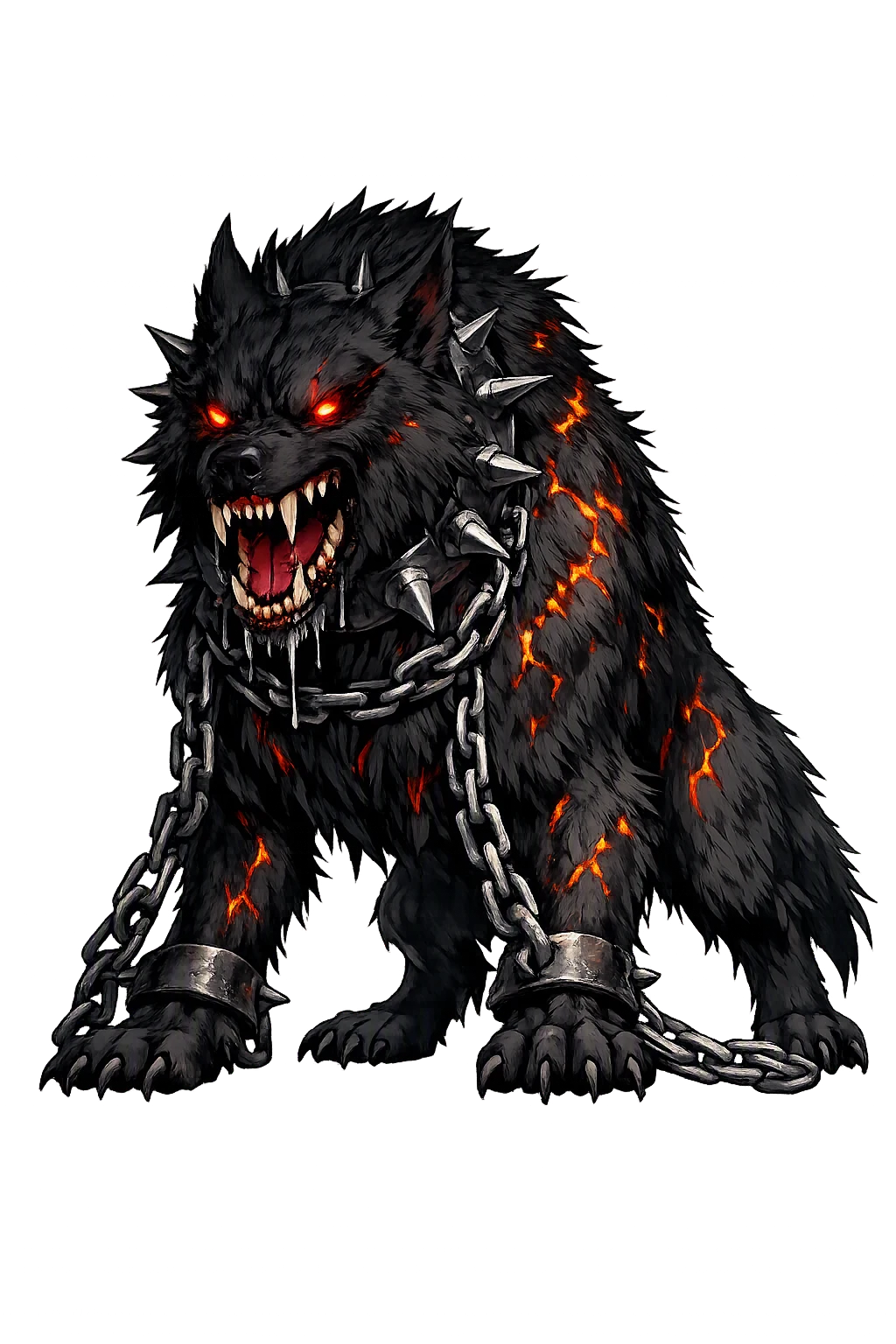
Garmr's portrait exists only in words, and the words agree on the essentials: a hound bound before the overhanging cave, bloodied about the breast from whatever crosses his path, baying long enough to serve as a clock. Baldrs draumar supplies the one physical detail the corpus preserves — the blood on the breast, in front — while Grímnismál gives him his superlative, best of hounds, and Gylfaginning his terror: mesta forað, the greatest of monsters, once the fetter snaps. No Viking-Age image of him survives, and none can be securely identified; the beasts that crouch at the edges of the picture stones have been proposed, but a chained hound at the world's border is an interpretation, not a reading, and the stones themselves are silent. The texts hand a sculptor everything required — chain, cave, gore, howl — and for a thousand years that verbal portrait was all anyone had.

06

Reception & Transformation

The name after its own age — transmission, translation, survival

Afterlives

Garmr's entire afterlife rests on four fragile manuscripts. Vǫluspá, Grímnismál, and Baldrs draumar reached the modern world through the Codex Regius of the Poetic Edda, written in Iceland around 1270 and sent to Denmark in 1640 after three centuries of silence; Baldrs draumar survives in no other medieval copy at all. The refrain that made the hound famous — Garmr geyr fyr Gnipahelli — entered print with the great Copenhagen edition of the Edda of 1787–1828, and crossed into English with the Victorian translation wave, Benjamin Thorpe's of 1866 and Henry Adams Bellows' of 1923. Nineteenth-century mythography gave him his European frame: Jacob Grimm's Deutsche Mythologie set the end-time hounds of the North beside the wolf, and the twentieth-century handbooks refined the standing verdict, de Vries to Simek, that Garmr is best read as the Fenris-complex seen from Hel's side of the gate. His name, meanwhile, never left the language it was born in.

Identifications Across Traditions

Garmr belongs to one of the oldest comparative dossiers in Indo-European studies: the hellhound. Greece keeps Kerberos, the many-headed hound of Hades whom Hesiod names among the monstrous brood of Echidna; the Ṛgveda gives Yama, the first of the dead, two four-eyed brindled hounds — the Sárameyas — who guard the path and watch over men; and Wales keeps the Cŵn Annwn, the white, red-eared hounds of Arawn's otherworld pack in the First Branch of the Mabinogion. Linguists since the nineteenth century have connected Kerberos with Sanskrit śarvara-, the epithet of Yama's hounds, and Bruce Lincoln's classic study 'The Hellhound' traces the full complex — the watcher at death's border, the barred return, the dog that must be fed or fought by the crossing hero. The North's witness fits the pattern with one northern difference: where Kerberos guards the gate of a permanent kingdom, Garmr guards a gate that will not hold. He is the hellhound of a mythology whose underworld itself has an expiry date.

Modern Legacy

Garmr's afterlife runs on the two rails his sources laid down: the watchdog and the countdown. Victorian and modern retellings of Ragnarök keep the Vǫluspá refrain as the moment the end becomes audible — the howl before the fire. Tolkien gave the name, half in jest, to the talking dog Garm of Farmer Giles of Ham, a watchdog who cannot keep watch; and the modern games industry has restored the full terror, with God of War Ragnarök (2022) casting Garm as the giant unkillable wolf whose unbinding threatens the realms. In Iceland the name never left the kennels: Garmur remains an ordinary dog's name, which is perhaps the truest survival of all — the hound of Hel, brought home and given a bowl.

08

The Original Script Note

What the written record preserves — and what it does not

Original Script

The normalized Old Norse form is Garmr — already plain ASCII, with no diacritic or distinctive letter for the restoration to recover; in the Younger Futhark the name would have been carved ᚴᛅᚱᛘᛦ (g-a-r-m-R, ᛦ writing the final nominative -r), a normalized reconstruction only, as no runic attestation of the name is known. Because the name is pure ASCII, its domain was registered decades ago in the ordinary way: garmr.com is held by a third party outside the PuniCodex collection and is watched for release — no form of the name is currently owned, and this temple claims none.

09

The Meditation

What Garmr means — beyond the dictionary

Garmr is the guardian of a gate that is fated to open. Every element of his myth is a postponement: the fetter holds until Ragnarök, the cave holds the hound until the refrain is sounded, the border holds the dead until the last age. He does his duty perfectly and it changes nothing — the Edda's whole theology of duty in one animal. What the North saw in him is what it saw everywhere: that watching is not winning, that the fiercest fidelity serves a world already sentenced, and that the howl at Gnipahellir is not a warning anyone can act on. It is simply the sound the world makes when it keeps its appointments. Garmr bays because that is what the watch is for; the fetter breaks because that is what time is for. The guardian and the doom are the same fact, heard from two sides of the gate.

10

Frequently Asked Questions

Deep-dives into the cult, attestation, reception, and sources of Garmr

01How do we know how Garmr was worshipped?

Garmr is an entirely textual hound: no runestone names him, no votive deposit is his, and no image can be securely identified with him. The full cult record →

02Where do the earliest attestations of Garmr come from?

The record rests on Poetic Edda: Vǫluspá 44, 49, 58 (the thrice-sounded refrain: Garmr bays before Gnipahellir); Grímnismál 44 (best of hounds); Baldrs draumar 2–3 (the bloodied hound on the Hel-road), Snorri Sturluson, Prose Edda: Gylfaginning 51 (Garmr breaks loose at Ragnarök and kills, and is killed by, Týr); Skáldskaparmál (kennings for Týr as one-handed god and feeder of the wolf), Cleasby–Vigfusson, An Icelandic-English Dictionary, s.v. garmr ('the dog of the nether world'), gnipa; Zoëga, A Concise Dictionary of Old Icelandic, s.v. Garmr; de Vries, Altnordisches etymologisches Wörterbuch, s.v. Garmr (etymology uncertain), among 5 cited works. The full source apparatus →

03How did later traditions reinterpret Garmr?

Garmr's entire afterlife rests on four fragile manuscripts. Reception & transformation →

04What do the surviving images of Garmr actually show?

Garmr's portrait exists only in words, and the words agree on the essentials: a hound bound before the overhanging cave, bloodied about the breast from whatever crosses his path, baying long enough to serve as a clock. The iconography →

05What does the written record of Garmr actually preserve?

The normalized Old Norse form is Garmr — already plain ASCII, with no diacritic or distinctive letter for the restoration to recover; in the Younger Futhark the name would have been carved ᚴᛅᚱᛘᛦ (g-a-r-m-R, ᛦ writing the final nominative -r), a normalized reconstruction only, as no runic attestation of the name is known. The Original Script note →

11

Scholarly Sources

The philological foundations of the record

Every claim on this page is grounded in established scholarship. The orthographic restorations follow disciplinary convention. The etymological chain follows the best available reference works. This is not invention — it is resurrection through scholarship.

◈

Lexicography & Philology

  • Cleasby-Vigfusson
  • Zoëga
◎

Primary Texts

  • Poetic Edda: Vǫluspá 44, 49, 58 (the thrice-sounded refrain: Garmr bays before Gnipahellir); Grímnismál 44 (best of hounds); Baldrs draumar 2–3 (the bloodied hound on the Hel-road)
  • Snorri Sturluson, Prose Edda: Gylfaginning 51 (Garmr breaks loose at Ragnarök and kills, and is killed by, Týr); Skáldskaparmál (kennings for Týr as one-handed god and feeder of the wolf)
  • Comparative witnesses: Hesiod, Theogony 310–312 (Kerberos); Ṛgveda 10.14 (Yama's hounds, the Sárameyas); Pwyll Pendeuic Dyuet, First Branch of the Mabinogion (the Cŵn Annwn); Lincoln, 'The Hellhound', Journal of Indo-European Studies 7 (1979)
◉

Archaeology & Art History

  • Foote, P., & Wilson, D. M. The Viking Achievement; Graham-Campbell, J. Viking Art.
✦

Religious Studies

  • Cleasby–Vigfusson, An Icelandic-English Dictionary, s.v. garmr ('the dog of the nether world'), gnipa; Zoëga, A Concise Dictionary of Old Icelandic, s.v. Garmr; de Vries, Altnordisches etymologisches Wörterbuch, s.v. Garmr (etymology uncertain)
  • Simek, Dictionary of Northern Mythology, s.v. Garmr (double of the Fenris-wolf); Orchard, Dictionary of Norse Myth and Legend; Lindow, Norse Mythology: A Guide — s.v. Garmr, Týr, Ragnarök
Return

The Surface Awaits

You have traced the name from its earliest attestation to its canonical restoration. Now return to the myth. The story is where the name lives.

Back to Lore
Garmr mascot