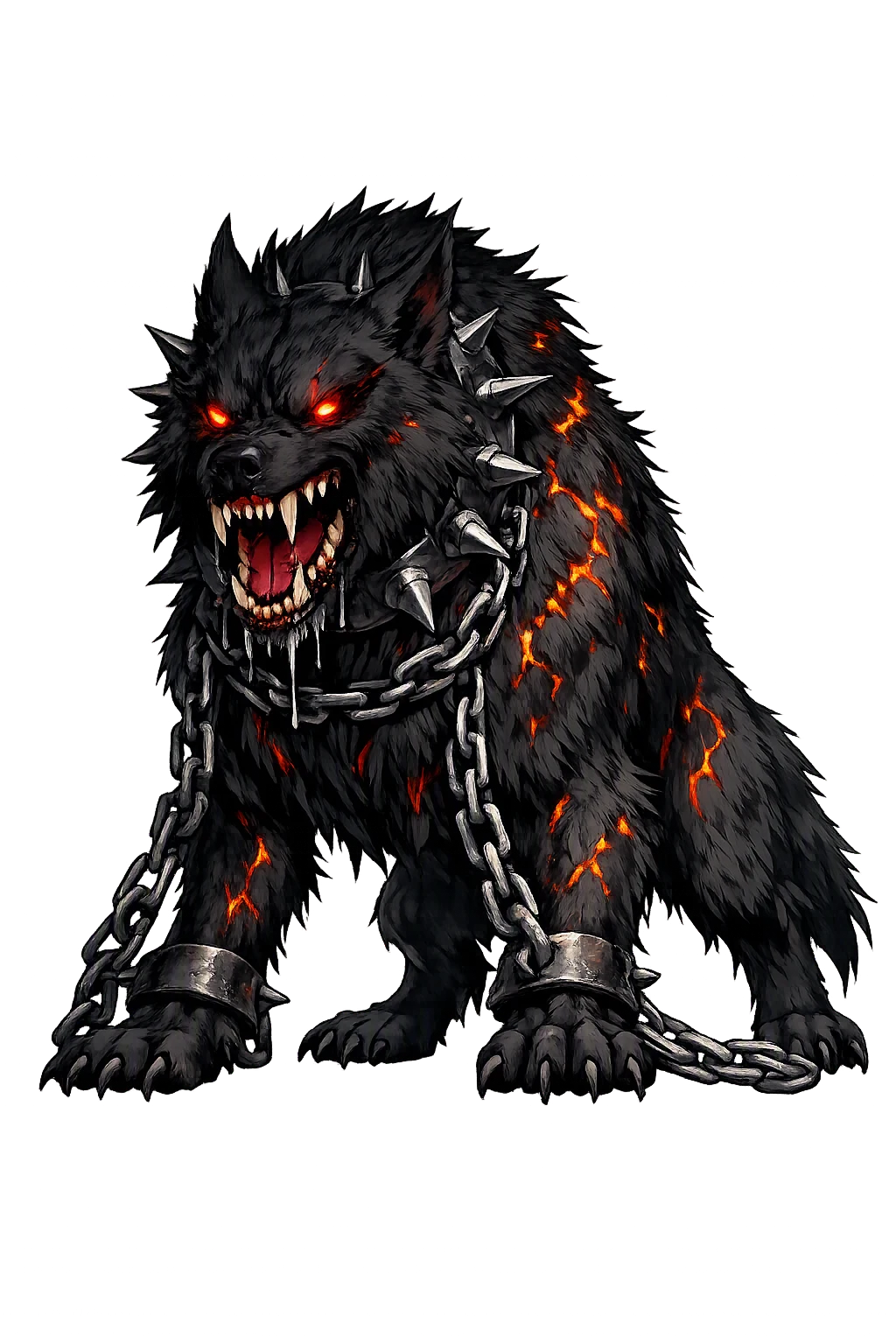
Stories of Garmr
Garmr has no adventures and no childhood; he exists in the sources the way a bell exists — to sound at the appointed hour. Three poems and one prose chapter hold the whole dossier: the best-of-hounds catalogue, the thrice-sounded bay of Vǫluspá, the bloodied watcher on the Hel-road, and the last fight with Týr.
Grímnismál closes its catalogue of the world's first things with a litany every Norse listener could recite: Yggdrasill is the best of trees, Skíðblaðnir of ships, Óðinn of the Æsir, Sleipnir of steeds, Bifrǫst of bridges, Bragi of skalds, Hábrók of hawks — and Garmr of hounds. The hound of Hel takes his place in the superlative order of the cosmos without explanation and without rival: whatever else the poets disagreed about, the office of watchdog at the world's border had one incumbent.
Vǫluspá counts down the end of the world by the hound's voice. Three times, as the vision darkens — when the bonds of the world loosen, when the giants and the dead come to the field, and at the last, before the earth sinks into the sea — the seeress breaks off with the same refrain: 'Garmr bays loudly before Gnipahellir; the fetter will snap, and the wolf run free.' The poem never names the wolf that runs: freki, 'the ravenous one', is the word the kennings use for Fenrir, and Snorri reads the freed beast as the Fenris-wolf — but the refrain hangs the moment on Garmr himself, the watcher whose post is the first to fall. Three stanzas, three howls: the Edda's own clock of doom.
When Baldr dreams baleful dreams, Óðinn saddles Sleipnir and rides down the road to Niflhel — and the first living thing the poem sets on that road is the hound. 'He met a hound come out of Hel: it was bloody about the breast in front, and it bayed long at the Father of Spells. Óðinn rode on — the earth resounded — until he came to the high hall of Hel.' The poem never names the hound, but the tradition has never hesitated: the watcher bloodied at Hel's gate is Garmr, doing in Baldrs draumar exactly what Gnipahellir's bound hound does in Vǫluspá — announcing that something living has crossed, and that the dead know it.
Snorri's Ragnarök gives Garmr his single act and his single line of description. When the sons of Muspell ride over Bifrǫst and the gods arm at Vígríðr, 'then Garmr, who is bound before Gnipahellir, breaks loose; he is the most terrible of monsters — mesta forað. He fights with Týr, and each becomes the other's death.' The pairing is the Edda's quiet arithmetic: Týr is the god who gave his hand to bind one wolf, and at the end he is spent killing another. Fenrir takes Óðinn; Garmr takes the one-handed god; the wolves of the North divide the gods' courage between them.
The tradition itself seems to have kept two ledgers for one hound. Týr's kennings in Skáldskaparmál call him 'feeder of the wolf' and 'the one-handed god' — titles earned in the binding of Fenrir — yet it is Garmr who kills him at Ragnarök. Vǫluspá's refrain makes the same ambiguity work the other way: it is Garmr who bays, and 'the wolf' who runs free. Scholars from the handbooks onward have read the two figures as a doublet — Simek notes that Garmr is probably best understood as a double of the Fenris-wolf, the bound monster of the end seen from the side of Hel rather than from the side of the gods. Whether kinsman, understudy, or echo, Garmr holds the watcher's half of the story Fenrir holds the devourer's half of.
Guardian, Underworld Hound
Garmr is the blood-bayed watchdog of Helheim: the hound bound before the cave of Gnipahellir whose howling, sounded three times in Vǫluspá, opens the world's last age. Grímnismál calls him simply the best of hounds; at Ragnarök he breaks his fetter and meets one-handed Týr, and each is the other's death.
The Gnipa-cave — the overhanging rock at the border of Hel before which the hound is bound until the world's unbinding.
Vǫluspá's refrain: the fetter will snap and the wolf run free — the chain that holds only until the end.
The hound Óðinn met on the Hel-road in Baldrs draumar, bloodied about the breast and baying long — the poem's own portrait of the watcher.
At Ragnarök Garmr fights the one-handed god who once fed the wolf, and each is the other's death.
From the original script to the living URL
ᚴᛅᚱᛘᚱ
The name in its original Norse form. Garmr (ᚴᛅᚱᛘᚱ) is attested in the source tradition — “Howler”. Its original diacritics and script distinctions carry the full phonetic and orthographic weight of the source tradition.
garmr
The plain garmr form is identical to the Unicode restoration. Because this name is already written in Latin letters, no diacritics, stress, or script information were lost — only capitalization differs.
Garmr
The Unicode restoration does not need to recover lost marks for Garmr. Its value is canonical spelling and consistent cataloguing, not the reconstruction of erased orthography. The domain is readable as-is to both DNS and humanity.
Garmr.com
This restoration is written entirely in ASCII letters — no Punycode encoding stands between Garmr and the DNS. The domain reads identically to machines and to human eyes.
Owned, ideal, and ASCII forms of Garmr
Garmr
Restores ᚴᛅᚱᛘᚱ. The full Unicode restoration. garmr.com is not in the PuniCodex collection — it is watched for release; if it drops, this temple upgrades to an owned flagship.
How Garmr was spoken
How Garmr travels from ancient script to the modern URL
The lore you have read is the living myth. Extended Lore opens the scholarly vault beneath it: the cult and its material remains, a history of the image, the name after antiquity, a meditation on what the name still means, and the full scholarly apparatus — etymology, orthography, sources.
Enter Extended Lore