
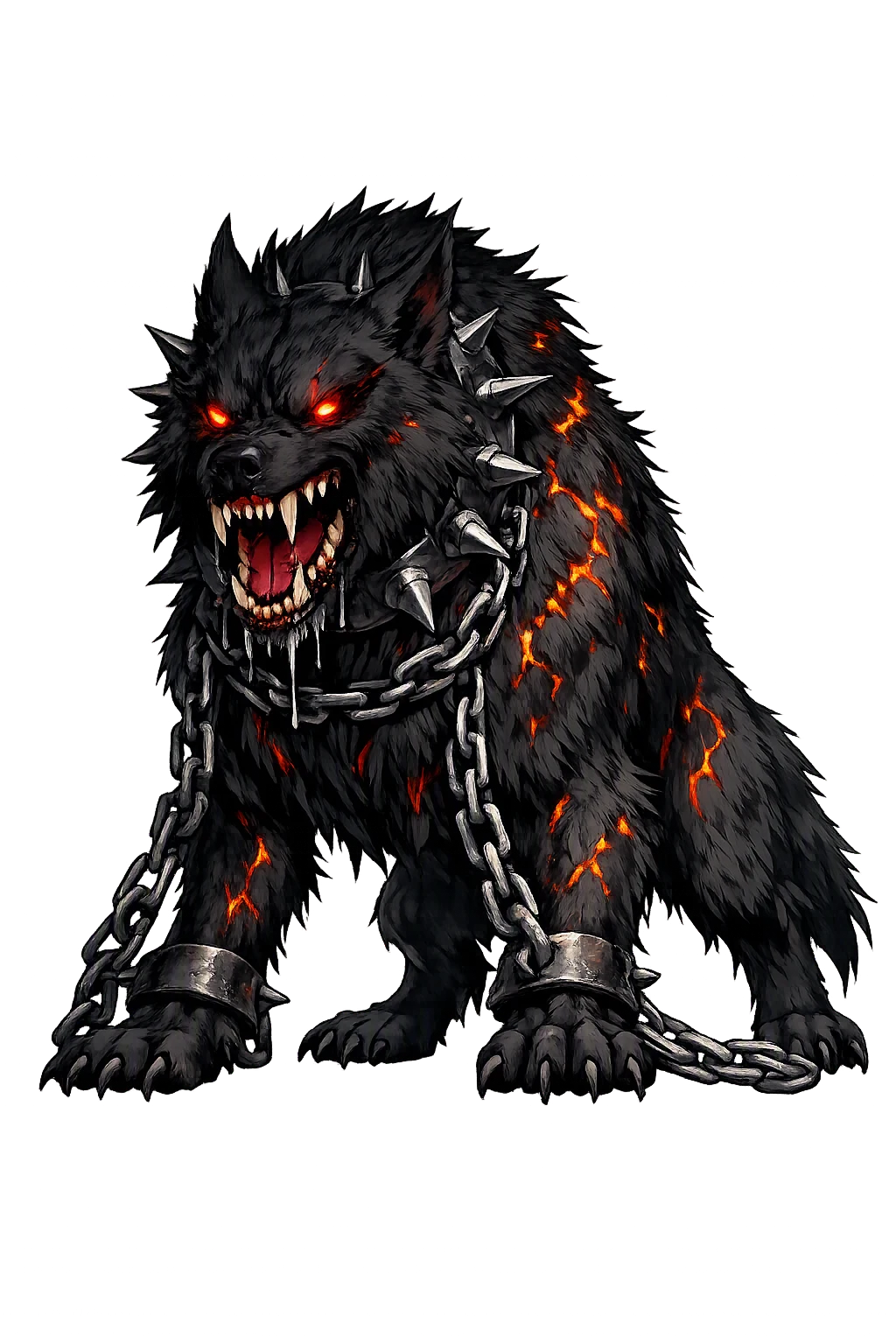
How Garmr was rebuilt, mark by mark
Bench notes, Garmr: what we found, what we rejected, and what we finally set down. Kept in the open, because a restoration you cannot audit is just a spelling with confidence.
What We Found
The attestation runs through the tradition's own sources: ᚴᛅᚱᛘᚱ. Meaning: "Howler".
The figure behind the name: Garmr has no adventures and no childhood; he exists in the sources the way a bell exists — to sound at the appointed hour.
What the Name Carried In
The Best of Hounds. Grímnismál closes its catalogue of the world's first things with a litany every Norse listener could recite: Yggdrasill is the best of trees, Skíðblaðnir of ships, Óðinn of the Æsir, Sleipnir of steeds, Bifrǫst of bridges, Bragi of skalds, Hábrók of hawks — and Garmr of hounds. The hound of Hel takes his place in the superlative order of the cosmos without explanation and without rival: whatever else the poets disagreed about, the office of watchdog at the world's border had one incumbent.
The Thrice-Sounded Bay. Vǫluspá counts down the end of the world by the hound's voice. Three times, as the vision darkens — when the bonds of the world loosen, when the giants and the dead come to the field, and at the last, before the earth sinks into the sea — the seeress breaks off with the same refrain: 'Garmr bays loudly before Gnipahellir; the fetter will snap, and the wolf run free.
A spelling that has to carry stories like these is not a label. It is equipment.
Where It Stood Before Us
Garmr is an entirely textual hound: no runestone names him, no votive deposit is his, and no image can be securely identified with him. The picture-stone corpus of Gotland preserves riders and beasts at the borders of the world, and the bloodied hound of Baldrs draumar has occasionally been sought among the animal figures that attend the dead on stones such as Ardre VIII — but the stones carry no inscription, and the identifications remain suggestions. His witnesses are the manuscripts: the Codex Regius for Vǫluspá and Grímnismál, the fourteenth-century AM 748 I 4to for Baldrs draumar — the poem's sole medieval home — and the Codex Regius and Codex Wormianus of the Prose Edda for Gylfaginning's Ragnarök chapter. The absence of cult is itself the record: Garmr was never prayed to, because he was never anyone's god. He was the North's watchdog, and a watchdog needs no temple — only a post, a chain, and the hour he is waiting for. The bench inherits all of it — the web temple is the newest site, not the first.
What We Rejected
Any form invented for availability. The rule on the bench: if the evidence does not carry it, the domain does not get it — whatever the registrar has in stock.
What We Set Down
Garmr — One decisive feature survives — a single, honest mark — which places the restoration in Tier-2: exact, and exactly labeled.
For the voice: gAHRM-ur — nearly a single syllable: a hard g, a short open 'ah', the r and m run together, and the final nominative -r sounded as a light syllabic trill, as in Icelandic.
The temple stands at /garmr/ — the notes above are public in its Scholarly Edition, sources and all.
At a Glance
- Restored name: Garmr
- ASCII form: garmr
- Meaning: "Howler"
- Domain of influence: Guardian, Underworld Hound
- Pantheon: Norse
- Classification: Tier 2
- Original script: ᚴᛅᚱᛘᚱ
- Series: The Restoration Files, No. 169 of 548
The File Continues
The temple's founding dispatch tells the name's story; its Resonance File reads the myths into the industries; the blog index holds the whole archive.
Continue the series — previous file: Gaṅgā (read it here) · next file: Gaurī (read it here).
The Restoration Files are written from the same canonical record as the temples themselves: the lexicon, the lore catalog, the pattern atlas, and the cited scholarly sources. If a file ever disagrees with its temple, the temple is right — tell us, and the file will be corrected.