
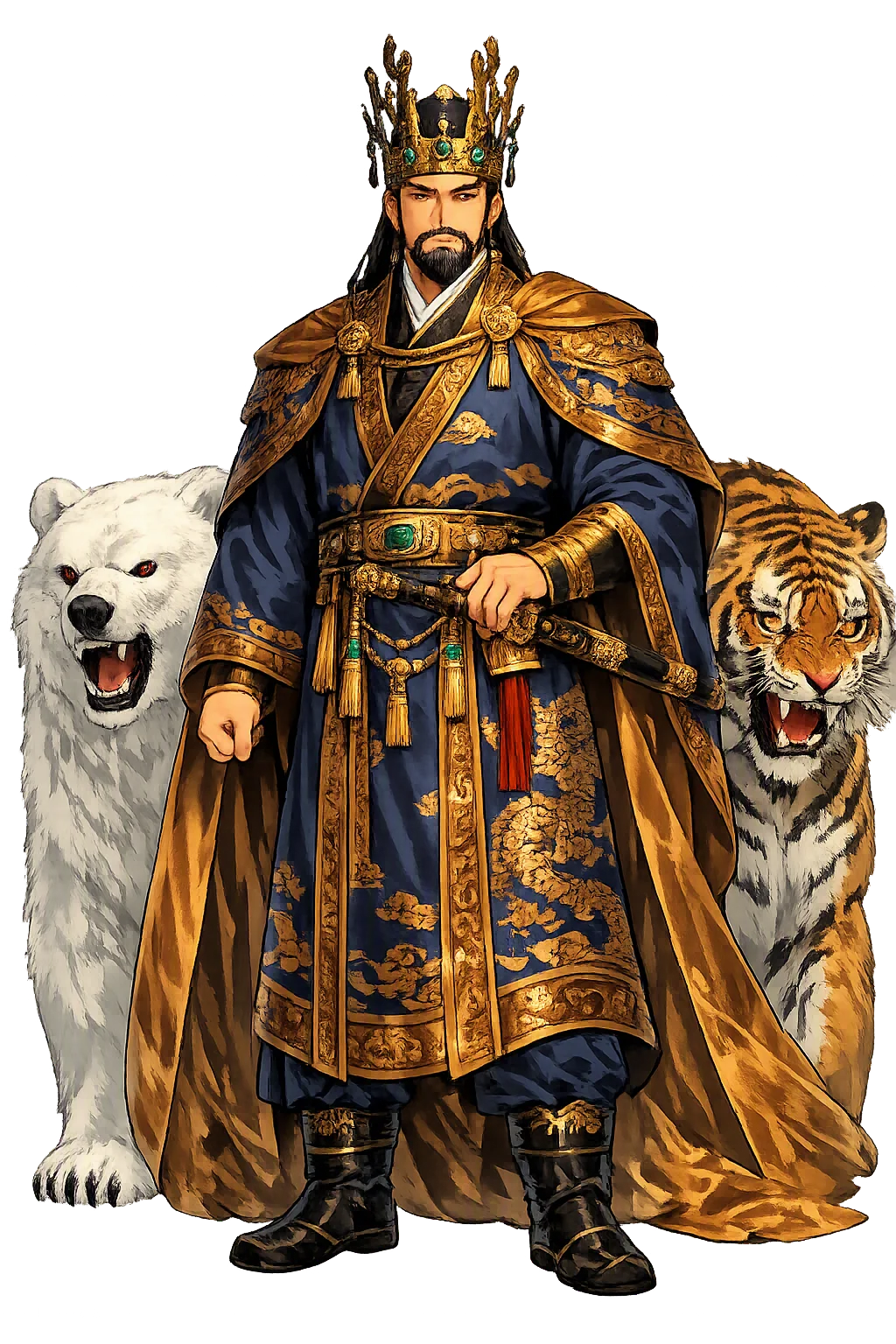
How Dangun was rebuilt, mark by mark
Bench notes, Dangun: what we found, what we rejected, and what we finally set down. Kept in the open, because a restoration you cannot audit is just a spelling with confidence.
What We Found
The attestation runs through the tradition's own sources: 단군 (檀君). Meaning: "Lord of the sandalwood".
The figure behind the name: The Dangun cycle is Korea’s charter myth: a heavenly prince descends beneath a sandalwood tree, an animal bride endures a hundred days of darkness, and the first king binds law, grain, and ritual into a single realm.
What the Name Carried In
Hwanung Comes Down to Sin-si. The Samguk Yusa opens the tale in heaven: the supreme lord Hwanin ruled the sky, and his son Hwanung, gazing down upon the world, begged leave to govern it and bring order to humankind. Hwanin looked and saw that the land was worth the blessing; granting his son the three heavenly seals and three thousand followers, he sent him down to the foot of the sandalwood tree, where Hwanung established the holy city of Sin-si, the ‘city of god’.
The Bear Who Endured. When a bear and a tiger living together prayed to Hwanung that they might become human, the heavenly prince set them an ordeal: eat only garlic and mugwort, and shut yourselves away from sunlight for one hundred days. The tiger grew restless and broke the fast before the days were out, but the bear endured to the end and was transformed into a woman — Ungnyeo, the ‘bear-woman’.
A spelling that has to carry stories like these is not a label. It is equipment.
Where It Stood Before Us
No artifact names Dangun, and the material record of Gojoseon is real but mute: the great Bronze Age dolmen fields of Gochang, Hwasun, and Ganghwa (UNESCO World Heritage), the walled earthworks of the northern fortresses, and the Han commandery remains at Lelang near Pyongyang, which anchor the region’s early statehood around the turn of the era. In 1993 North Korean scholars announced the excavation of Dangun’s tomb at Kangdong, near Pyongyang — a chamber with 86 ‘relics’ dated to 501 BCE — a finding honored domestically and regarded by most outside scholars as a modern construction rather than an ancient burial. The genuine artifacts of his cult are the mountain altars: Chamseongdan on Manisan, where legend says Dangun offered sacrifice to heaven, still crowns Ganghwa Island above the tidal flats, a stone witness to fifteen hundred mythic years. The bench inherits all of it — the web temple is the newest site, not the first.
What We Rejected
Any form invented for availability. The rule on the bench: if the evidence does not carry it, the domain does not get it — whatever the registrar has in stock.
What We Set Down
Dangun — One decisive feature survives — a single, honest mark — which places the restoration in Tier-2: exact, and exactly labeled.
For the voice: 'TAHNG-goon' — The initial consonant is an unaspirated velar stop, closer to a soft ‘t’ than to English ‘d’; the final nasal closes the first syllable. The scholarly capital marks the name as a proper noun.
The temple stands at /dangun/ — the notes above are public in its Scholarly Edition, sources and all.
At a Glance
- Restored name: Dangun
- ASCII form: dangun
- Meaning: "Lord of the sandalwood"
- Domain of influence: Founder of Korea, First King
- Pantheon: Korean
- Classification: Tier 2
- Original script: 단군 (檀君)
- Series: The Restoration Files, No. 118 of 548
The File Continues
The temple's founding dispatch tells the name's story; its Resonance File reads the myths into the industries; the blog index holds the whole archive.
Continue the series — previous file: Dakṣa (read it here) · next file: Daramulum (read it here).
The Restoration Files are written from the same canonical record as the temples themselves: the lexicon, the lore catalog, the pattern atlas, and the cited scholarly sources. If a file ever disagrees with its temple, the temple is right — tell us, and the file will be corrected.