
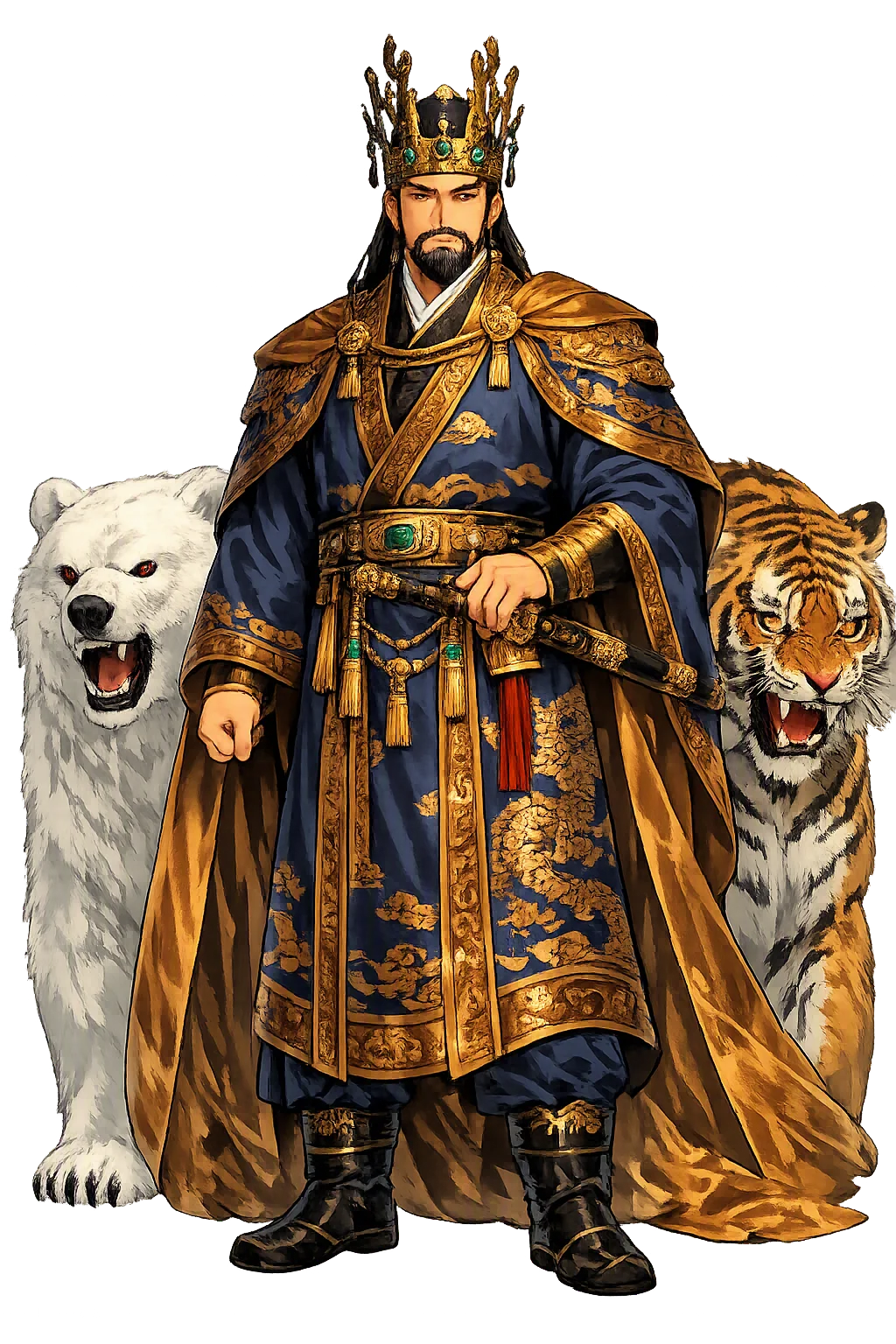
The appointments Dangun made — and who is keeping them
The mistake is reading myths as entertainment. Dangun's cycle reads more like a charter — each story assigning a duty the modern world still pays for.
At a Glance
- Temple: Dangun
- Pantheon: Korean
- Domain of influence: Founder of Korea, First King
- Pattern seats: 3
- Sectors touched: Society & Spirit · Culture & Entertainment
- Strongest seat: Education, Research & Knowledge
- Series: The Resonance Files, No. 118 of 548
The Cycle, Read Forward
Education, Research & Knowledge — through Hwanung Comes Down to Sin-si
The Samguk Yusa opens the tale in heaven: the supreme lord Hwanin ruled the sky, and his son Hwanung, gazing down upon the world, begged leave to govern it and bring order to humankind. Hwanin looked and saw that the land was worth the blessing; granting his son the three heavenly seals and three thousand followers, he sent him down to the foot of the sandalwood tree, where Hwanung established the holy city of Sin-si, the ‘city of god’.
The atlas states the seat in one line: Primary seat: Dangun embodies founder of korea, first king — the core of education. The story above is the long version of the same sentence. The trade thinks it is optimizing a process. It is re-enacting a charter.
Mythic Name Restoration — through The Bear Who Endured
When a bear and a tiger living together prayed to Hwanung that they might become human, the heavenly prince set them an ordeal: eat only garlic and mugwort, and shut yourselves away from sunlight for one hundred days. The tiger grew restless and broke the fast before the days were out, but the bear endured to the end and was transformed into a woman — Ungnyeo, the ‘bear-woman’.
The atlas states the seat in one line: Resonant seat: Dangun shares symbolic territory with mythic restoration. The story above is the long version of the same sentence. The trade thinks it is optimizing a process. It is re-enacting a charter.
Writing, Publishing & Media — through Asadal and the Fifteen Hundred Years
Dangun grew and in his day founded the state of Gojoseon, ‘Joseon of old’, establishing its capital at Asadal — a name later tradition ties to the sandalwood tree of his father’s descent and to a peak in the Taebaek range. The Samguk Yusa credits him with a reign of one thousand five hundred years, a fabulous span that marks his kingship as belonging to mythic time rather than history; the Samguk Sagi, more sober, enters the founding under 2333 BCE in the Dangi calendar that Korean tradition still counts from.
The atlas states the seat in one line: Resonant seat: Dangun shares symbolic territory with publishing media. The story above is the long version of the same sentence. The trade thinks it is optimizing a process. It is re-enacting a charter.
The Theme That Runs the Cycle
The Dangun cycle is Korea’s charter myth: a heavenly prince descends beneath a sandalwood tree, an animal bride endures a hundred days of darkness, and the first king binds law, grain, and ritual into a single realm. Its fullest early telling is Iryeon’s Samguk Yusa (1281), with a briefer notice in Kim Pusik’s Samguk Sagi (1145); shamanic and popular retellings vary the details without changing the spine.
The Method, Stated Plainly
Skeptical? Good — the system is built for you. Every seat in this file carries its why-line and its weight, the full derivation is public at the methodology page, and the challenge process is part of the design. Falsifiable is not a posture here; it is the mechanism.
For the Ones Who Work There
If you work in education, research & knowledge, mythic name restoration, or any trade this temple holds a seat in, this is the honest version of what a placement means: your industry beside the story it has been re-telling all along — on the temple floor itself, before an audience that came specifically to read it. The patron tier and the advertising terms describe the mechanics; the resonance above describes the fit.
The File Continues
One of 548 Resonance Files — the series where the pantheon goes to work. Read the founding dispatch for the name, the Restoration File for the spelling, or the whole archive end to end.
Continue the series — previous: Dakṣa (read it) · next: Daramulum (read it).
The Resonance Files are argued from the same canonical record as the pattern atlas itself: the lexicon, the lore catalog, and the cited sources. Every seat can be challenged at the methodology page — and the challenge is the point.