
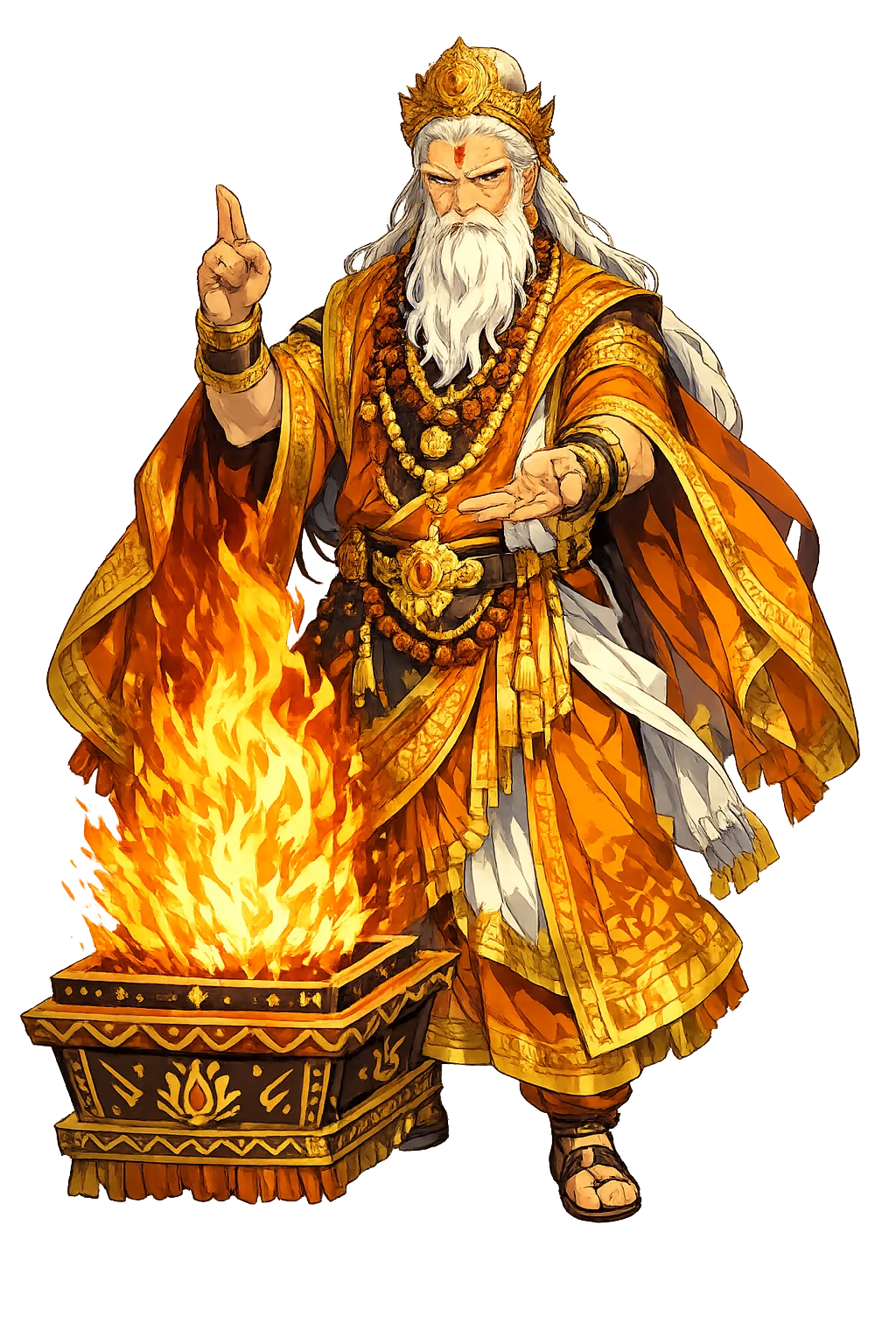
The provenance file on Dakṣa
Catalogue entry — Dakṣa. Every claim below carries its chain of custody.
Provenance
1. The attestation. दक्ष, from the tradition's own record. On record: Ṛgveda 10.72 (Dakṣa among the Ādityas), Mahābhārata, Ādi parvan (the sacrifice retold), Śiva Purāṇa, Rudrasaṃhitā (Satīkhaṇḍa; Dakṣakhaṇḍa), Kālikā Purāṇa (the Goddess's version).
2. The narrative record. Satī and the Ascetic — His daughter Satī loved Śiva — the ash-smeared, skull-garlanded wanderer whom Dakṣa regarded as no fit match for a Prajāpati's house. The Purāṇas make the marriage the scandal of the age: Dakṣa's open scorn, Satī's immovable devotion, Śiva serenely indifferent to court opinion (Śiva Purāṇa, Rudrasaṃhitā, Satīkhaṇḍa). Satī's Self-Immolation — Satī came uninvited to her father's rite and endured his contempt until she could endure no more: declaring that she would no longer wear a body born of one who insulted her lord, she entered the sacrificial fire and burned (Śiva Purāṇa, Satīkhaṇḍa; the Devībhāgavata gives the Goddess's own version). Her body, scattered in Śiva's grief-stricken dance across the land, seeded the fifty-one Śakti Pīṭhas — the holiest map of Śakta India, from Kamakhya in Assam to Hinglaj beyond the Indus.
3. The physical record. The Kankhal complex at Haridwar — the Daksha Mahadev temple and the Śrī Daksheśvara site on the Ganga — marks the traditional ground of the great sacrifice, continuously rebuilt from early times and renovated in 1810 and 1962. Satī's pīṭhas, from Kamakhya to Hinglaj, give the myth the largest sacred geography of any Indian story. Iconography shows him goat-headed in the act of worship — the humbled adept — in Purāṇic panels across the Deccan and the South.
4. The current holding. The temple at /daksa/, classified Tier 1. What survives here cannot be shown in ASCII: a feature of the original that the fallback alphabet flattens. That is the Tier-1 test, and this name passes it without argument.
5. The documented resonances. Ancestry & Heritage Services, Education, Research & Knowledge, Leadership, Governance & Public Administration — seats argued and weighted in the pattern atlas, read through the myths in this temple's Resonance File.
6. The primary sources. Rig Veda, Ramayana — the library this file answers to, open at the Sacred Texts collection.
7. The continuing record. The Dakṣa-yajña cycle is among the most retold stories in India — sculpture, dance-drama, and television epics return to it constantly — and the Śakti Pīṭha pilgrimage map it generates still organizes Śakta devotion. His name lives in the language: dakṣa/daksh remains the word for the capable professional, and the dakṣiṇā, the ritual fee 'of the skilled hand,' is paid at every Hindu rite today.
At a Glance
- Restored name: Dakṣa
- ASCII form: daksa
- Meaning: "'The skilled, the able' (from dakṣa), a Prajāpati"
- Domain of influence: Skill, Creation, Order
- Pantheon: Sanskrit
- Classification: Tier 1
- Original script: दक्ष
- Series: The Restoration Files, No. 117 of 546
The File Continues
Read the founding dispatch for the name's full story, the Resonance File for the archetype at work — or the whole archive in one sitting.
Continue the series — previous file: Dagda (read it here) · next file: Dangun (read it here).
The Restoration Files are written from the same canonical record as the temples themselves: the lexicon, the lore catalog, the pattern atlas, and the cited scholarly sources. If a file ever disagrees with its temple, the temple is right — tell us, and the file will be corrected.