
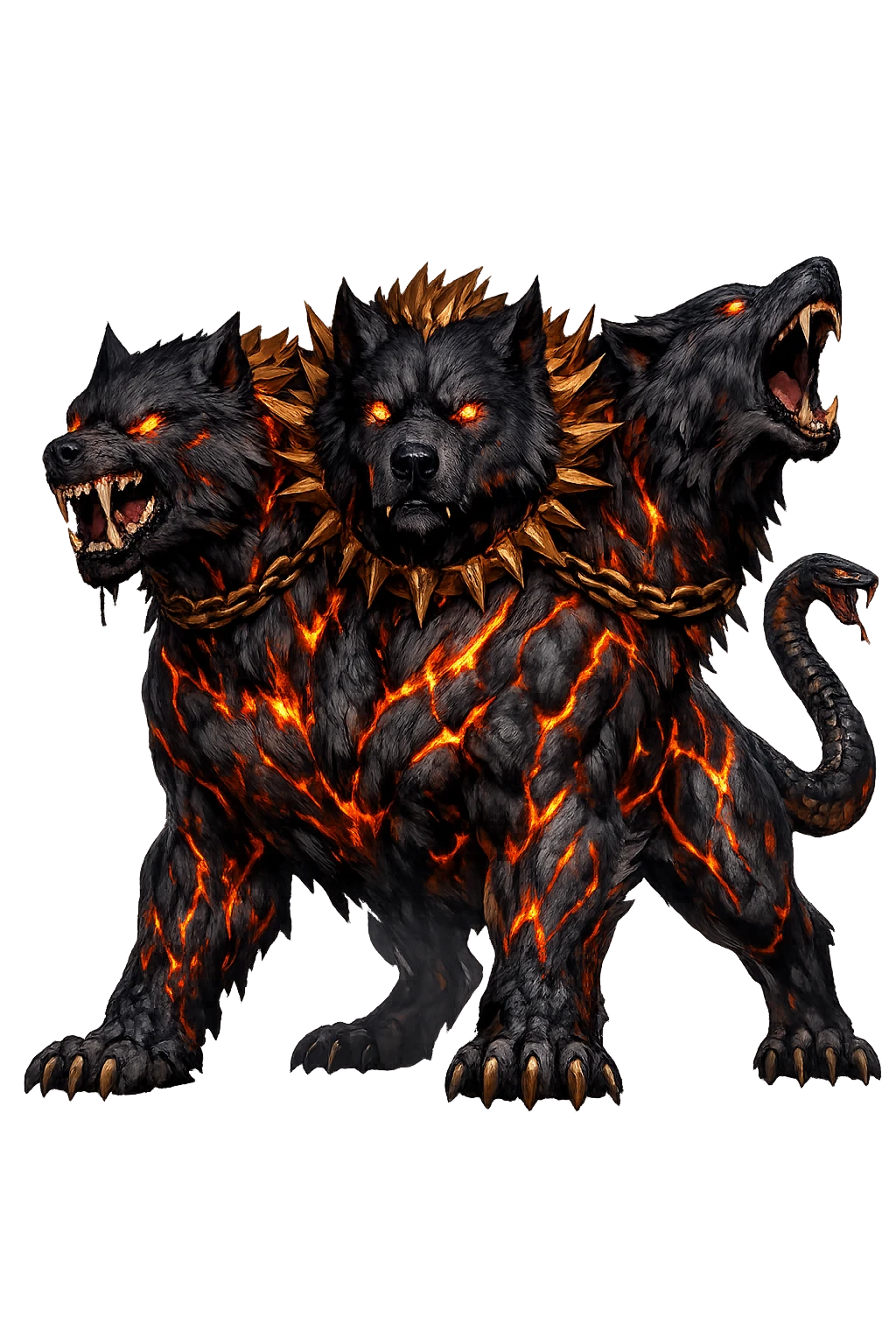
How Kérberos was rebuilt, mark by mark
Bench notes, Kérberos: what we found, what we rejected, and what we finally set down. Kept in the open, because a restoration you cannot audit is just a spelling with confidence.
What We Found
The attestation, on the evidence Hesiod, Theogony 306–312, 767–773. and Homer, Odyssey 11.623–626; Iliad 8.367–369. set down: Κέρβερος. Meaning: "Spot, darkness".
The figure behind the name: Kérberos' myths are the myths of every threshold that must not be crossed — the one-way gate of Hades, the hero who chains it, and the musicians and magicians who slip past it — and together they are the West's oldest anatomy of a boundary.
What the Name Carried In
Born of Typhon and Echidna. Hesiod sets him in the monstrous brood of Typhon and Echidna (Theogony 306–312): first Orthrus, the hound of Geryon, then “Cerberus the flesh-eater, the brazen-voiced hound of Hades, fifty-headed, shameless and strong,” and after him the Lernaean Hydra and the Chimaira — with the Nemean lion and the Sphinx of Thebes among the family's cousins. It is the underworld's kennel and armory in a single bloodline: wherever the myths need an impossible guardian, one of Echidna's children is already on duty.
The Porter of the Dead. Later in the same poem (Theogony 767–773) Hesiod gives the hound his job description: Kérberos waits before the dark house of Hades and dread Persephone, and on those who come in he fawns with his tail and both ears — but he lets none go back out; he watches, and devours whomsoever he catches passing the gates. It is the earliest full portrait of the boundary's one-way logic: courtesy inward, annihilation outward.
A spelling that has to carry stories like these is not a label. It is equipment.
Where It Stood Before Us
Greek art drew him early and often: black-figure vases of the sixth century BCE show Heracles leading the hound on a chain, usually with two or three heads though Hesiod says fifty, and the type persists through the Caeretan hydriai and Attic red-figure. The Greeks pointed to real descents: the cave at Cape Tainaron in the southern Peloponnese was shown as the mouth by which Heracles dragged him up (Pausanias 3.25), and Heracleia Pontica claimed the same honor on the Black Sea. His lines in the Theogony remain the oldest written portrait of the underworld's watch-dog. The bench inherits all of it — the web temple is the newest site, not the first.
What We Kept
The evidence, mark by mark — 1 feature the keyboard form cerberus cannot hold:
- e → é — Acute on e. Kept.
What We Rejected
Any form invented for availability. The rule on the bench: if the evidence does not carry it, the domain does not get it — whatever the registrar has in stock.
What We Set Down
Kérberos — One decisive feature survives — a single, honest mark — which places the restoration in Tier-2: exact, and exactly labeled.
For the voice: kAIR-beh-ros — the acute falls on the first syllable; sound the final -ros with a light trill.
The temple stands at /cerberus/ — the notes above are public in its Scholarly Edition, sources and all.
At a Glance
- Restored name: Kérberos
- ASCII form: cerberus
- Meaning: "Spot, darkness"
- Domain of influence: Underworld Guardian
- Pantheon: Greek
- Classification: Tier 2
- Original script: Κέρβερος
- Series: The Restoration Files, No. 100 of 546
The File Continues
The temple's founding dispatch tells the name's story; its Resonance File reads the myths into the industries; the blog index holds the whole archive.
Continue the series — previous file: Cáishén (read it here) · next file: Cerēs (read it here).
The Restoration Files are written from the same canonical record as the temples themselves: the lexicon, the lore catalog, the pattern atlas, and the cited scholarly sources. If a file ever disagrees with its temple, the temple is right — tell us, and the file will be corrected.