
Cerēs: the stories first, then the spelling
The marks in Cerēs make the most sense standing next to the myths they have to carry. So the myths come first.
The Stories That Carry the Name
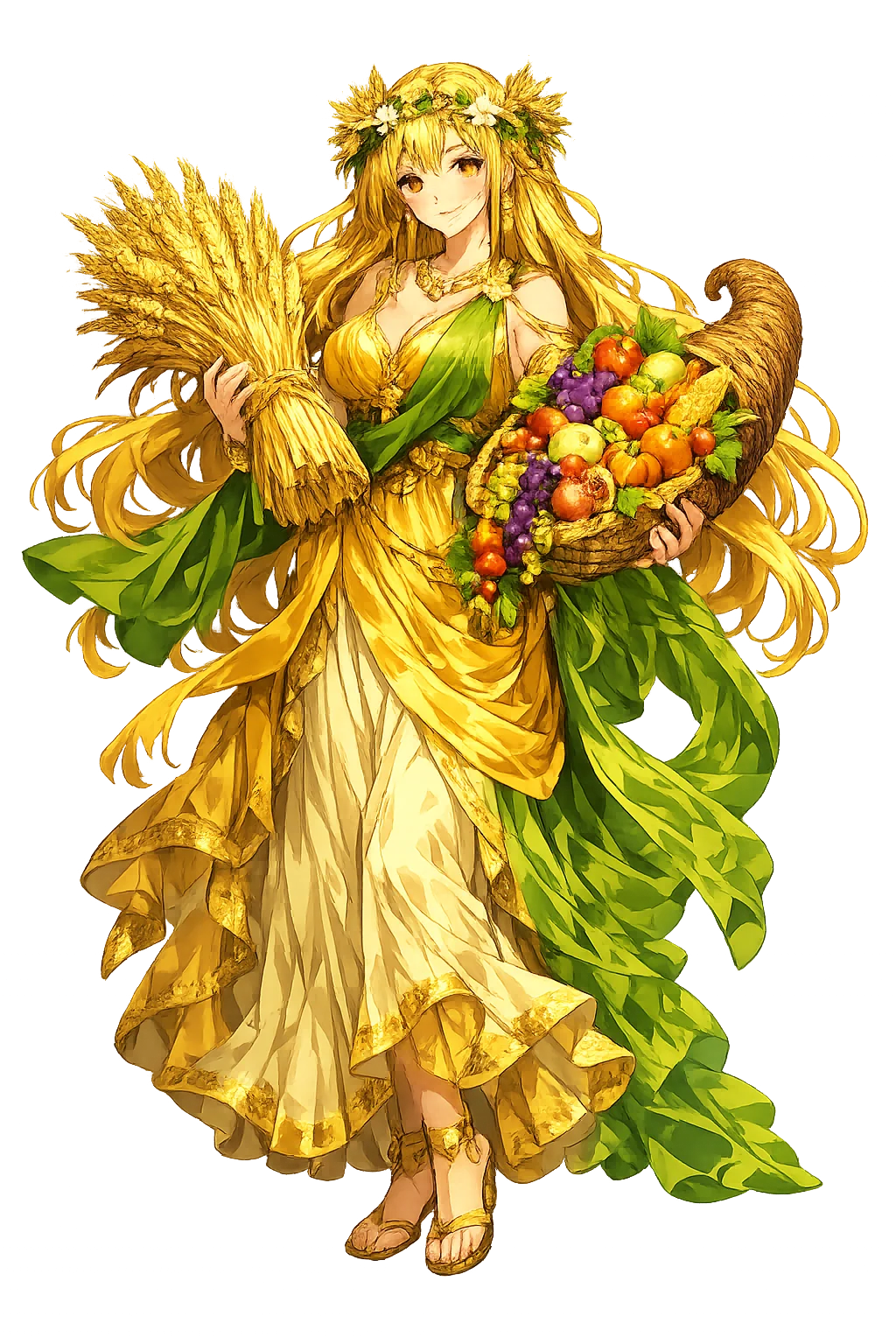
The Teaching of the Furrow. Before Cerēs, the poets say, humanity ate acorns and called it food. She taught the cutting of the furrow, the keeping of seed, the harvest's measure — and with grain came surplus, and with surplus came law: Ovid and Cicero both note that Rome's oldest laws guarded the field and its boundaries, because the goddess who invented agriculture also, necessarily, invented property. Her temple was the archive of the plebeians' laws: grain and statute, one house.
The Torches of Cerēs. When Plūtō took Proserpina, Cerēs lit torches at Aetna's crater and searched the world for nine days, fasting and raging. Finding her daughter queen of the underworld, she refused the compromise until the earth starved with her; the settlement — Proserpina's year divided between the realms — is the myth that explains why the field sleeps and wakes. Rome told it as the charter of the Cerealia, her April festival of the grain's return.
The Aventine Triad. Her great temple on the Aventine (493 BCE) belonged not to the patricians but to the plebs: Cerēs, Liber, and Libera — grain, wine, and growth — were the people's trinity, the asylum where debtors sheltered and the archive where the plebeians kept their laws. When the plebs seceded to the Sacred Mount, it was to her hill they walked: the goddess of bread is also, in Rome, the goddess of the bargain between bread and power.
And Here Is What the Spelling Preserves
At a Glance
- Restored name: Cerēs
- ASCII form: ceres
- Meaning: "Goddess of grain and growth — the source of the word "cereal""
- Domain of influence: Agriculture, Grain, Harvest
- Pantheon: Roman
- Classification: Tier 1
- Original script: —
- Series: The Restoration Files, No. 55 of 271
The Name Travels
Her equation with Dēmētēr was total by the 5th century BCE — the Sibylline Books themselves prescribed the merger — but Rome added its own stresses: the plebeian politics, the annona grain-supply, and the Cerealia's games. Sicily, her mythic homeland and Rome's first granary, kept her temples as the island's patron (Enna, her meadow); and through the grain-fleet she became the one goddess every province ate with daily, the most-consumed deity in the empire.
The Address It Earned
The temple of Cerēs stands at /sites/ceres/ — lore, scholars, patterns — because a name carrying this much story deserves more than a parking page. The restoration preserves more than the ASCII form can express — stress, length, or a letter the Latin keyboard lost — which places it, mechanically, in Tier-1.
The Sources Are Open
The myths above are retold from the temple's record; the primary voices are in the Sacred Texts: Metamorphoses. Nothing in this file outranks them.
The File Continues
Read the founding dispatch for the name's full story, the Resonance File for the archetype at work — or the whole archive in one sitting.
Continue the series — previous file: Kérberos (read it here) · next file: Cháos (read it here).
The Restoration Files are written from the same canonical record as the temples themselves: the lexicon, the lore catalog, the pattern atlas, and the cited scholarly sources. If a file ever disagrees with its temple, the temple is right — tell us, and the file will be corrected.