
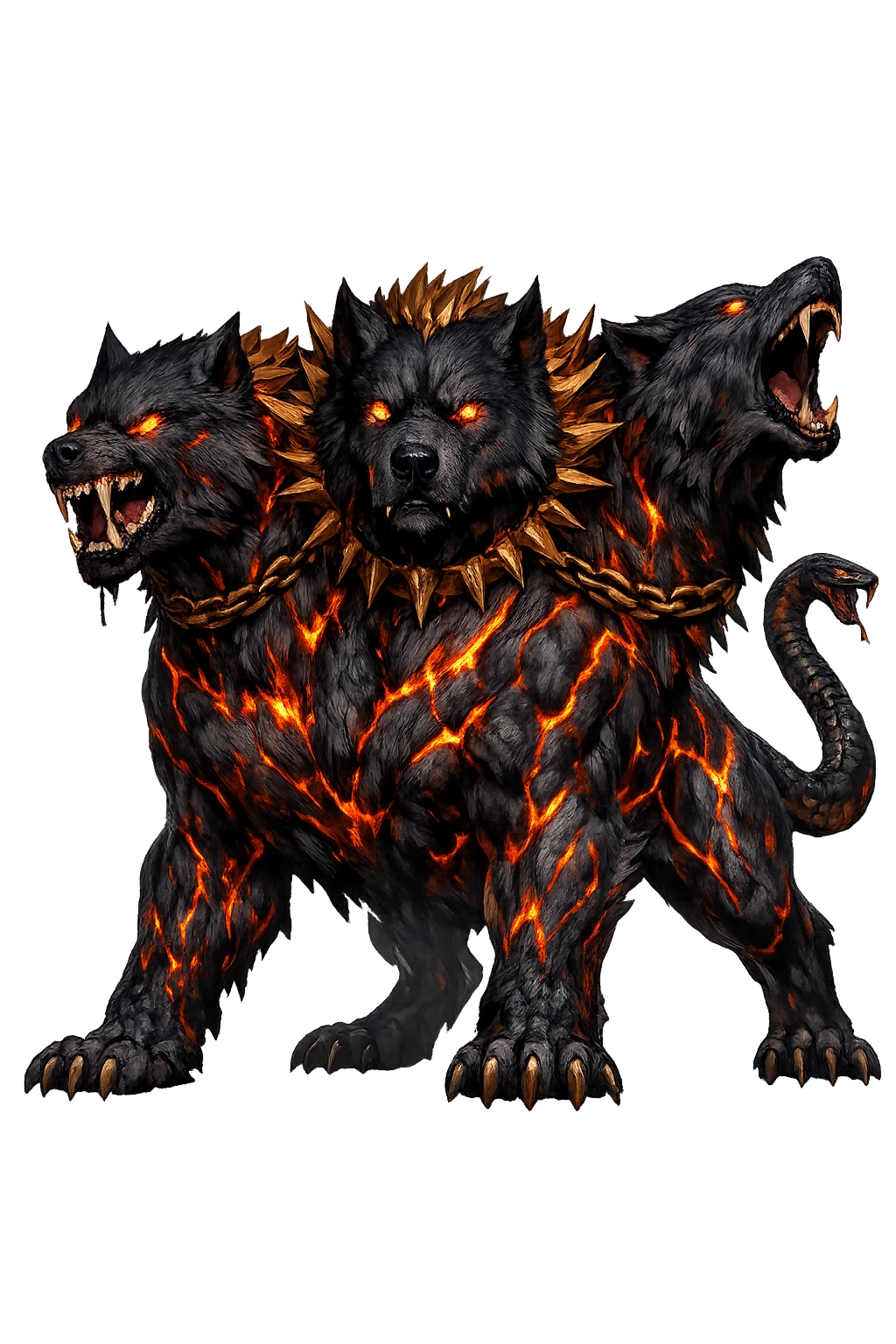
The appointments Kérberos made — and who is keeping them
The mistake is reading myths as entertainment. Kérberos's cycle reads more like a charter — each story assigning a duty the modern world still pays for.
At a Glance
- Temple: Kérberos
- Pantheon: Greek
- Domain of influence: Underworld Guardian
- Pattern seats: 3
- Sectors touched: Technology & Innovation · Commerce & Governance · Home & Lifestyle
- Strongest seat: Cybersecurity & Digital Protection
- Series: The Resonance Files, No. 54 of 271
The Cycle, Read Forward
Cybersecurity & Digital Protection — through Born of Typhon and Echidna
Hesiod sets him in the monstrous brood of Typhon and Echidna (Theogony 306-312): Orthrus the hound of Geryon, then "Cerberus the flesh-eater, the brazen-voiced hound of Hades, fifty-headed, shameless and strong," and after him the Lernaean Hydra and the Chimaira. The family is the underworld's kennel and armory in one: wherever the myths need an impossible guardian, one of Echidna's children is already on duty.
The atlas states the seat in one line: The three-headed watchdog at the gate; the perimeter that never sleeps. The story above is the long version of the same sentence. Industries do not invent their archetypes; they inherit them and call them best practice.
Defense, Military & Security — through The Porter of the Dead
Later in the same poem (Theogony 767-773) Hesiod gives the hound his job description: he waits before the houses of Hades and dread Persephone, and on those who come in he fawns with his tail and both ears — but he lets none go back out; he watches, and devours whomsoever he catches passing the gates. It is the earliest full portrait of the boundary's one-way logic: courtesy inward, annihilation outward.
The atlas states the seat in one line: The warden of the dead; border security with three heads and one rule — none leave. The story above is the long version of the same sentence. The trade thinks it is optimizing a process. It is re-enacting a charter.
Pet Care & Animal Industries — through The Twelfth Labor
The last and hardest labor set by Eurystheus was to bring the hound up from the dead. Apollodorus (Library 2.
The atlas states the seat in one line: The most famous hound in myth; the ancestor of every guard dog. The story above is the long version of the same sentence. The trade thinks it is optimizing a process. It is re-enacting a charter.
The Theme That Runs the Cycle
Kérberos' myths are the myths of every threshold that must not be crossed — and of the handful of heroes who crossed his anyway.
The Method, Stated Plainly
Skeptical? Good — the system is built for you. Every seat in this file carries its why-line and its weight, the full derivation is public at the methodology page, and the challenge process is part of the design. Falsifiable is not a posture here; it is the mechanism.
For the Ones Who Work There
If you work in cybersecurity & digital protection, defense, military & security, or any trade this temple holds a seat in, this is the honest version of what a placement means: your industry beside the story it has been re-telling all along — on the temple floor itself, before an audience that came specifically to read it. The patron tier and the advertising terms describe the mechanics; the resonance above describes the fit.
The File Continues
One of 271 Resonance Files — the series where the pantheon goes to work. Read the founding dispatch for the name, the Restoration File for the spelling, or the whole archive end to end.
Continue the series — previous: Qāyīn (read it) · next: Cerēs (read it).
The Resonance Files are argued from the same canonical record as the pattern atlas itself: the lexicon, the lore catalog, and the cited sources. Every seat can be challenged at the methodology page — and the challenge is the point.