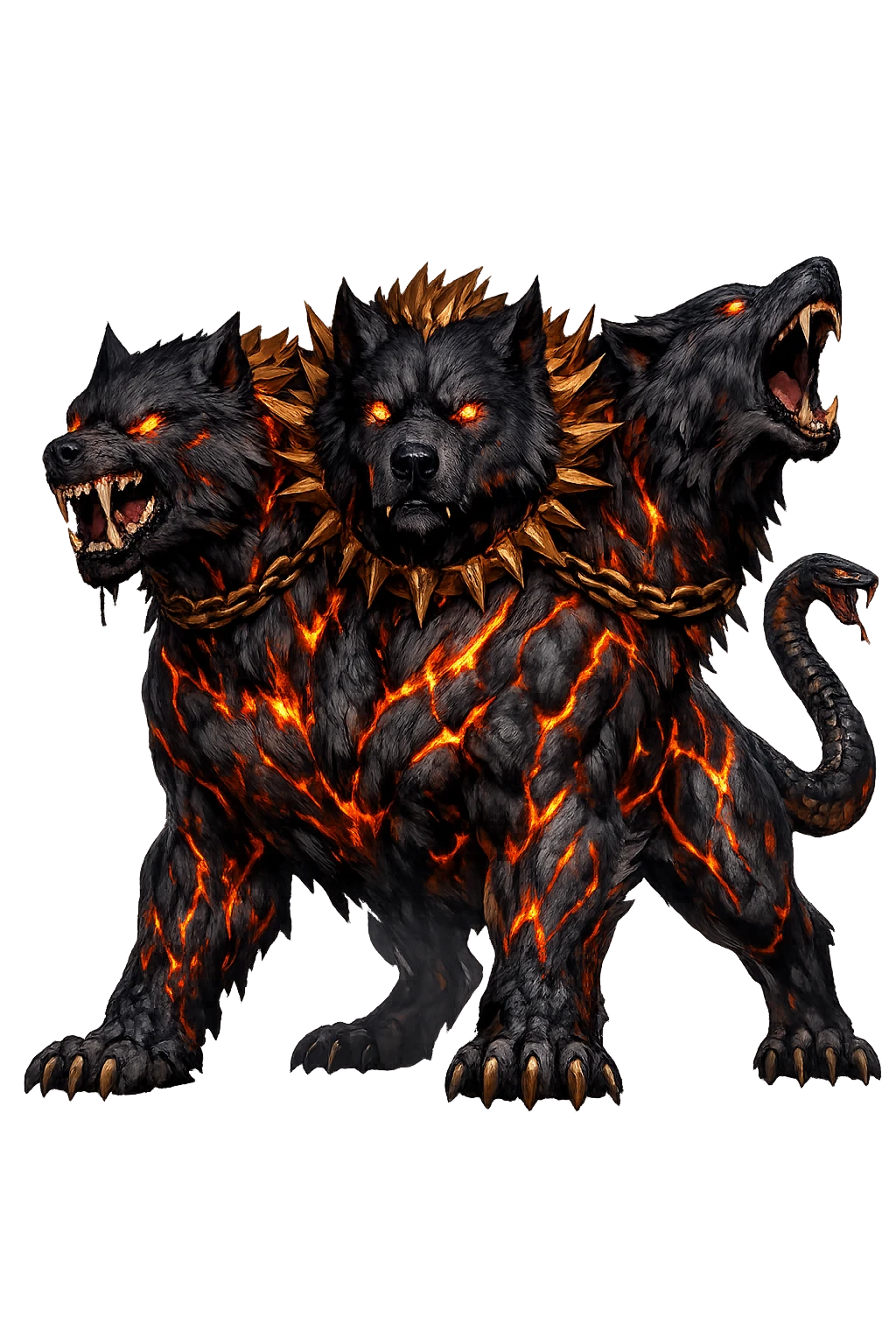
Stories of Kérberos
Kérberos' myths are the myths of every threshold that must not be crossed — the one-way gate of Hades, the hero who chains it, and the musicians and magicians who slip past it — and together they are the West's oldest anatomy of a boundary.
Hesiod sets him in the monstrous brood of Typhon and Echidna (Theogony 306–312): first Orthrus, the hound of Geryon, then “Cerberus the flesh-eater, the brazen-voiced hound of Hades, fifty-headed, shameless and strong,” and after him the Lernaean Hydra and the Chimaira — with the Nemean lion and the Sphinx of Thebes among the family's cousins. It is the underworld's kennel and armory in a single bloodline: wherever the myths need an impossible guardian, one of Echidna's children is already on duty. Fifty heads is Hesiod's number, and the earliest vase-painters modestly drew two or three; the tradition never settles, because the point is not arithmetic but totality — a watchfulness with no blind side. The genealogy also fixes his allegiance from birth: sired by the storm-giant who once stormed Olympus, he ends up as Hades' doorman, the monster employed by order. His family makes monsters; his job is to keep them in.
Later in the same poem (Theogony 767–773) Hesiod gives the hound his job description: Kérberos waits before the dark house of Hades and dread Persephone, and on those who come in he fawns with his tail and both ears — but he lets none go back out; he watches, and devours whomsoever he catches passing the gates. It is the earliest full portrait of the boundary's one-way logic: courtesy inward, annihilation outward. The detail that he fawns — tail wagging, ears flat — is stranger and better than mere ferocity: the gate of death is not cruel, only absolute. Everyone is welcome to enter, and no one is allowed to leave; hospitality and appetite are the same policy seen from different sides. Every later descent-katabasis narrative in Greek, and arguably in the West, inherits this grammar — Charon's fare, the rivers, the judges — but the dog was there first, holding the door in the oldest written map of the Greek underworld.
The last and hardest labor set by Eurystheus was to bring the hound up from the dead. Apollodorus (Library 2.5.12) tells it plainly: Heracles descended — through the cave at Tainaron in the southern Peloponnese, Pausanias notes (3.25.5), though Heracleia Pontica claimed the same honor — asked Hades for the dog, and was given leave to take him if he could master him without weapons. Wrapped in the lion's skin, Heracles grappled Kérberos until the hound yielded, led him up into the light, and showed him to Eurystheus, who hid in his bronze storage jar — then dutifully carried him back down again. Homer already knows the tale: the Odyssey (11.623–626) remembers Heracles' fetching “the hound of the loathed king of the underworld,” and the Iliad remembers the wound Hades took at Pylos over the same expedition. The labor completes the hero's curriculum: having visited every extremity of the living world, he is sent for its door itself — and brings it home on a chain, briefly, as proof.
Music succeeded where force was not asked to try. In Virgil's Georgics (4.483) Orpheus' song holds Kérberos gaping, his three mouths stilled and his jaws relaxed, as the poet walks the path toward Eurydice. A generation of readers later the Aeneid (6.417–423) gives the Sibyl the practical method: a cake sopped in honey and soporific drugs, tossed into the three ravenous throats, which sink the watchdog into sprawled unconsciousness while Aeneas slips past. Force, song, and pastry: the three keys the tradition cuts for the one lock the dead cannot pick. The Aeneid's detail is the more honest one — the sop is a bribe paid to a functionary, and the Sibyl treats the hound less as a monster than as customs. Both versions agree on the rule that governs every threshold: what cannot be overpowered can sometimes be put to sleep, and what cannot be put to sleep can sometimes be sung through — but the gate itself never opens both ways.
The Fifty Heads, the Brazen Voice, and the Gate of No Return
Kérberos is the watch-dog of the dead: Hesiod's brazen-voiced, fifty-headed hound of Hades, who fawns on every soul that enters and devours any that tries to leave — the boundary of the underworld made flesh, fur, and teeth.
Hesiod's count in the Theogony; the painters usually settle for three, and the poets keep multiplying.
Chalkéophōnos — bronze-throated: the bay of the underworld that the poets heard as metal.
The twelfth labor: dragged to the daylight without weapons, shown to Eurystheus, and taken home again.
He stands inside the doors of Hades — welcome laid out for the entering, ruin for the leaving.
From the original script to the living URL
Κέρβερος
The name in its original Greek form. Kérberos (Κέρβερος) is attested in the source tradition — “Spot, darkness”. Its acute accents carry the full phonetic and orthographic weight of the source tradition.
cerberus
Reduced to plain cerberus, the name loses everything that made it specific: acute accents. What remains is an ASCII string that machines can parse but that no longer speaks with its original voice.
Kérberos
The Unicode restoration recovers what ASCII flattened. Kérberos restores acute accents, returning the name to its original written dignity. The domain encodes to Punycode, but the browser displays the truth.
Kérberos.com → xn--krberos-bya.com
The non-ASCII characters in Kérberos are encoded while the ASCII remains visible. To the DNS, it is Punycode. To humanity, it is Kérberos.
Owned, ideal, and ASCII forms of Kérberos
Kérberos
Restores Κέρβερος. The live temple domain — kérberos.com.
cerberus
Flattens Κέρβερος. The plain ASCII fallback — what DNS and legacy systems see.
How Kérberos was spoken
How Kérberos is preserved in writing
A bespoke provenance study for Kérberos is being prepared by the PUNICODEX scholarly team.
Contribute scholarly provenance →The lore you have read is the living myth. Extended Lore opens the scholarly vault beneath it: the cult and its material remains, a history of the image, the name after antiquity, a meditation on what the name still means, and the full scholarly apparatus — etymology, orthography, sources.
Enter Extended Lore