
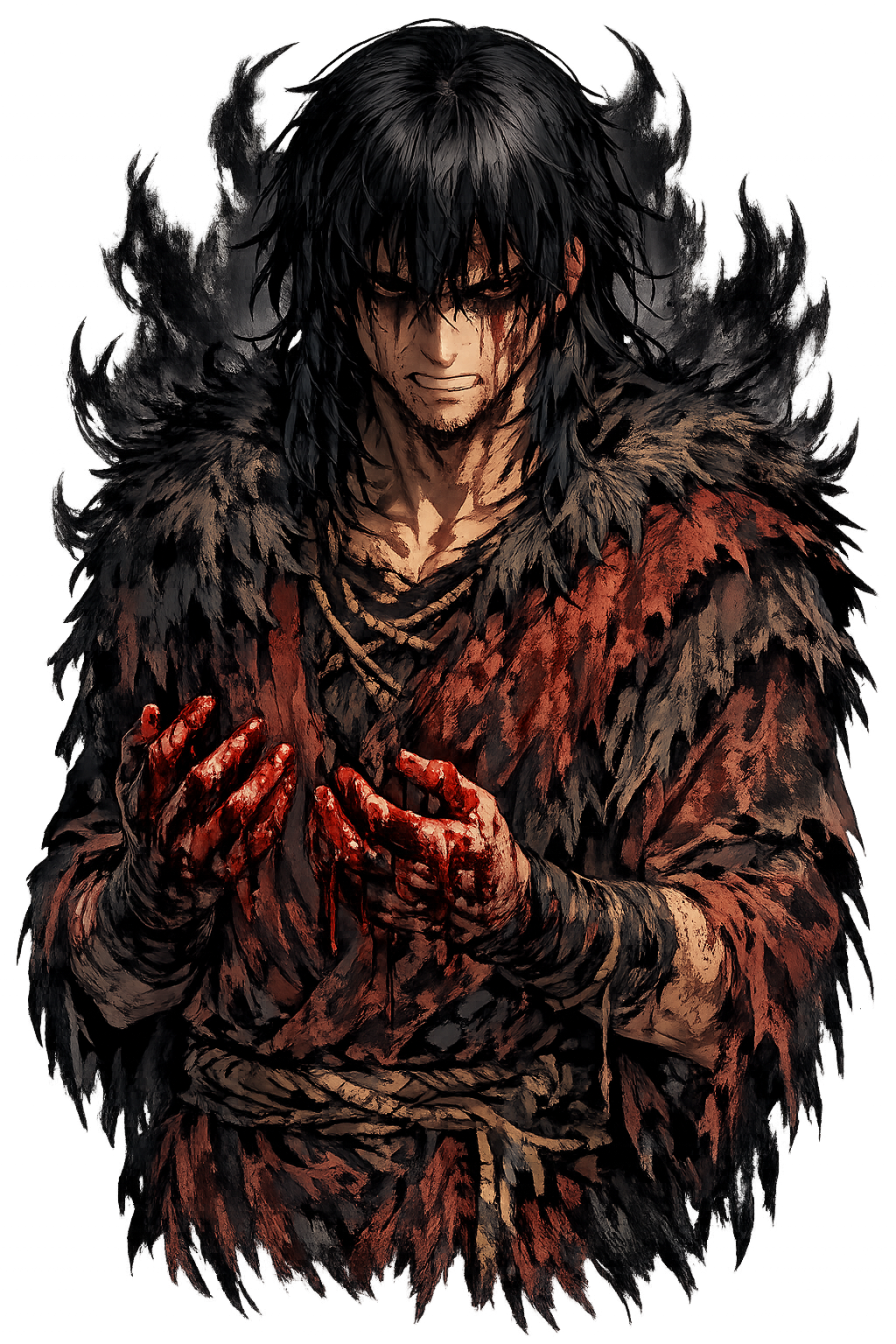
How Qāyīn was rebuilt, mark by mark
Bench notes, Qāyīn: what we found, what we rejected, and what we finally set down. Kept in the open, because a restoration you cannot audit is just a spelling with confidence.
What We Found
The attestation runs through the tradition's own sources: קַיִן. Meaning: "First son of Adam and Eve".
The figure behind the name: Qāyīn's mythology is short, dense, and endlessly reinterpreted.
What the Name Carried In
Two Brothers, Two Offerings. In Eve's cry — 'I have acquired a man with the help of the LORD' (Genesis 4:1) — the Hebrew qaniti, 'I have acquired,' rings on the name Qāyīn itself; the mother already hears what the son will become. Abel (Hevel) means 'breath' or 'vapor,' and the text treats him like one: he appears only to be slain.
The First Murder. Cain speaks to Abel — the text gives no content to the conversation, and later tradition filled the gap with a quarrel over land or over a twin sister (the Book of Jubilees 4 makes the brothers twins born with sisters, and their rivalry the world's first inheritance dispute) — and then, when they were in the field, Cain rose up against his brother and killed him. No weapon is named, no blow described: the Bible's first human death gets less narrative attention than any animal sacrifice in the chapter.
A spelling that has to carry stories like these is not a label. It is equipment.
Where It Stood Before Us
No archaeological evidence links to the individual Cain, whose story belongs to the primeval history of Genesis rather than to datable history. The narrative does reflect the broader transition to agricultural and pastoral lifeways in the ancient Levant during the Neolithic and Chalcolithic periods. Early settled communities, metallurgy, and the tension between farmers and herders are all part of the material backdrop against which the story was told. The bench inherits all of it — the web temple is the newest site, not the first.
What We Kept
The evidence, mark by mark — 2 features the keyboard form qayin cannot hold:
- a → ā — Macron: long vowel. Kept.
- i → ī — Macron: long vowel. Kept.
What We Rejected
Any form invented for availability. The rule on the bench: if the evidence does not carry it, the domain does not get it — whatever the registrar has in stock.
What We Set Down
Qāyīn — Tier-1 is not a compliment; it is a measurement. This restoration keeps something the ASCII form provably loses, and the measurement is repeatable.
For the voice: 'kah-YEEN' — the first consonant is a deep 'k' made at the back of the throat (like Arabic qāf); the second syllable is a long 'yeen'.
The temple stands at /cain/ — the notes above are public in its Scholarly Edition, sources and all.
At a Glance
- Restored name: Qāyīn
- ASCII form: qayin
- Meaning: "First son of Adam and Eve"
- Domain of influence: First Murderer
- Pantheon: Canaanite
- Classification: Tier 1
- Original script: קַיִן
- Series: The Restoration Files, No. 98 of 546
The File Continues
The temple's founding dispatch tells the name's story; its Resonance File reads the myths into the industries; the blog index holds the whole archive.
Continue the series — previous file: Búri (read it here) · next file: Cáishén (read it here).
The Restoration Files are written from the same canonical record as the temples themselves: the lexicon, the lore catalog, the pattern atlas, and the cited scholarly sources. If a file ever disagrees with its temple, the temple is right — tell us, and the file will be corrected.