
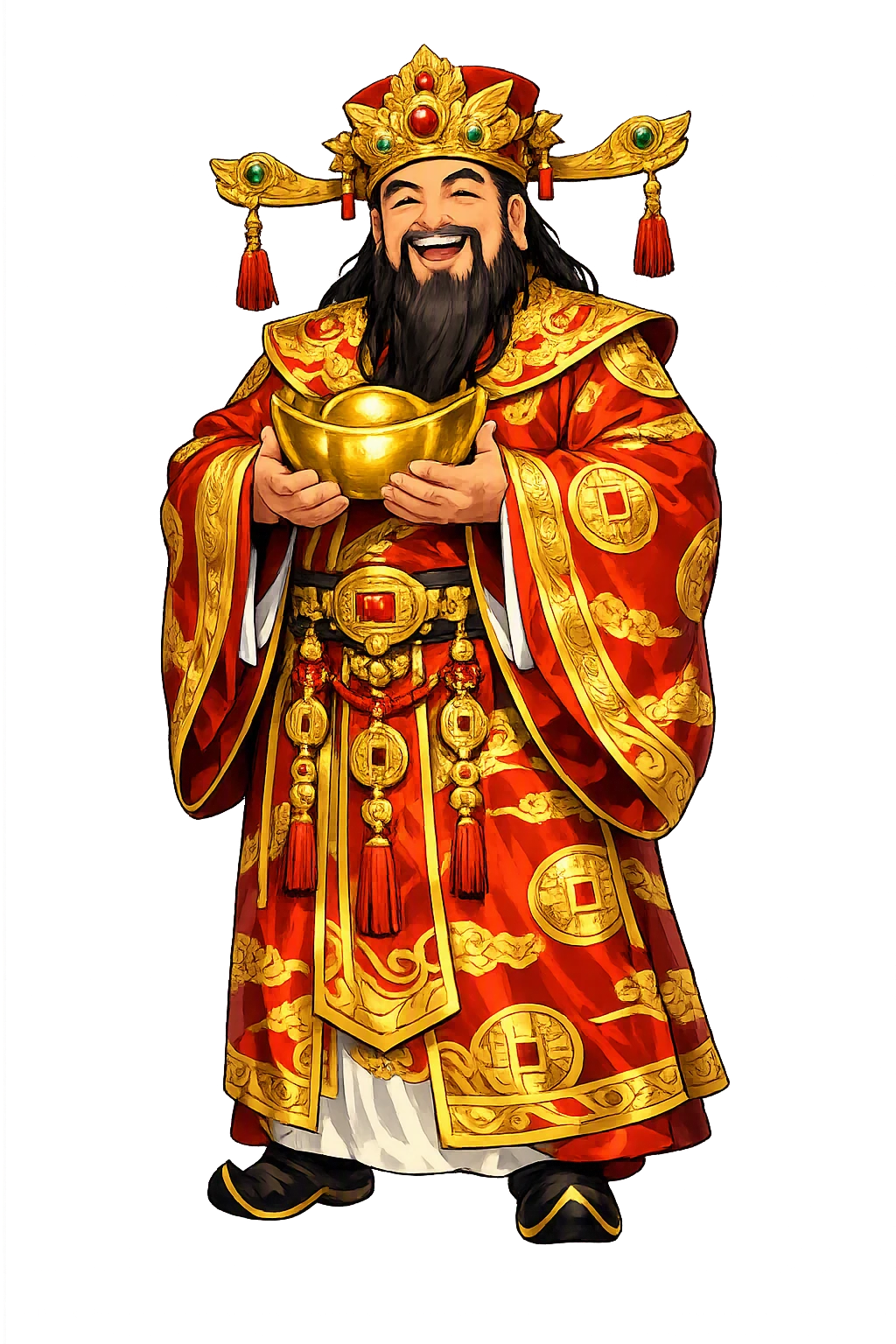
Why Cáishén is spelled that way — and what it costs to get it right
There is a version of this name the early internet had to settle for: caishen. This is the file on how Cáishén replaced it.
Cáishén's mythology is young and openly composite. The cult is a Song-dynasty growth over older roots, and every avatar brings his own story: a Ming novel supplies the marshal, a Han historian the heartless minister, merchants the retired sage. The tradition never pretends otherwise — and its honesty is part of its power.
At a Glance
- Restored name: Cáishén
- ASCII form: caishen
- Meaning: "God of wealth"
- Domain of influence: Wealth, Prosperity, New Year
- Pantheon: Chinese
- Classification: Tier 1
- Original script: 財神
- Series: The Restoration Files, No. 99 of 548
The Name Before the Marks
The name is attested as 財神, as Fengshen Yanyi (Investiture of the Gods, Ming) and Santjiao soushen daquan (Yuan–Ming compendium) record. On the evidence, it means "God of wealth".
Strip Cáishén to caishen and 2 pieces of evidence vanish:
- a → á — Acute tone mark: the stress position the ASCII form cannot show.
- e → é — Acute tone mark: the stress position the ASCII form cannot show.
A reader who knows the marks hears the name correctly on the first try. A reader who never sees them never gets the chance.
Spoken, the name runs `/caishen/` — 'CAISHEN' — pronounce the restored form with attention to the preserved diacritics and length.
The Temple That Stands Now
The restored name is not a plaque; it is an address. The temple of Cáishén lives at /caishen/, with its mythology in the lore halls, its peer-reviewed record in the Scholarly Edition, and its place in the pattern atlas on the patterns floor.
Tier-1 is not a compliment; it is a measurement. This restoration keeps something the ASCII form provably loses, and the measurement is repeatable.
Where the Name Stood First
The material record of Cáishén is popular, mass-produced, and deliberately ephemeral — which is itself testimony. Late-imperial woodblock New Year prints (nianhua) from Yangliuqing (Tianjin), Taohuawu (Suzhou), and Mianzhu (Sichuan) turned out hundreds of thousands of red-and-gold god-images each winter, to be pasted above doorways and burned in the fourth-night send-off. The Yuan–Ming god-compendium Santjiao soushen daquan reached households in cheap woodblock editions that carried the mythology to the non-literate. Wealth-god shrines stand in guild halls and temples across the Sinosphere, usually flanked by his assistants with the tiger at his feet; paper and porcelain icons still sit on shop altars everywhere, replaced annually — wealth itself made a renewable rite. The temple on the web is the newest of these addresses — the first one that fits in a pocket.
The Archetype at Work
The pattern atlas seats this temple in 6 industries, each match argued and weighted: Finance, Wealth & Commerce (the Chinese god of wealth whose image appears in shops, homes, and businesses during the New Year.); Mythic Name Restoration (the Chinese god of wealth in toned pinyin.); Retail & Marketplaces (the god of wealth is the patron of merchants; his image hangs in shops and market stalls across the Chinese diaspora.). The Resonance File reads those seats through the myths themselves.
In the Sacred Texts
The Chinese tradition is not a vibe; it is a library. The Sacred Texts collection holds Tao Te Ching — the primary sources the temple's scholarship is built on. The temple is the argument; the texts are the evidence.
The File Continues
The temple's founding dispatch tells the name's story; its Resonance File reads the myths into the industries; the blog index holds the whole archive.
Continue the series — previous file: Qāyīn (read it here) · next file: Kérberos (read it here).
The Restoration Files are written from the same canonical record as the temples themselves: the lexicon, the lore catalog, the pattern atlas, and the cited scholarly sources. If a file ever disagrees with its temple, the temple is right — tell us, and the file will be corrected.